The Companies That Stayed Good — And How
Costco pays workers $20/hour and outperformed Amazon. Patagonia rewrote its charter to resist buyouts. Here's the structural DNA of companies that proved ethics and profit aren't mutually exclusive.
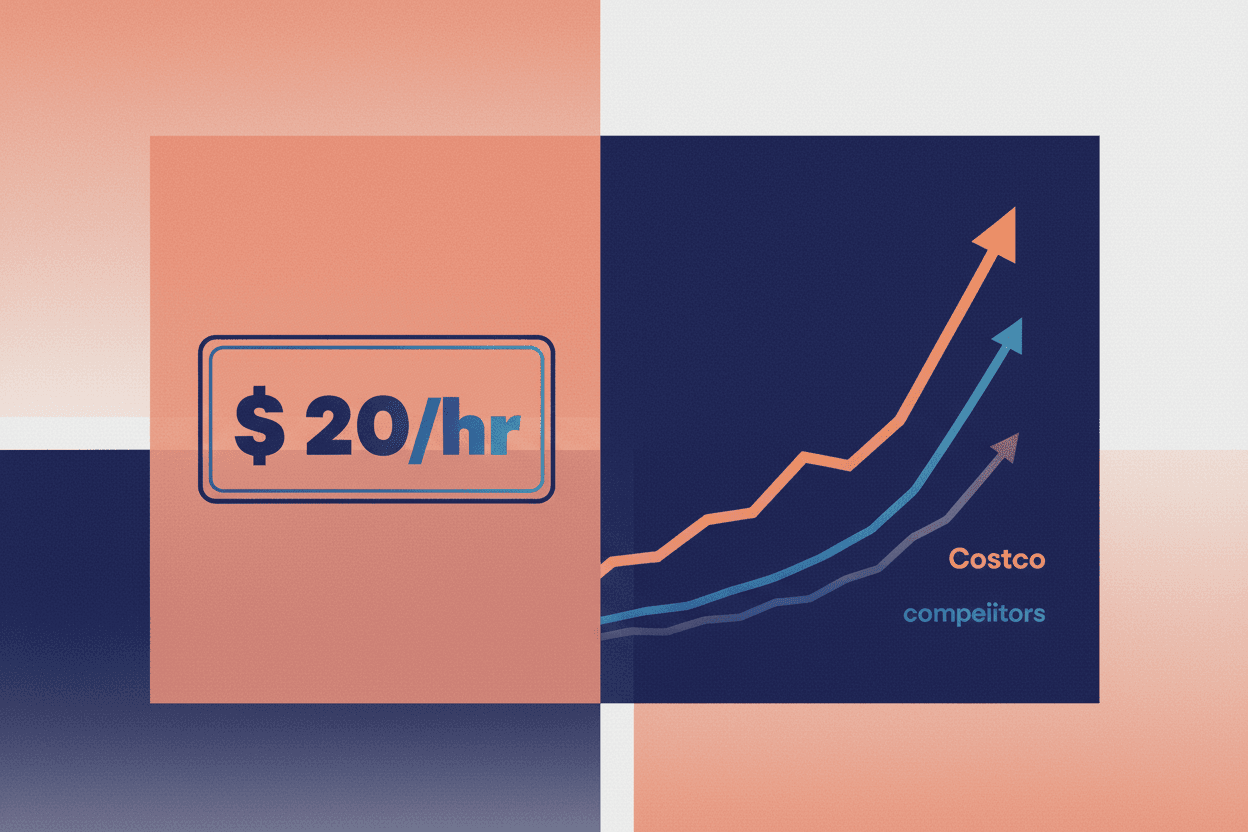
Costco pays its entry-level workers $20/hour in an industry where $14 is standard. Its stock has outperformed Amazon over the last decade. This isn't charity. Costco discovered that the Friedman Doctrine is empirically wrong — at least for certain business models.
In 2024, the average retail turnover rate hit 60%, costing companies an estimated $19 billion annually in replacement costs. Costco's turnover? Less than 10%. The math is so compelling that it raises an uncomfortable question for business schools: if treating workers well is so profitable, why do so few companies do it?
The answer lies not in morality, but in structural architecture. A small cluster of companies — Costco, Patagonia, REI, and a handful of others — have built organizational DNA that makes ethical behavior economically rational rather than charitable. They didn't just choose to be good. They designed systems where being good and making money became the same thing.
The Costco Paradox: When Cheap Labor Is Expensive
Jim Sinegal, Costco's co-founder, famously quipped, "Employees are not a cost to be minimized. They're an asset to be optimized." This wasn't sloganeering — it was a calculated bet on a different profit equation.
[!INSIGHT] Costco's labor costs are roughly 70% higher than Walmart's as a percentage of revenue. Yet Costco's profit per employee is nearly double: $14,631 versus Walmart's $7,515. Higher wages create more productive, loyal workers who generate more revenue per person.
The structural mechanism works through three channels:
-
Reduced Turnover Costs: Replacing a retail worker costs 50-200% of their annual salary in recruiting, training, and lost productivity. Costco's low turnover saves an estimated $300 million annually — money that flows directly to the bottom line.
-
Productivity Premium: Costco workers handle 30% more transactions per hour than industry average. Experienced workers know where everything is, resolve problems faster, and sell more effectively.
-
Membership Retention: Costco's business model depends on membership renewals (93% renewal rate, industry-leading). Friendly, knowledgeable staff keep customers coming back.
“"We could certainly pay less. But then we'd have less productive employees, higher turnover, and ultimately make less money. The economics are actually quite simple.”
Why Can't Walmart Copy This?
This is where structural analysis becomes critical. Walmart's entire business model is built on volume and supplier pressure. Their stores are designed for self-service. Their workforce is deskilled by design. Switching to Costco's labor model would require rebuilding their entire operating system — a transition cost measured in tens of billions of dollars.
Costco's model works because it was designed that way from day one. The membership fee structure (which provides 70% of profit) creates predictable revenue that allows long-term investment in workers. The limited SKU count (3,700 items versus Walmart's 120,000) reduces complexity, allowing fewer workers to manage more.
[!NOTE] Walmart's average hourly wage reached $17.50 in 2023 after years of pressure. But structural constraints — thin margins on groceries (1-3%), massive SKU complexity, high-volume low-service format — make Costco-level wages economically impossible without fundamentally restructuring the company.
Patagonia: The Company Designed to Be Unsold
In 2022, Yvon Chouinard, Patagonia's 83-year-old founder, did something unprecedented in corporate history: he gave away the company. Ownership was transferred to a trust and nonprofit dedicated to fighting climate change. Every dollar not reinvested in Patagonia would go to environmental causes.
But the more interesting story is what Chouinard did in 2012 — a decade before the giveaway — when he rewrote Patagonia's articles of incorporation to include the "benefit corporation" legal structure.
[!INSIGHT] Benefit corporations are legally permitted — and required — to consider stakeholders beyond shareholders. Directors cannot be sued for prioritizing environmental or social goals over profit maximization. This legal shield makes ethical decisions defensible in court.
The structural innovations accumulate:
-
Ownership Lock: By transferring to a trust, Patagonia made it legally impossible to sell to private equity or public markets. The "exit strategy" for founders — selling to the highest bidder — was permanently removed.
-
Mission Lock: The company's environmental mission is encoded in its charter. Future managers who want to prioritize profit over planet can be legally challenged.
-
1% for the Planet: Since 1985, Patagonia has donated 1% of sales (not profits — sales) to environmental causes. This is a structural cost, not a discretionary donation.
The Financial Heresy That Worked
Conventional finance theory predicts that giving away 1% of revenue should make a company less competitive. Patagonia's actual results contradict this:
- Revenue grew from $400 million (2012) to $1.5 billion (2022)
- Profit margins exceed industry average
- Brand loyalty metrics that competitors cannot replicate
“"The more you give away, the more business comes back. It's the most counterintuitive thing in business, but it's absolutely real.”
The mechanism? In a world of commoditized outdoor gear, Patagonia's mission creates differentiation that cannot be copied. Anyone can make a fleece jacket. Only Patagonia makes a fleece jacket that funds environmental activism. For a specific customer segment, that creates inelastic demand.
REI and the Cooperative Alternative
REI (Recreational Equipment Inc.) represents a third structural model: the consumer cooperative. With 24 million members and $3.8 billion in annual revenue, REI operates at scale while remaining member-owned.
The cooperative structure creates different incentives:
-
No External Shareholders: Profits are returned to members as dividends (typically 10% of purchases) or reinvested. There's no pressure to maximize short-term earnings for Wall Street.
-
Governance Rights: Members vote for the board. In 2024, REI members rejected a proposed board slate in a rare display of activist governance, forcing the co-op to reconsider its direction.
-
Mission Priority: REI's charter explicitly prioritizes outdoor recreation and environmental stewardship. The co-op has spent $140 million on outdoor places since 1976 — not because it's good PR, but because it's what members want.
[!NOTE] Cooperative structures face genuine constraints: raising capital is harder without stock issuance, and decision-making can be slower. But these "inefficiencies" are precisely what insulate cooperatives from the pressures that push public companies toward short-termism.
The Structural Pattern: Four Design Principles
Analyzing these counterexamples reveals a pattern — four structural features that make ethical behavior economically sustainable:
1. Ownership Architecture
All three companies have ownership structures that insulate them from short-term financial pressure. Costco's founder-held voting shares (until recent years) allowed patient capital. Patagonia's trust ownership is permanent insulation. REI's cooperative model has no external shareholders to appease.
2. Revenue Model Alignment
Costco's membership fees create recurring revenue that rewards long-term customer relationships. Patagonia's premium pricing is paid by customers who specifically value the mission. REI's member dividends align spending with returns. In each case, the revenue model reinforces rather than contradicts ethical behavior.
3. Operational Simplicity
Complexity creates pressure to cut corners. Costco's limited SKU count reduces operational complexity. Patagonia's focused product line enables supply chain transparency. REI's specialized retail format allows deep expertise. These companies do fewer things, which makes doing them ethically manageable.
4. Cultural Lock-In
Structures alone aren't enough. All three companies have cultures so distinctive that outsiders who acquire power would struggle to change them. Costco's culture of promoting from within (over 70% of managers started as hourly workers). Patagonia's environmentalist identity attracts employees who self-select for mission alignment. REI's member governance creates cultural accountability.
“[!INSIGHT] The most important finding: none of these companies are "charitable." They are ruthlessly profit-seeking within structural constraints that align profit with ethics. They prove that the Friedman Doctrine isn't wrong because profit maximization is immoral”
Implications: Why This Matters
The existence of these counterexamples matters for three reasons:
For Business Education: Business schools still teach shareholder primacy as received wisdom. The empirical evidence from Costco, Patagonia, and REI suggests this is not just incomplete but actively misleading. Alternative models exist and outperform.
For Policy: Current corporate law assumes shareholder primacy as the default. Benefit corporation statutes exist in 40 states but remain optional. These examples suggest that stakeholder-oriented structures could be more broadly encouraged — or even required.
For Individual Action: Consumers and workers often feel powerless against corporate dysfunction. These examples show that supporting alternative structures — buying from cooperatives, choosing benefit corporations, accepting membership models — is not just symbolic but economically meaningful.
“"The problem isn't that companies are evil. The problem is that we've built a system where evil is profitable. Change the system, and good companies win.”
Conclusion
The companies that stayed good didn't stay good through superior morality. Jim Sinegal wasn't a saint; he was a shrewd businessman who discovered that treating workers well was more profitable than treating them poorly. Yvon Chouinard didn't give away Patagonia out of altruism; he built structures that made ethical behavior the path of least resistance.
The companies profiled here prove that stakeholder capitalism isn't just morally preferable — it's empirically superior. The remaining question is why more companies haven't copied them. The answer, as we'll explore in future episodes, may have less to do with economics than with power.
Sources: Costco 2023 Annual Report; Harvard Business Review "The Costco Way" (2022); Patagonia Benefit Corporation Filing (2012); REI Cooperative Principles Report (2024); National Retail Federation Turnover Data (2023); Bureau of Labor Statistics Retail Wage Data; "Owning Our Future" by Marjorie Kelly; Stanford Graduate School of Business Case Studies on Benefit Corporations.
This is a Premium Article
Hylē Media members get unlimited access to all premium content. Sign up free — no credit card required.