The Degree That Pays Off Is the One Nobody Warns You Not to Choose
The highest-ROI degrees share one trait: a licensing exam limiting supply. Discover why regulated professions outperform prestige degrees.
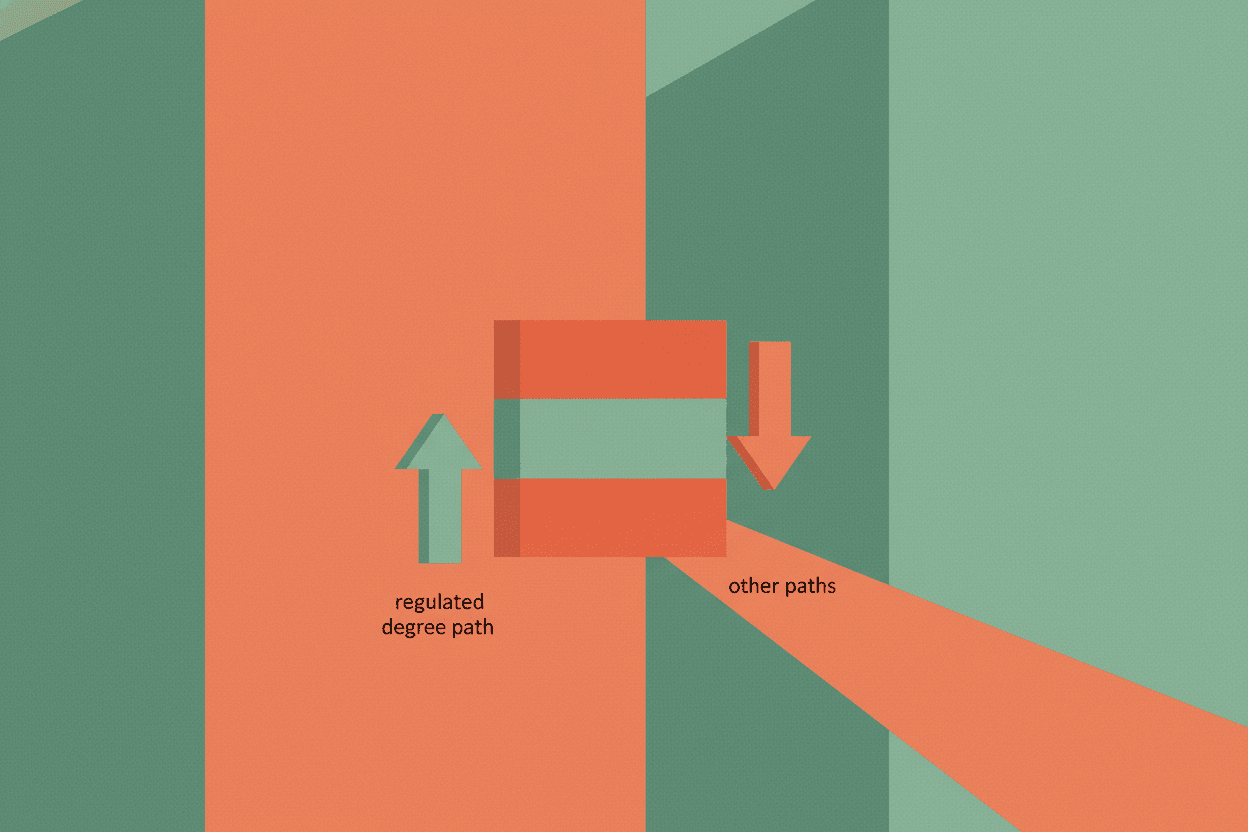
The highest ROI degrees aren't the most prestigious ones. They're the ones with a licensing exam at the end — where someone else controls the supply of graduates. That's not education. That's a cartel with a diploma.
In 2024, petroleum engineering graduates from top universities faced a 12% unemployment rate. Meanwhile, nurse practitioners from community colleges enjoyed 99% employment with starting salaries exceeding $120,000. The difference isn't rigor or prestige — it's that nursing boards deliberately limit how many new practitioners enter the field each year. One profession lets the market flood. The other builds a dam and charges admission.
Why do guidance counselors never explain this? Why do elite universities continue selling "exploratory" liberal arts degrees at $80,000 per year while trade schools quietly produce the highest return-on-investment graduates in America? The answer reveals an uncomfortable truth about how modern education really works — and who benefits from your confusion.
The Architecture of Artificial Scarcity
Professional licensing operates as a supply-control mechanism hiding in plain sight. The American Medical Association, state nursing boards, dental associations, and bar examiners don't primarily protect patients — they protect incumbents by restricting market entry.
[!INSIGHT] Occupational licensing affects approximately 23% of U.S. workers, up from just 5% in the 1950s. This expansion correlates with a 15-20% wage premium for licensed workers — not because they're more skilled, but because they're fewer.
The mechanism works through three structural barriers:
-
Cap Exams: The NCLEX for nursing, Bar Exam for law, USMLE for medicine, and FE/PE exams for engineering create bottlenecks where pass rates can be adjusted to control graduate supply. When nursing shortages hit, pass rates mysteriously improve. When oversupply threatens, standards "tighten."
-
Training Hour Mandates: Nurse practitioners require 500-1,000 supervised clinical hours. Bar admission demands specific law school accreditation plus character reviews. These requirements take years, effectively preventing rapid market adjustment to demand shifts.
-
Scope-of-Practice Laws: Even qualified practitioners face restrictions on what services they can offer without physician "supervision" — often a paperwork arrangement generating rents for doctors who sign off without providing meaningful oversight.
The result? A radiologic technologist with an associate degree earns a median $73,410 annually with near-guaranteed employment. A cinema studies graduate from a top-20 university earns a median $45,000 with chronic underemployment. The technologist faces a licensing board capping supply. The cinema graduate competes against every English major who ever watched movies.
“"We cloak protectionism in the language of patient safety. Some regulation is legitimate. Much is simply economics disguised as ethics.”
Self-Regulating Cartels vs. State-Mediated Cartels
Not all high-ROI professions operate identically. Two distinct models exist:
Industry Self-Regulation (The Soft Cartel): Accounting (CPA), actuarial science, commercial piloting, and project management (PMP) let professional bodies set examination difficulty without direct government oversight. These organizations respond to industry demand — when firms need more accountants, pass rates ease. The system maintains quality while allowing market signals to function.
Certified Registered Nurse Anesthetists exemplify this balance. Their certification pass rate hovers around 85%, high enough to meet demand but low enough to prevent commodity pricing. Median salary: $203,090. Required education: master's degree plus certification. The barrier is real but navigable.
State-Mediated Supply Control (The Hard Cartel): Medicine, dentistry, law, and pharmacy involve legislated restrictions tied to public funding. Medical residency slots — the true bottleneck in physician supply — are capped by Medicare funding. Congress controls how many doctors America produces regardless of demand. This creates a structural shortage generating persistent premium wages.
[!NOTE] The FAA faces a 10,000-controller shortage crisis in 2024 because its training academy deliberately graduates only 1,500 controllers annually. Meanwhile, air traffic has increased 40% since 2010. The shortage is policy, not accident.
The hard cartel model generates superior returns but demands political connections. The American Medical Association spends $20 million annually on lobbying — not to help doctors treat patients, but to ensure no competing practitioners (nurse practitioners, physician assistants) gain independent practice authority.
The Prestige Trap
Elite universities sell a different product: credential signaling rather than licensable competence. A Harvard English degree signals intelligence, work ethic, and social class. It does not restrict supply because every Ivy League and elite liberal arts college produces similar graduates annually.
The data is brutal. According to the Federal Reserve Bank of New York, 2024 underemployment rates by major show:
- Art history: 67% underemployed
- Psychology (bachelor's only): 58% underemployed
- Business management: 47% underemployed
- Nursing: 4% underemployed
- Electrical engineering: 12% underemployed
[!INSIGHT] The unemployment rate for law school graduates varies from 2% at Yale to 35% at unranked schools. Same degree, same bar exam — dramatically different outcomes. Licensing creates floor demand, but can't solve oversupply at the bottom.
Parents and students systematically misunderstand this landscape. Survey data from the Princeton Review shows college applicants rank "academic reputation" as their #1 selection criterion. "Graduate employment rate" ranks seventh. "Average starting salary" ranks ninth. Students select for prestige; the labor market pays for scarcity.
Implications for Education Policy
The cartel theory of credential value has disturbing implications:
For Students: The rational strategy is identifying professions with licensing barriers BEFORE selecting a major. A BSN nursing program at a state university ($28,000 total cost) outperforms a private university marketing degree ($180,000) across every financial metric. Yet counselors push students toward "fit" and "passion" rather than market structure.
For Universities: Most higher education is a residual claimant on cartel access. Pre-med programs exist because the AMA restricts doctors. Law schools enroll far more students than legal employment supports. Universities capture tuition; students bear the downside of oversupply.
For Reformers: Breaking occupational licensing would lower wages in protected professions by an estimated 10-15%. Consumer prices would fall. But the political coalition of licensed professionals fiercely defends these rents. The "public safety" framing makes reform politically toxic.
“"Every profession creates a conspiracy against the laity. Licensing makes it legal.”
The Uncomfortable Choice
None of this means students should abandon passion for profit. But they deserve honest information about how labor markets function. The current system — where elite universities sell prestige credentials with no supply restrictions while trade schools quietly produce cartel-protected high earners — represents market failure enabled by information asymmetry.
The next time someone tells you to "follow your passion" regardless of employability, ask yourself: whose interests does that advice serve? The university collecting tuition? Or the graduate repaying loans for decades?
Choose your cartel carefully.
Sources: Federal Reserve Bank of New York, Labor Market Outcomes of College Graduates (2024); Morris Kleiner, Stages of Occupational Licensing (Brookings, 2023); Bureau of Labor Statistics Occupational Outlook Handbook; Princeton Review College Hopes & Worries Survey (2024); AMA Advocacy & Policy Reports.