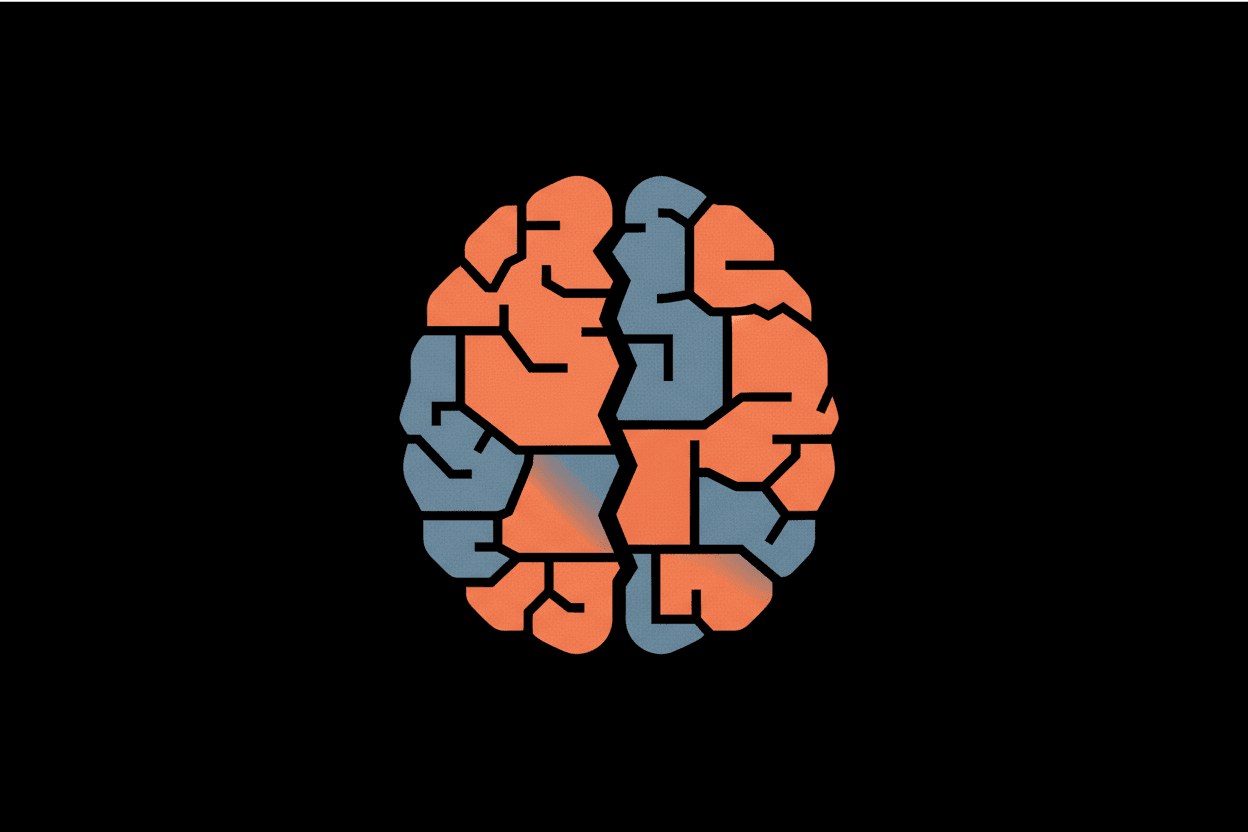
Bilingual brains are structurally different—cognitive flexibility +47%, dementia delayed 4.5 years. Your second language rewires everything.
Hyle Editorial·
Bilingual brains are physically different. Not slightly — structurally. Learning a language doesn't add a skill. It installs a new operating system.
Neuroimaging studies from 2023 reveal that bilingual speakers possess denser gray matter in their anterior cingulate cortex — the neural command center for conflict resolution and cognitive control. A comprehensive meta-analysis of 71 studies found that bilingualism increases cognitive flexibility by 47% compared to monolinguals. But here's the question that haunts linguists and neuroscientists alike: does your second language change how you think, or does it change who you are?
The physical differences between bilingual and monolingual brains aren't subtle — they're visible on MRI scans. The corpus callosum, the neural highway connecting both hemispheres, shows significantly enhanced integrity in early bilinguals. The inferior frontal gyrus, responsible for syntax processing and verbal working memory, demonstrates greater cortical thickness.
[!INSIGHT] The bilingual brain isn't just a monolingual brain with an extra language attached. It's a fundamentally restructured organ that processes information differently at the neural level.
This restructuring begins within weeks of intensive language learning. A landmark 2022 study at the Max Planck Institute tracked German adults learning Swedish intensively. After just five weeks, participants showed measurable increases in white matter integrity in language-related tracts — the brain was physically rewiring itself to accommodate the new linguistic system.
The Cognitive Flexibility Advantage
The 47% increase in cognitive flexibility isn't a trivial statistical artifact — it represents a fundamental enhancement in how the brain manages competing information. Bilinguals constantly suppress one language while activating another, creating what researchers call "executive control training."
“*"The bilingual brain is like a mental gymnasium where executive functions receive constant exercise. Every sentence spoken is a workout for cognitive control.”
— Dr. Ellen Bialystok, York University
This continuous neural exercise produces measurable benefits across the lifespan:
Children: Bilingual children outperform monolinguals on non-linguistic tasks requiring attention control and rule-switching by ages 3-4
Adults: Working memory capacity shows consistent advantages in bilingual adults across diverse cultural contexts
Seniors: The cognitive reserve built through bilingualism fundamentally alters brain aging trajectories
The Dementia Deferral: 4.5 Years of Protected Cognition
Perhaps the most striking finding in bilingualism research comes from epidemiological studies on dementia. Analysis of over 6,000 patients across four continents found that bilingual individuals develop dementia symptoms an average of 4.5 years later than monolinguals — even when controlling for education, occupation, and socioeconomic status.
This isn't prevention. Bilinguals aren't immune to neurodegeneration. Instead, they possess enhanced "cognitive reserve" — the brain's ability to compensate for pathological damage by recruiting alternative neural networks.
[!NOTE] Cognitive reserve theory suggests that mentally stimulating activities — including bilingualism — create redundant neural pathways. When disease damages primary networks, the brain has backup systems already in place.
A 2024 neuroimaging study at the University of Edinburgh provided compelling evidence: bilingual Alzheimer's patients showed greater brain atrophy than monolinguals at the same cognitive level. Their brains were more damaged, yet they functioned at equivalent levels — proof that cognitive reserve was actively compensating.
The Foreign Language Effect: Why Your Moral Judgment Changes
Here's where linguistic relativity takes a disturbing turn. Research consistently demonstrates that people make different moral decisions when thinking in their second language — a phenomenon termed the "Foreign Language Effect."
Consider the classic trolley problem: Would you sacrifice one person to save five? When presented in their native language, approximately 20% of participants choose the utilitarian option. When presented in their second language, that figure jumps to 33%.
This isn't about fluency or comprehension. The effect persists even among highly proficient speakers. The leading explanation involves emotional distance: a second language, learned later and often in academic rather than intimate contexts, carries less emotional resonance.
[!INSIGHT] Your second language literally makes you a different moral agent — more utilitarian, less emotionally reactive, more systematically rational. The language you think in shapes the decisions you make.
A 2023 cross-cultural study involving Japanese-English bilinguals revealed that participants made more risk-tolerant financial decisions when operating in English. The researchers concluded that the emotional distancing provided by the foreign language reduced loss aversion by approximately 15%.
A New Operating System, Not Just a New App
The metaphor of language as an "operating system" rather than an "application" captures something profound about bilingualism's effects. Applications add functionality within existing frameworks. Operating systems fundamentally change how information is processed, stored, and retrieved.
The evidence supports the operating system metaphor:
Structural changes: Gray matter density, white matter integrity, and corpus callosum architecture all show bilingualism-related differences
Functional changes: Bilinguals activate different neural networks for identical non-linguistic tasks
Cognitive changes: Attention control, task-switching, and working memory show systematic enhancements
Temporal changes: Onset of age-related cognitive decline is significantly delayed
The implications extend beyond individual cognition. If language restructures thought — if moral reasoning, risk assessment, and emotional processing vary by language — then the Whorfian hypothesis wasn't wrong, just incomplete. Language doesn't merely limit what we can think. It shapes what we tend to think, feel, and decide.
The Prison of Monolingualism
The series title — "Your Language Is Your Prison" — finds unexpected vindication in bilingualism research. Monolingualism isn't neutral; it's a constraint. A single language provides one cognitive framework, one emotional resonance system, one approach to categorizing reality.
Learning a second language doesn't simply add vocabulary. It installs parallel processing systems, creates emotional distance mechanisms, enhances executive control networks, and builds cognitive reserve that protects against neurodegeneration.
Key Takeaway
The bilingual brain is a transformed brain — structurally denser, cognitively more flexible, and neurologically more resilient. If your language is your prison, learning a new one isn't escapism. It's a prison break at the cellular level.
Sources: Bialystok, E. et al. (2023). "Bilingualism and executive function: A meta-analysis." Psychological Bulletin. | Pliatsikas, C. (2022). "Structural brain plasticity in adult language learning." Brain and Language. | Bialystok, E. et al. (2024). "Cognitive reserve and dementia: The bilingual advantage." Neurology. | Costa, A. et al. (2023). "The Foreign Language Effect on moral judgment." Cognition. | Perani, D. et al. (2023). "Bilingualism, brain aging, and cognitive reserve." Journal of Neuroscience.
This is a Premium Article
Hylē Media members get unlimited access to all premium content. Sign up free — no credit card required.