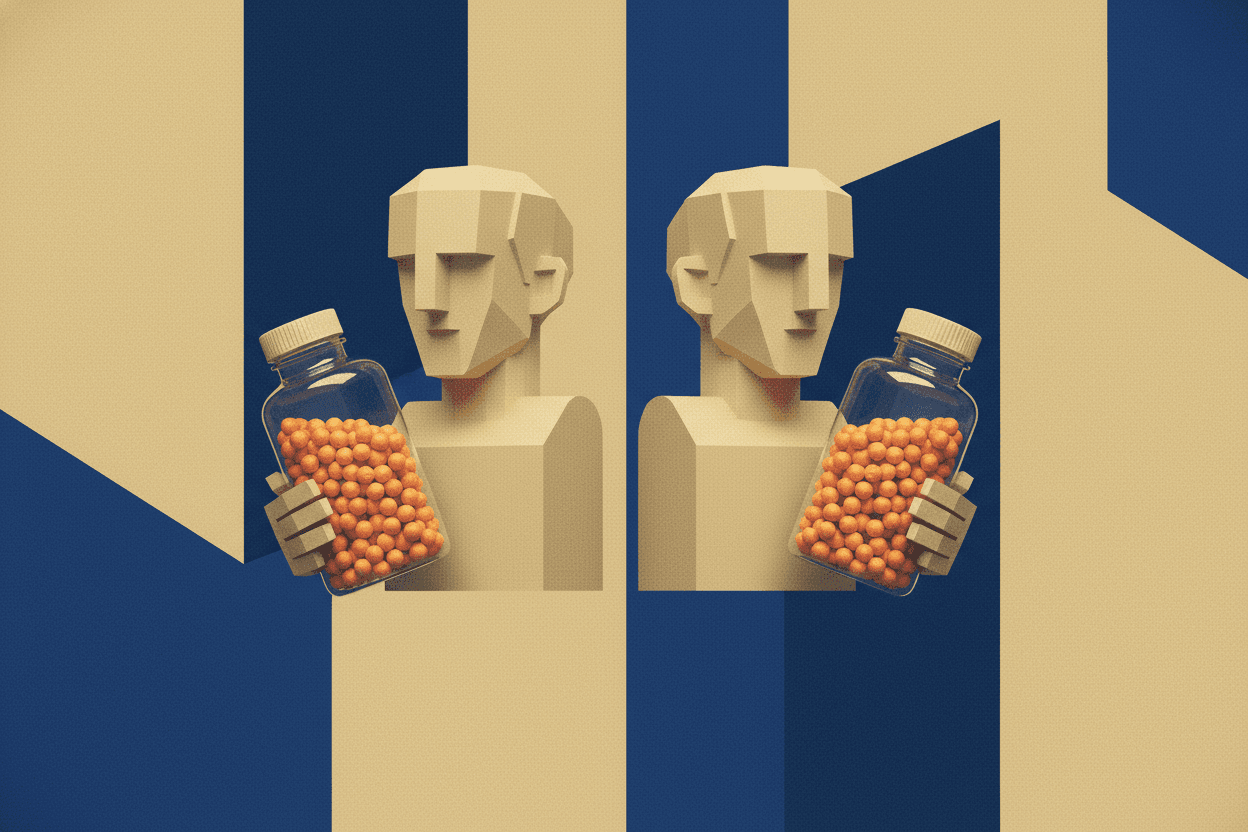
Double Nobel laureate Linus Pauling championed megadose vitamin C for decades despite mounting evidence. His story reveals how scientific prestige can amplify cognitive bias and resist correction.
Hyle Editorial·
Linus Pauling had two Nobel Prizes. He was also catastrophically wrong about vitamin C — and his prestige made him impossible to correct for 30 years. By 1992, approximately 35% of Americans were taking vitamin C supplements, largely influenced by Pauling's advocacy. Yet by the time of his death in 1994, every major clinical trial had contradicted his central claims. How does one of history's greatest scientists become so profoundly wrong, and why does the scientific establishment struggle to correct its most celebrated members?
The answer reveals an uncomfortable truth about human cognition: expertise in one domain does not immunize against errors in another. In fact, the very traits that produce scientific genius — intellectual confidence, pattern-seeking, and resistance to conformity — may predispose brilliant minds to spectacular failures when they venture beyond their expertise.
Pauling's credentials were unimpeachable. His 1954 Nobel Prize in Chemistry recognized his groundbreaking work on the nature of the chemical bond, quantum chemistry foundations, and the alpha-helix structure of proteins. His 1962 Nobel Peace Prize honored his campaign against nuclear weapons testing. By 1970, Pauling was arguably the most famous scientist in America, mentioned in the same breath as Einstein.
The Orthomolecular Turn
In 1966, at age 65, Pauling received a letter from biochemist Irwin Stone suggesting that vitamin C at megadose levels (3,000-18,000 mg daily, versus the RDA of 60 mg) could extend lifespan and prevent disease. Pauling began taking 3,000 mg daily and reported feeling healthier. Subjective experience became conviction.
In 1970, Pauling published Vitamin C and the Common Cold, claiming that 1,000-2,000 mg daily could reduce cold incidence by 45%. The book sold millions. But this was not a peer-reviewed scientific publication — it was a popular book that bypassed scientific scrutiny entirely.
“[!INSIGHT] Pauling's transition from rigorous quantum chemist to health crusader exemplifies what psychologists call "expansion of expertise”
— the mistaken belief that brilliance in one field confers authority in unrelated domains.
The Evidence Against Megadose Vitamin C
The Common Cold Studies
Between 1972 and 2004, over 30 controlled clinical trials involving more than 11,000 subjects tested Pauling's cold hypothesis. The results were devastatingly consistent:
1975 Mayo Clinic study (Anderson et al.): 3,249 subjects, 1,000 mg/day vitamin C. Result: No reduction in cold incidence, only a modest 0.7-day reduction in symptom duration.
2004 Cochrane meta-analysis: Review of 55 studies concluded that vitamin C does not reduce cold incidence in the general population. Extreme physical stress (marathon runners, skiers) showed modest benefit — but this was not Pauling's claim.
Therapeutic trials: High-dose vitamin C taken after cold onset showed no effect whatsoever.
The Cancer Claims
In 1979, Pauling and Scottish surgeon Ewan Cameron published Cancer and Vitamin C, claiming that 10,000 mg daily could extend cancer patient survival. The Mayo Clinic conducted three rigorous randomized controlled trials (RCTs) between 1979 and 1985, all showing no benefit.
Pauling's response was revealing: he attacked the methodology, accused researchers of bias, and never revised his position.
“"I have been enormously impressed by the courage shown by Dr. Cameron and Dr. Pauling in carrying out these studies. But I think they're wrong.”
— Dr. Charles Moertel, Mayo Clinic, 1985
Molecular Mechanisms: Why Pauling Was Wrong
Pauling's theory rested on the premise that humans, unlike most mammals, cannot synthesize vitamin C due to a mutation in the L-gulono-γ-lactone oxidase (GULO) gene. He argued this created a chronic deficiency requiring supplementation far beyond dietary intake.
However, biochemistry tells a different story:
Absorption saturation: The intestinal vitamin C transporter (SVCT1) saturates at ~200-400 mg intake. Above this, bioavailability drops to ~30% at 1,000 mg and ~15% at 6,000 mg.
Renal excretion: Excess vitamin C is rapidly excreted. At 1,000 mg/day, ~80% of the absorbed dose appears in urine within 24 hours.
Plasma ceiling: Blood plasma concentrations plateau at ~70-80 μmol/L regardless of intake above 400 mg/day — the body actively maintains homeostasis.
The chemical equation for vitamin C (ascorbic acid) degradation is:
Excess ascorbate is oxidized to dehydroascorbic acid and eventually metabolized to oxalate — which brings risks.
[!NOTE] Megadose vitamin C carries documented risks: approximately 20% of users develop gastrointestinal distress, and long-term high intake correlates with increased kidney stone formation (calcium oxalate). One 2013 analysis estimated 2-3% of kidney stones in high-dose supplement users were attributable to vitamin C.
The Psychology of Unshakeable Belief
Why did Pauling persist? The answer lies in cognitive mechanisms that affect all humans — including Nobel laureates.
Confirmation Bias and the Self-Experimentation Trap
Pauling's belief originated from personal experience (n=1), the weakest form of evidence. Once convinced, he selectively cited supporting studies while dismissing contradictory evidence as methodologically flawed.
Reputation Shielding
By 1980, Pauling's identity was inseparable from vitamin C advocacy. To admit error would mean acknowledging that he had misled millions and potentially harmed cancer patients who delayed conventional treatment. The psychological cost of recantation became unbearable.
The Authority Paradox
Pauling's Nobel Prizes gave his health claims disproportionate influence. Media outlets presented "both sides" of the vitamin C debate as if scientific consensus didn't exist. This false balance — equating one famous scientist with the collective weight of clinical evidence — persists in health journalism today.
[!INSIGHT] A 2017 analysis in JAMA Internal Medicine found that vitamin and mineral supplement use in the U.S. exceeds $30 billion annually, despite consistent evidence that supplements provide no mortality benefit for well-nourished populations. Pauling's legacy continues to influence behavior decades after his claims were refuted.
The Pauling Lesson: Authority and Error Correction
The scientific method ultimately corrected Pauling's claims — but the process took 30 years and persists in popular culture. Several lessons emerge:
Expertise is domain-specific: Excellence in quantum chemistry provides no special insight into clinical nutrition.
Scientific prestige can impede correction: Junior researchers hesitated to challenge a double Nobel laureate, and journals gave his opinions disproportionate weight.
Personal experience is seductive but unreliable: Pauling's subjective health improvements were real to him but biologically meaningless without controlled study.
The canonical value of vitamin C — 75-90 mg/day for adults — is based on neutrophil saturation and urinary excretion thresholds. This is the level at which the body achieves optimal vitamin C status. Everything beyond this is, biochemically speaking, expensive urine.
Key Takeaway
Linus Pauling's vitamin C crusade demonstrates that scientific brilliance offers no protection against cognitive bias. In fact, the confidence that enables breakthrough discoveries may, when misapplied, produce costly public health detours. The scientific community must develop better mechanisms for correcting its most celebrated members — not through deference, but through the same rigorous evidence standards applied to any claim.
Sources: Pauling, L. (1970). Vitamin C and the Common Cold. Freeman; Hemilä, H. & Chalker, E. (2013). Cochrane Database Syst Rev. PMID: 23440782; Creagan, E.T. et al. (1979). NEJM, 301(13), 687-690; Moertel, C.G. et al. (1985). NEJM, 312(3), 137-141; Levine, M. et al. (1996). PNAS, 93(8), 3704-3709; Offit, P.A. (2013). Do You Believe in Magic? HarperCollins.
This is a Premium Article
Hylē Media members get unlimited access to all premium content. Sign up free — no credit card required.