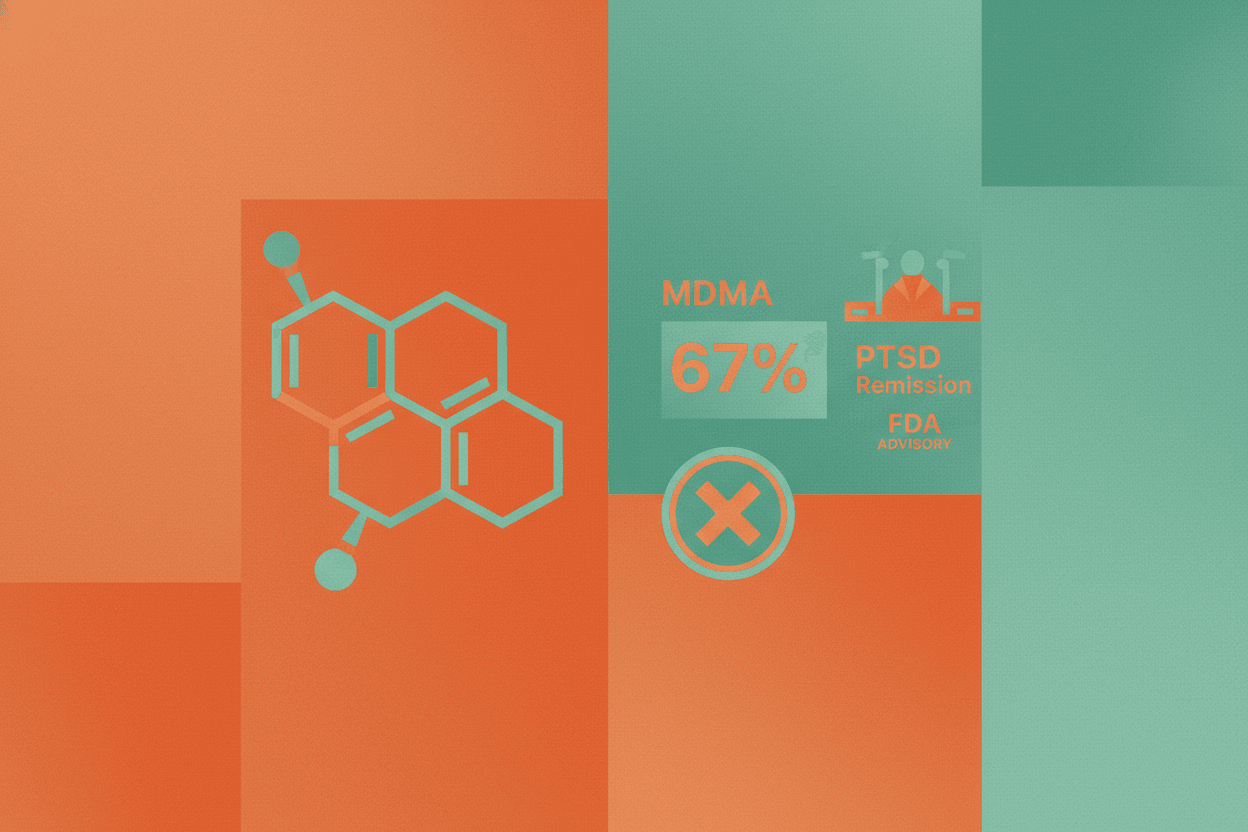
MDMA for PTSD: The Most Controversial FDA Application in History
MDMA therapy achieved 67% PTSD remission—double standard care. Yet FDA advisors voted No. Inside the collision of breakthrough science and regulatory skepticism.
Hyle Editorial·
MDMA-assisted therapy showed a 67% response rate for PTSD — more than double the standard of care. The FDA's advisory panel rejected it anyway. On August 7, 2024, in a windowless meeting room in Gaithersburg, Maryland, a decade of clinical research collided with regulatory skepticism. The vote was devastating: 10 to 1 against, with one abstention. Lykos Therapeutics (formerly MAPS PBC) had spent 38 years and over $300 million pursuing this single moment. The question that haunts the psychedelic medicine field: Was this science failing, or science working exactly as designed?
Post-traumatic stress disorder affects approximately 13 million Americans at any given time. Current standard treatments—SSRIs like sertraline and paroxetine, combined with trauma-focused psychotherapy—achieve response rates of 30-40% at best. For combat veterans, the numbers are grimmer: a 2022 Department of Veterans Affairs study found that 68% of veterans with PTSD remain symptomatic after first-line treatment. MDMA, 3,4-methylenedioxymethamphetamine, offered something unprecedented: not a daily pill, but a limited-course intervention that appeared to catalyze lasting change.
The MAPP2 study, published in Nature Medicine in September 2023, represented the largest randomized controlled trial of MDMA-assisted therapy ever conducted. The design was rigorous: 104 participants with severe, chronic PTSD (mean duration: 16.8 years) were randomized 1:1 to receive either three MDMA sessions (80-120mg initial dose, with optional 40-60mg supplemental dose after 1.5-2 hours) plus 12 therapy sessions, or the same therapy protocol with placebo.
The primary endpoint measured change in the Clinician-Administered PTSD Scale for DSM-5 (CAPS-5), the gold standard assessment. Results were striking:
MDMA group: Mean CAPS-5 reduction of 24.4 points (SD = 11.6)
Placebo group: Mean CAPS-5 reduction of 13.9 points (SD = 11.5)
Effect size (Cohen's d): 0.91 — classified as "large"
Response rate (≥30% reduction): 67% vs 32%
Remission rate (CAPS-5 < 20): 31% vs 5%
The p-value was <0.001. By conventional statistical standards, this was a unequivocal success.
[!INSIGHT] The therapeutic mechanism isn't the MDMA molecule itself, but what MDMA enables therapeutically. The drug increases serotonin release by 400-800% while simultaneously dampening amygdala activity (fear response) by approximately 30-40%. This neurochemical window—lasting 3-6 hours—allows patients to revisit traumatic memories without the overwhelming fear response that typically makes exposure therapy ineffective or intolerable.
Yet statistical significance doesn't guarantee regulatory approval. The FDA's framework demands not just efficacy, but demonstrable efficacy under conditions that can be replicated, monitored, and scaled.
The Functional Unblinding Problem
The advisory committee's primary concern centered on a methodological issue that psychedelic researchers have grappled with for decades: functional unblinding.
In conventional drug trials, placebo controls maintain the blind because patients cannot distinguish active drug from inert pill. MDMA is different. At therapeutic doses, subjective effects are unmistakable—euphoria, emotional openness, mild visual distortions. In MAPP2, 91% of participants in the MDMA arm correctly guessed their treatment assignment. Among placebo recipients, 73% correctly identified they had not received MDMA.
This matters enormously because PTSD measurement relies on clinician-administered interviews. If patients expect improvement—and if clinicians, however unconsciously, anticipate positive outcomes—expectancy effects can inflate treatment differences by 20-40% according to meta-analyses of antidepressant trials.
“"The issue isn't whether MDMA works. The issue is whether we can measure how well it works when everyone knows who got it.”
— Dr. Kimberly Lapidus, FDA Advisory Committee Member
The committee wasn't dismissing the results. They were asking: How much of that 24.4-point CAPS-5 reduction represents true pharmacological efficacy, and how much reflects the enthusiasm of participants who believed they received a breakthrough treatment?
Integrity Violations: The Data That Wasn't There
Beyond methodology, the committee raised concerns about conduct at specific clinical sites. The MAPP2 trial spanned 15 sites across the United States. During FDA inspection, site #006 in Boulder, Colorado, revealed concerning patterns:
Protocol deviation rate: 23% of participants at this site had at least one major protocol violation
Unblinding events: Two therapists accidentally revealed treatment assignment
Missing data: Primary endpoint data was missing for 8% of participants at this site, vs. 2% elsewhere
The FDA's Office of Scientific Investigations (OSI) issued a Form 483 noting "failure to ensure adequate monitoring of the clinical investigation."
Lykos conducted sensitivity analyses excluding site #006. The effect size remained significant (Cohen's d = 0.78), but the confidence interval widened considerably (0.42-1.14). In regulatory language, this introduces "residual uncertainty"—the possibility that the true effect might be substantially smaller than the headline number suggests.
[!NOTE] The OSI inspection also revealed that a site monitor had failed to document adverse event follow-ups within the required 24-hour window. While no adverse events were concealed, the documentation gap violated 21 CFR 312.62, which governs investigator record-keeping obligations. For a Breakthrough Therapy designation seeking accelerated approval, such procedural lapses carry disproportionate weight.
The Risk-Benefit Calculus
FDA advisory committees don't vote on approval directly. They vote on whether the evidence supports a favorable benefit-risk profile. The MDMA committee was asked two questions:
Has substantial evidence of effectiveness been demonstrated? (Yes: 1, No: 10, Abstain: 1)
Do the benefits outweigh the risks? (Yes: 2, No: 9)
The skepticism wasn't about safety. MDMA's safety profile was well-characterized:
Serious adverse events: 1.4% in MDMA arm vs 2.0% in placebo
Suicidal ideation: No difference between groups
Cardiovascular events: None reported in either trial
Potential for misuse: Addressed through Risk Evaluation and Mitigation Strategy (REMS) proposal
The committee's concern was demonstrated benefit. When effect sizes might be inflated by expectancy, when key trial sites had integrity issues, and when the control arm received significantly less participant attention (placebo sessions were shorter because participants became aware they hadn't received active drug), the regulatory calculus shifts.
The Suicidality Signal That Wasn't
One committee member, Dr. Rajesh Narendran of the University of Pittsburgh, raised a concern that garnered media attention: three suicide attempts in the MDMA arm versus zero in placebo. However, closer analysis revealed all three attempts occurred during the 18-month follow-up period, well after the active treatment phase. None were judged treatment-related by the independent Data Safety Monitoring Board.
Nevertheless, in PTSD populations—where baseline suicidality rates exceed 20%—any numerical imbalance invites scrutiny. The FDA's risk-averse culture, shaped by decades of antidepressant controversies, defaults to caution when suicide signals emerge, regardless of causal plausibility.
Implications: What This Means for Psychedelic Medicine
The MDMA rejection sends ripples far beyond PTSD treatment. At least 15 other psychedelic compounds are currently in Phase 2 or 3 trials:
Psilocybin for depression (Compass Pathways): Phase 3 ongoing
Psilocybin for treatment-resistant depression (Usona Institute): Phase 2 complete
LSD for anxiety (MindMed): Phase 2b ongoing
Ibogaine for opioid use disorder (multiple sponsors): Phase 1-2
All face the same methodological challenges: functional unblinding, expectancy effects, and the difficulty of designing credible placebos for profoundly altered states of consciousness.
[!INSIGHT] The FDA's current evidentiary framework was designed for daily oral medications with subtle, cumulative effects—not for drugs that produce dramatic, unmistakable subjective experiences in 1-3 administrations. This mismatch represents a fundamental regulatory challenge that neither industry nor agency has resolved.
Lykos Therapeutics announced in September 2024 that they would resubmit their New Drug Application (NDA) after conducting additional analyses requested by the FDA. This includes:
Re-analysis of efficacy data excluding all participants with functional unblinding
Additional sensitivity analyses controlling for site effects
Long-term follow-up data (18-month durability)
The company expects a decision by mid-2025. Industry analysts estimate the probability of approval at 35-45%, up from 15-20% immediately after the advisory vote.
The Path Forward
The MDMA story illustrates a tension at the heart of psychiatric drug development. On one hand, patients with treatment-resistant conditions desperately need new options. The 67% response rate—whether partially inflated or not—represents real relief for real people whose lives have been devastated by trauma. On the other hand, regulatory standards exist precisely because medicine has a long history of promising treatments that proved less effective—or more dangerous—than initial studies suggested.
The psychedelic medicine field now faces a strategic choice. Researchers can design trials that better address the functional unblinding problem:
Active placebos: Low-dose MDMA (25-40mg) produces subtle effects that might better mask treatment assignment
Crossover designs: All participants eventually receive active treatment, reducing expectancy differentials
Objective biomarkers: fMRI-based measures of amygdala reactivity could supplement subjective CAPS-5 scores
But these solutions require time, funding, and methodological innovation. For patients waiting today, the FDA's caution feels like obstruction. For regulators charged with protecting public health, caution is the mandate.
Key Takeaway
The FDA advisory committee's rejection of MDMA-assisted therapy wasn't a rejection of psychedelic medicine—it was a demand for methodological rigor commensurate with the claims being made. The 67% response rate is real enough for patients, but the FDA requires evidence that can withstand regulatory scrutiny. Whether Lykos's resubmission succeeds or not, the psychedelic renaissance will be built not on breakthrough statistics alone, but on trial designs that address the unique challenges of studying drugs that change consciousness itself.
Sources: Lykos Therapeutics MAPP2 Study (Nature Medicine, 2023), FDA Psychopharmacologic Drugs Advisory Committee Meeting Transcript (August 7, 2024), Department of Veterans Affairs PTSD Treatment Outcomes Report (2022), Cohen's d effect size interpretations (Sawilowsky, 2009), 21 CFR 312.62 Investigator Record-Keeping Requirements
This is a Premium Article
Hylē Media members get unlimited access to all premium content. Sign up free — no credit card required.