Normal Is Always the Majority's Self-Portrait
The 9-to-5, the nuclear family, standardized testing — every 'normal' was designed by and for a specific subset. The rest were told to adapt.
In 2024, the Centers for Disease Control and Prevention reported that 1 in 36 children in the United States is identified with autism spectrum disorder — up from 1 in 150 just two decades earlier. The World Health Organization estimates that 15-20% of the global population is neurodivergent. Yet our schools, workplaces, and social institutions remain built for a mythical 'typical mind' that, statistically, describes a shrinking minority.
Here is the uncomfortable question: If normal was never universal, what exactly was it a portrait of?
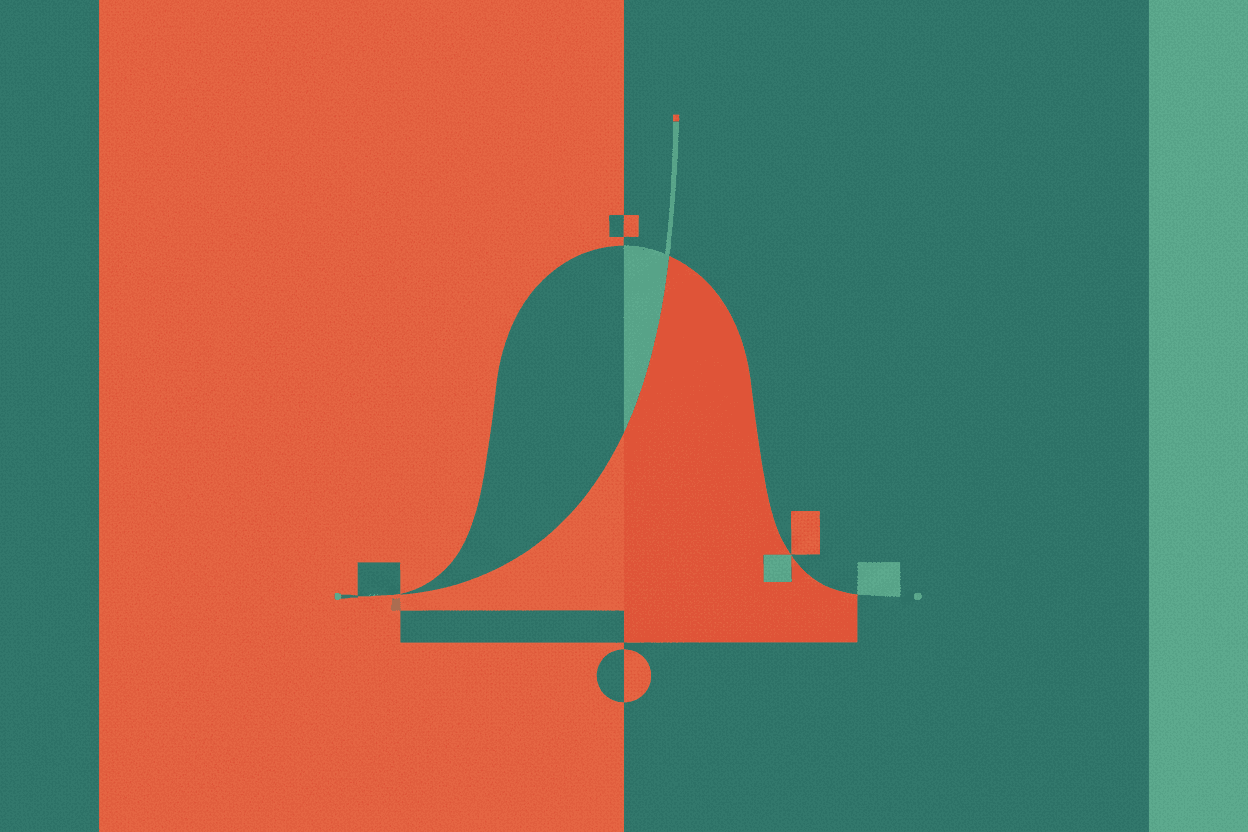
The word 'normal' entered the English lexicon in the mid-19th century, not from psychology, but from statistics. Belgian astronomer Adolphe Quetelet developed the 'average man' (l'homme moyen) as a statistical construct — a tool for identifying the center of a distribution. But what began as a mathematical convenience rapidly hardened into a moral ideal.
[!INSIGHT] The concept of 'normal' was a statistical tool that became a weapon. The average was never meant to be aspirational — it was simply a measurement.
By the early 20th century, the eugenics movement had weaponized statistical normality. IQ testing, introduced during World War I to screen military recruits, became a gatekeeping mechanism for immigration, employment, and even forced sterilization. The 'normal' mind these tests measured was explicitly calibrated to Western, educated, middle-class, Protestant values.
Consider the standardized test. The SAT, introduced in 1926, was originally called the 'Scholastic Aptitude Test' — implying it measured innate ability. Yet longitudinal studies consistently show that SAT scores correlate more strongly with parental income (r = 0.47) than with college success. The test does not measure 'aptitude'; it measures proximity to the demographic for which it was designed.
The Neurotypical Default
The term 'neurotypical' emerged in the 1990s autistic community as a neutral descriptor — not a slur, but a way to name what had previously been invisible. The dominant group never needs a label; only the deviation requires naming.
But here is what the neurodiversity movement has revealed: the 'neurotypical' profile describes a specific cognitive pattern — linear information processing, normative social intuition, typical sensory thresholds — that characterizes roughly 80-85% of the population. It is a majority, yes. But majority status has been conflated with natural law.
“*"The term 'normal' is a singularly difficult one to define. It suggests a standard, but the standard is always moving.”
Whose Portrait Is It?
When we examine the institutions that structure modern life, a pattern emerges. Each was designed during a specific historical moment, by a specific demographic, to solve specific problems.
The 9-to-5 Workday
The eight-hour workday was championed by labor unions in the late 19th century and codified in the Fair Labor Standards Act of 1938. It was designed for factory workers — predominantly men performing repetitive physical tasks under supervision. The assumption embedded in this structure:
- Work happens in discrete, predictable hours
- Productivity is linear and accumulative
- Separation of 'work' and 'life' is both possible and desirable
For neurodivergent individuals, this structure poses fundamental challenges. Autistic workers often report hyperfocus states where productivity is burst-driven, not linear. People with ADHD frequently experience 'time blindness' that makes rigid scheduling cognitively costly. The flexible remote work arrangements accelerated by the COVID-19 pandemic revealed what disabled advocates had long argued: the office itself was an accessibility barrier.
A 2023 study by McKinsey found that companies offering flexible work arrangements saw 25% lower attrition among neurodivergent employees. The 'normal' workday was never neutral.
The Nuclear Family
The postwar ideal of the nuclear family — married heterosexual couple, 2.5 children, single-family home — peaked in 1960, when 73% of American children lived with two married parents, one of whom (usually the mother) stayed home. By 2023, that figure had fallen to roughly 38%.
Yet family law, tax codes, and social welfare systems still encode the nuclear family as the default. The assumption that caregiving is provided by an unpaid spouse continues to penalize single parents, extended family arrangements, and chosen family structures — disproportionately affecting disabled and neurodivergent communities who often rely on collective care networks.
[!INSIGHT] The nuclear family was not a human universal but a postwar economic compact. Normalizing it required actively suppressing multigenerational households, communal child-rearing, and non-marital partnerships.
The Educational Assembly Line
The modern educational system — age-segregated cohorts, standardized curricula, bell schedules, letter grades — was explicitly modeled on factory organization. Horace Mann, who championed the American public school system in the 1840s, admired the Prussian model for its efficiency in producing 'obedient citizens and soldiers.'
This system assumes:
- All children develop at roughly the same pace
- Learning is linear and cumulative
- Attention can be subdivided into 45-90 minute blocks
- Verbal and mathematical intelligence are the primary cognitive virtues
For neurodivergent learners, these assumptions create friction. A 2022 report from the National Center for Education Statistics found that 34% of students receiving special education services were suspended or expelled at least once, compared to 12% of the general student population. The system was not designed for them; their presence registers as disruption.
The Epistemic Challenge of Neurodiversity
The neurodiversity movement, which emerged from autistic self-advocacy in the late 1990s, poses what philosopher Ian Hacking calls a 'looping effect' — the process by which classified people change their classification by understanding themselves through it.
But neurodiversity also poses a deeper epistemic challenge: What if the way neurotypical people perceive, process, and engage with the world is not the 'standard' against which all cognition should be measured, but simply one variant among many?
Consider sensory processing. Neurotypical sensory thresholds evolved to filter out 'irrelevant' stimuli — background noise, peripheral movement, fluorescent lights. But autistic sensory processing, often described as 'enhanced perception,' includes information that neurotypical brains automatically discard. Research by neuroscientist Henry Markram suggests this may explain both autistic sensory overload and autistic pattern-recognition abilities.
[!NOTE] The concept of 'sensory processing disorder' pathologizes what may be a cognitive trade-off: heightened sensitivity accompanied by enhanced detail recognition. Many autistic adults argue their sensory experience is not 'disordered' but differently calibrated.
The implications extend beyond accommodation. If neurodivergent cognition is not defective but alternative, then the 'normal' built environment is not neutral but partisan. Fluorescent lights are not standard; they are hostile to a significant minority. Open-plan offices are not efficient; they are exclusionary.
From Accommodation to Redesign
The Americans with Disabilities Act (1990) established the principle of 'reasonable accommodation' — retrofitting existing structures to provide access. But accommodation accepts the default as neutral and treats deviation as requiring special treatment.
A neurodiversity framework demands something more radical: universal design. What if we built institutions for cognitive variation from the start?
- Flexible scheduling that allows for circadian variation and burst productivity
- Sensory-aware architecture with quiet spaces, natural lighting, and reduced visual clutter
- Multiple assessment modes that value demonstration over timed testing
- Care infrastructure that supports interdependence rather than assuming self-sufficiency
Some organizations are already experimenting. Microsoft's autism hiring program, launched in 2015, abandoned traditional interviews in favor of skills demonstrations and team exercises — and found it uncovered talent that standard screening missed. SAP reported that its neurodiverse teams were 30% more productive than neurotypical teams in certain roles.
The Self-Portrait Dissolves
Here is the crux: normal was never universal. It was a self-portrait of a specific demographic — Western, middle-class, non-disabled, neurotypical — projected onto humanity as a whole. That projection was so successful that it became invisible. The portrait was mistaken for the person.
But demographics are shifting. The 'typical' worker is no longer a male breadwinner with a stay-at-home spouse. The 'typical' student is no longer white, native-born, and neurotypical. The 'typical' family is no longer nuclear. The majority that defined normalcy is, in many contexts, becoming a minority.
This does not mean normal disappears. It means the self-portrait becomes visible as a portrait — one image among many, particular to its time and place, carrying its biases and limitations.
“*"We need to design for the edges, not just the center. When you design for disability, you often end up with designs that benefit everyone.”
Conclusion
Every institution we take for granted — the workday, the school, the family — encodes assumptions about human nature. Those assumptions were not drawn from universal human experience. They were drawn from the experience of the people who designed them, at a moment when that demographic held disproportionate power.
The neurodiversity movement is not asking for special treatment. It is asking why the baseline was calibrated without them — and what becomes possible when we recalibrate.
Sources: Centers for Disease Control and Prevention (2024), World Health Organization, McKinsey & Company (2023), National Center for Education Statistics (2022), Hacking, I. (1995). 'Rewriting the Soul,' Holmes, K. (2018). 'Mismatch: How Inclusion Shapes Design,' Markram, H. et al. (2010). 'Intense World Theory.'
This is a Premium Article
Hylē Media members get unlimited access to all premium content. Sign up free — no credit card required.