The OODA Loop for Biological Threats
Pandemics exploit a fatal timing gap in biodefense. Can AI-driven surveillance and 72-hour mRNA platforms close the OODA loop before the next pathogen strikes?
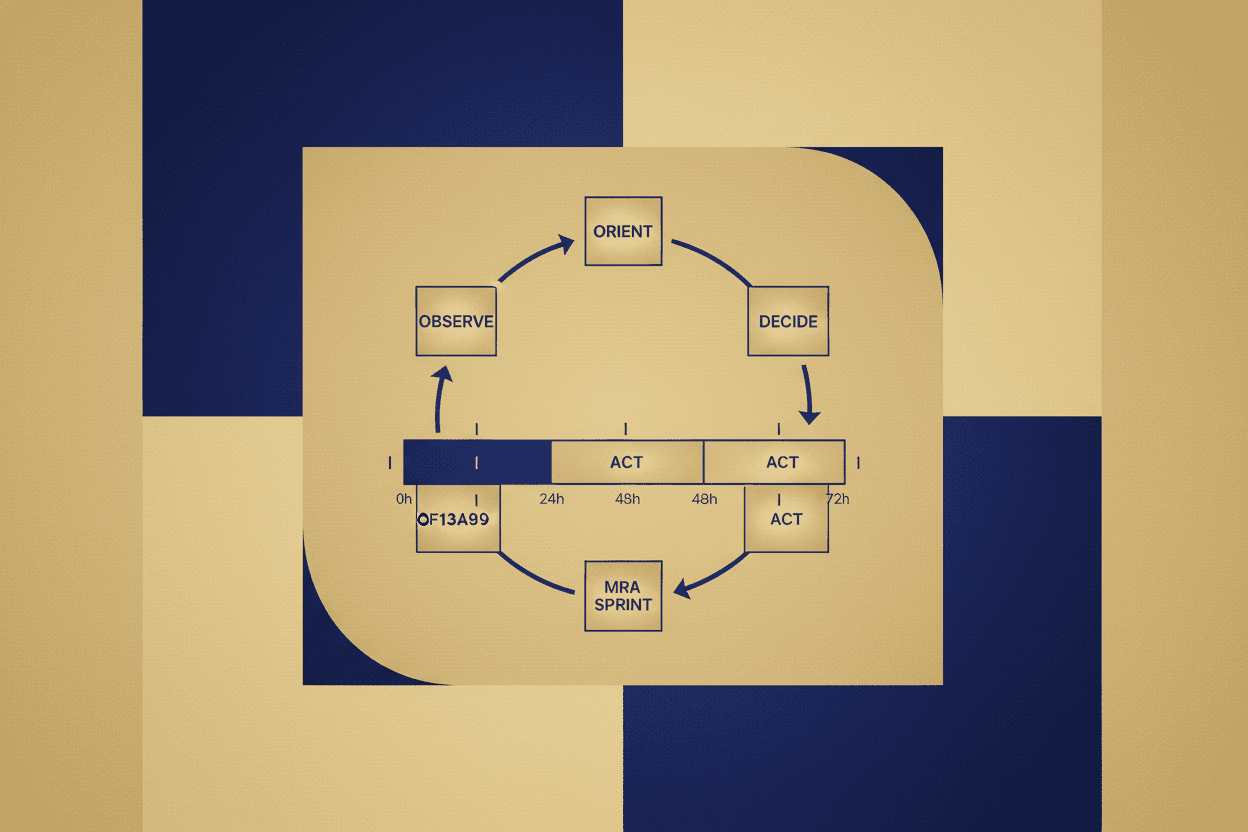
The military uses OODA loops — Observe, Orient, Decide, Act — to outmaneuver enemies. Applied to biodefense, we're fast at observation and slow at everything else. That's where pandemics win. In January 2020, Chinese scientists uploaded the SARS-CoV-2 genome to a public database within 72 hours of identification — a historic achievement in pathogen surveillance. Yet global lockdowns still lasted two years. The observation-to-action delta proved catastrophic: we saw the threat coming, but couldn't translate data into decisive response at sufficient speed.
Colonel John Boyd developed the OODA loop concept during the 1950s as a framework for aerial combat decision-making. The core insight was deceptively simple: whoever cycles through observation, orientation, decision, and action faster than their opponent gains a decisive advantage. In dogfights, this meant survival. In biological warfare — whether natural or engineered — it means millions of lives.
The mathematical reality is brutal. Pathogen replication follows exponential dynamics:
$$N(t) = N_0 \cdot e^{rt}$$
Where $N_0$ represents initial infections, $r$ is the reproduction rate, and $t$ is time in generations. A virus with $R_0 = 3$ and a 5-day serial interval doubles its infected population roughly every 3.5 days. By contrast, traditional vaccine development operates on 10-15 year cycles. The tempo asymmetry is staggering: pathogens execute thousands of replication cycles for every human decision cycle.
[!INSIGHT] Boyd's central insight was that speed of processing — not raw resources — determines victory. A smaller force with faster OODA loops defeats a larger force that cannot adapt quickly. Applied to pandemics, this suggests that surveillance infrastructure matters less than our ability to convert observations into coordinated action.
Observe: The Genome Surveillance Revolution
Modern pathogen observation represents the one phase where biodefense has genuinely accelerated. The Global Initiative on Sharing All Influenza Data (GISAID) database now contains over 15 million SARS-CoV-2 sequences, making it the largest genomic dataset for any organism in history. The Pathogen Surveillance Project and Africa CDC's Pathogen Genomics Initiative have extended this infrastructure to regions previously excluded from global surveillance networks.
The technical specifications are remarkable. Illumina's NovaSeq X Plus can generate 16 terabases of sequence data per run — equivalent to roughly 52,000 human genomes. Oxford Nanopore's portable MinION device enables real-time sequencing in field conditions, from Antarctic research stations to rural clinics. The observation layer of biodefense has achieved near-real-time capability.
“*"We've solved the observation problem. In 2024, we can identify a novel pathogen and sequence its genome within 48 hours of detection. The bottleneck isn't seeing the threat”
Orient: The AI Pattern Recognition Challenge
The orient phase — converting raw data into actionable intelligence — represents the current frontier of biodefense innovation. Artificial intelligence systems now scan genomic databases for anomalies that might indicate emerging threats. The premise is compelling: train deep learning models on known pathogen signatures to flag novel sequences that deviate from expected patterns.
Meta's ESM-2 protein language model, released in 2022, contains 15 billion parameters trained on 65 million protein sequences. It can predict protein structure from sequence alone, potentially identifying dangerous functional mutations before wet-lab confirmation. Similarly, researchers at the Broad Institute have developed machine learning classifiers that predict viral host range from genomic features with 92% accuracy.
However, the orient phase suffers from a critical vulnerability: political interference. Intelligence requires interpretation, and interpretation creates space for bias, denial, and bureaucratic friction. The WHO's Emergency Committee deliberated for days before declaring COVID-19 a Public Health Emergency of International Concern. During that interval, the virus spread unchecked across borders.
The Decide Bottleneck: Politics vs. Pathogens
The decision phase exposes the fundamental weakness in humanity's biodefense architecture. Viruses do not convene committees. They do not require interagency approval. They do not wait for consensus.
Consider the timeline disparities:
| Process | Typical Duration | COVID-19 Actual |
|---|---|---|
| Pathogen genome available | 48-72 hours | 11 days (Dec 31 - Jan 10) |
| WHO PHEIC declaration | Variable | 30 days |
| First national lockdowns | N/A | 46 days (Italy) |
| FDA Emergency Use Authorization | 3-6 months | 326 days (Pfizer vaccine) |
| Global vaccine distribution (50%) | Target: 12 months | Actual: 24+ months |
The decision latency created a compounding disaster. Each week of delay in implementing containment measures correlated with approximately 1.4 additional weeks of lockdown requirements later — a brutal interest rate on political hesitation.
[!NOTE] The "orient" and "decide" phases are where OODA loops collide with institutional design. Government agencies are structured for stability, not speed. Legal frameworks require consultation, review, and due process. These protections against hasty action become liabilities when facing exponentially replicating threats.
The 72-Hour mRNA Revolution
The act phase — our ability to respond decisively — has undergone the most dramatic transformation. Moderna designed its mRNA-1273 vaccine within 2 days of receiving the SARS-CoV-2 spike protein sequence. The subsequent translation to clinical trial material took 25 days, shattering previous vaccine development records.
The underlying technology enables unprecedented speed:
-
Sequence-to-Product Pipeline: mRNA vaccines eliminate cell culture entirely. Once the target antigen sequence is identified, the vaccine design is essentially complete.
-
Modular Manufacturing: Lipid nanoparticle formulations and synthetic mRNA production are platform technologies. The same facility can produce vaccines against influenza, coronavirus, or hypothetical engineered pathogens.
-
Distributed Production: Unlike traditional vaccines requiring massive bioreactor farms, mRNA synthesis can theoretically be decentralized to regional facilities.
[!INSIGHT] The 72-hour vaccine prototype is now technically feasible. BioNTech's manufacturing infrastructure can design, synthesize, and formulate candidate vaccines against novel pathogens within three days of receiving sequence data. The remaining 99% of vaccine development time involves clinical trials, regulatory review, and manufacturing scale-up — all decision-phase activities, not technical limitations.
The Engineered Threat Horizon
The OODA framework becomes exponentially more critical when considering engineered biological threats. CRISPR-based gene editing has democratized capabilities that were once restricted to nation-state laboratories. The cost of synthesizing novel DNA sequences has dropped from $10,000 per base pair in 1990 to less than $0.10 today.
A determined actor could theoretically:
- Modify an existing pathogen to increase transmissibility or virulence
- Design entirely novel pathogens using AI-predicted protein structures
- Release multiple engineered variants simultaneously to overwhelm surveillance systems
The 2017 horsepox synthesis experiment demonstrated that functional viruses can be reconstructed from publicly available sequences using mail-order DNA fragments. The total cost was approximately $100,000 — well within the resources of non-state actors.
“*"The technical barriers to biological weapons development are falling faster than our defensive capabilities are rising. We're racing against two curves: pathogen evolution and technological democratization.”
Implications: Rebuilding the OODA Architecture
Current biodefense investments remain heavily skewed toward the observe phase. The Biden Administration's $88 billion pandemic preparedness allocation emphasizes early warning systems, genomic surveillance, and laboratory capacity. These are necessary but insufficient.
A genuine OODA-optimized biodefense would require:
Pre-positioned Decision Frameworks: International agreements that trigger automatic response protocols upon verified pathogen detection, reducing political deliberation time from weeks to hours.
Adaptive Regulatory Pathways: Pre-approved clinical trial designs and rolling EUA frameworks that compress the decision-to-deployment timeline.
Distributed Act Capabilities: Regional mRNA manufacturing hubs that can produce vaccine candidates before central authorities grant final approval, enabling rapid local deployment.
The mathematical reality remains unchanged: pathogens replicate on hour timescales. Human institutions operate on week and month timescales. Closing this gap requires not better observation — we have that — but faster orientation, more decisive governance, and pre-built response infrastructure.
Sources: GISAID Database Statistics 2024; Boyd, John. "A Discourse on Winning and Losing" (2018); Hodcroft, E. et al. "Real-Time Genomic Surveillance" Nature Medicine 2023; Koblentz, G. "Living Weapons" Cornell University Press 2009; WHO Emergency Committee Timeline 2020; Moderna SEC Filings; BioNTech Manufacturing Technical Reports 2023
This is a Premium Article
Hylē Media members get unlimited access to all premium content. Sign up free — no credit card required.