The Philosopher Who Started a Revolution
Discover how Rousseau's Social Contract and Marx's Capital became intellectual weapons that toppled empires—and killed millions. The dangerous power of ideas.
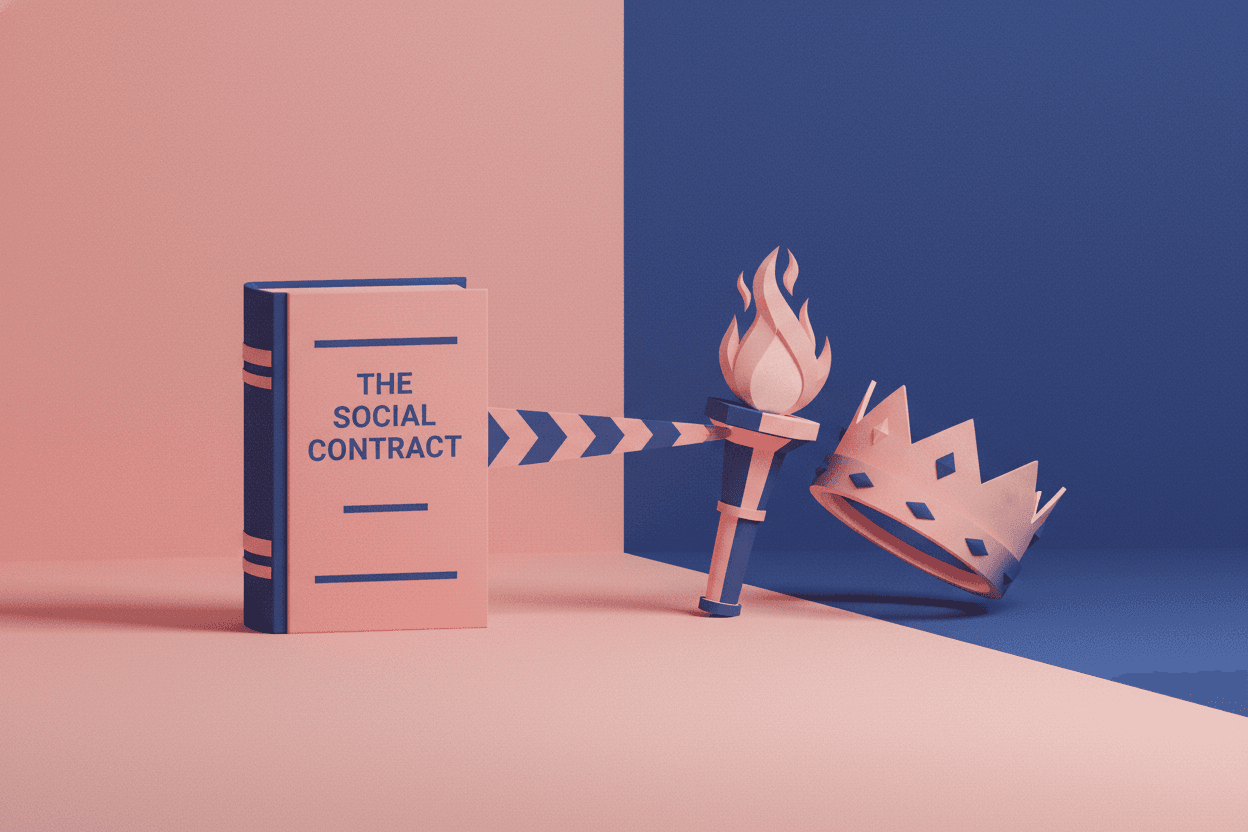
The Lethal Force of Ideas
A man who never held a weapon killed more people than any general in history. He wrote a book. In the two and a half centuries since Jean-Jacques Rousseau penned The Social Contract, and the century and a half since Karl Marx completed Das Kapital, these philosophical treatises have been implicated in the deaths of tens of millions. The French Revolution's Reign of Terror claimed 40,000 lives in just thirteen months. The Soviet experiment, justified through Marx's intellectual framework, resulted in an estimated 20 million deaths under Stalin alone. How do abstract ideas—mere words on a page—transform into physical forces capable of toppling empires and ending millions of lives?
The Architecture of Revolutionary Thought
The mechanism by which philosophy becomes violence follows a terrifyingly consistent pattern. It begins with what philosophers call a "legitimacy crisis"—a systematic critique that exposes the gap between what institutions claim to be and what they actually are.
Rousseau's 1762 masterwork opened with a sentence that functioned like intellectual dynamite: "Man is born free, and everywhere he is in chains." In seven words, Rousseau dissolved the divine right of kings, the naturalness of social hierarchy, and the legitimacy of every government in Europe. He didn't argue for violent revolution—he simply made existing arrangements intellectually indefensible.
[!INSIGHT] Rousseau's contribution wasn't a blueprint for revolution but a demolition of the mental architecture that made submission seem natural. Once you see the chains, you cannot unsee them.
The Social Contract introduced a concept that would prove explosive: the General Will. Rousseau argued that legitimate authority comes not from God or tradition but from the collective will of the people. This seemingly abstract principle had concrete consequences. When Louis XVI was executed in 1793, his prosecutors didn't accuse him of specific crimes—they declared him an enemy of the General Will.
Robespierre, the architect of the Terror, was explicit about his philosophical debts. In his speech on the principles of revolutionary government, he cited Rousseau directly: "The social order is a sacred right which serves as the basis for all other rights. But this right does not come from nature; it is therefore founded on conventions."
From Theory to Terror: The Translation Mechanism
The journey from philosophical text to guillotine involves three distinct stages that scholars have identified across multiple revolutions:
Stage 1: Conceptual Disruption. The text provides a new vocabulary that makes existing arrangements appear arbitrary rather than natural. Before Rousseau, inequality seemed ordained by God; after him, it became a human choice that could be undone.
Stage 2: Moral Authorization. The philosophy provides intellectual cover for actions that would otherwise seem morally prohibited. The revolutionary can tell themselves—and others—that violence isn't merely permissible but necessary for realizing a higher good.
Stage 3: Operational Simplification. Complex philosophical ideas get reduced to actionable slogans. Rousseau's nuanced discussion of the General Will became "the people" versus "enemies of the people"—a binary that justified eliminating anyone who dissented.
“"The philosophers have only interpreted the world, in various ways; the point is to change it.”
Marx understood this mechanism better than anyone. Where Rousseau was ambiguous about practical implementation, Marx was deliberate. Das Kapital (1867) was written as a work of economic analysis, but its revolutionary implications were explicit. By revealing capitalism's internal contradictions, Marx believed he was providing the working class with the intellectual weapon they needed to overthrow their oppressors.
The numbers speak to his success. By 1980, approximately one-third of humanity lived under governments claiming Marxist inspiration. The path from Marx's British Museum reading room to the Gulag archipelago was neither straight nor inevitable—but it was real.
“[!INSIGHT] The danger of philosophical weapons lies not in their direct application but in their capacity for what theorists call "hermeneutical capture”
The Intellectual's Dilemma: Responsibility Without Causation
Did Rousseau cause the Terror? Did Marx create Stalinism? The question reveals a category error. Philosophers don't cause events in the way a billiard ball causes another to move. Their contribution is different and perhaps more profound: they create the conditions of possibility for what follows.
Hannah Arendt, reflecting on the relationship between thought and action, distinguished between "planners" who design specific outcomes and "authors" who create frameworks. Rousseau and Marx were authors, not planners. They couldn't have predicted the specific forms their ideas would take any more than Newton could have predicted nuclear weapons.
Yet this doesn't absolve them entirely. Both philosophers embedded within their works elements that facilitated later catastrophe:
-
Rousseau's rejection of partial associations. By insisting that citizens should think only of the common good, Rousseau made pluralism itself suspect—a principle that justified suppressing dissent.
-
Marx's teleological determinism. By presenting revolution as historically inevitable, Marx made opposition seem not just wrong but "on the wrong side of history"—a phrase that has justified enormous violence.
-
Both philosophers' confidence in abstract reason. The belief that reality can be reorganized according to rational principles has proven repeatedly dangerous when applied to complex human societies.
[!NOTE] The 20th century alone saw philosophical ideas contribute to the deaths of approximately 100 million people through communist states, fascist movements, and various forms of revolutionary nationalism. This exceeds the death toll from all religious wars in human history combined.
The Weaponization of Philosophy: A Universal Pattern
What makes philosophy susceptible to weaponization? Three characteristics distinguish philosophical texts from other forms of writing:
Totalizing Ambition. Philosophy typically seeks to explain not just some things but everything. This comprehensive scope means that philosophical frameworks can be applied to any situation—including situations the philosopher never imagined.
Moral Authority. Philosophical arguments don't just describe; they prescribe. They carry normative force that can override conventional morality. If the General Will requires eliminating enemies, or if historical progress requires breaking eggs, the philosophical framework provides authorization.
Interpretive Flexibility. Because philosophical texts are abstract, they can be interpreted to support actions the author never intended. Lenin's interpretation of Marx differed radically from Bernstein's; Robespierre's Rousseau was not the same as Kant's.
This flexibility has a dark side. Once a philosophical framework gains institutional power, it tends to become what critics call a "thought regime"—a system that not only prescribes certain beliefs but makes alternative ways of thinking literally unthinkable.
The Unfinished Conversation
Rousseau and Marx shared something else: both were responding to genuine injustices. Rousseau wrote against a world where hereditary privilege determined life outcomes. Marx analyzed an economic system that generated unprecedented wealth alongside unprecedented misery. Their diagnoses were often brilliant; their prescriptions proved catastrophic.
This suggests an uncomfortable truth: the relationship between philosophical insight and practical wisdom may be weaker than we'd like to believe. One can be right about what's wrong while being dangerously wrong about what to do.
“"The reasonable man adapts himself to the world; the unreasonable one persists in trying to adapt the world to himself. Therefore all progress depends on the unreasonable man.”
Shaw's observation captures both the necessity and danger of philosophical thinking. Without those who imagine alternatives, we remain trapped in unjust arrangements. But the same imaginative capacity that enables critique also enables catastrophe when untethered from empirical constraints and moral humility.
Sources: Arendt, H. (1951). The Origins of Totalitarianism. Harcourt Brace. Rousseau, J.J. (1762). The Social Contract. Marx, K. (1867). Das Kapital. Furet, F. (1996). The Passing of an Illusion. University of Chicago Press. Applebaum, A. (2003). Gulag: A History. Doubleday. Schama, S. (1989). Citizens: A Chronicle of the French Revolution. Knopf.