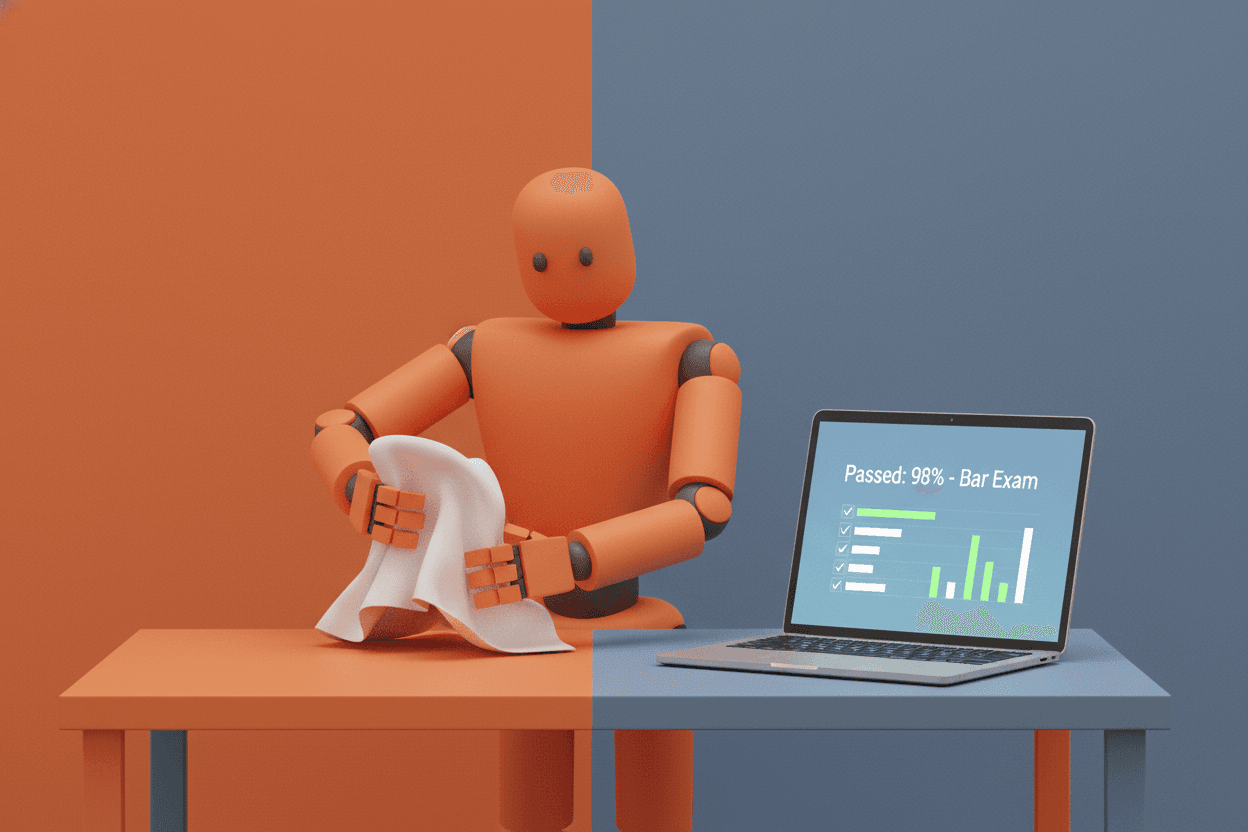
GPT aces the bar exam but fails at folding towels. Discover why Moravec's Paradox dooms current AI architectures — and what it means for AGI's future.
Hyle Editorial·
GPT can pass the bar exam but can't fold a towel. This isn't a temporary limitation — it's a fundamental design flaw. In 2024, the world's most advanced AI systems can write poetry, diagnose rare diseases, and beat grandmasters at chess. Yet deploy that same AI in a kindergarten classroom, and a five-year-old will outperform it at virtually every physical task. The child understands that blocks fall down, that water spills, that you need to grip before you lift. The AI knows none of this.
This bizarre inversion — where the hard becomes easy and the easy becomes impossible — is known as Moravec's Paradox. First articulated by roboticist Hans Moravec in the 1980s, it reveals something unsettling about intelligence itself: everything we think requires "smartness" turns out to be computationally trivial, while the "simple" things our bodies do automatically represent billions of years of evolutionary optimization that we still cannot replicate.
In 1988, Hans Moravec, Rodney Brooks, and Marvin Minsky observed something strange about artificial intelligence research. Early AI systems could perform complex logical deductions, solve algebraic equations, and play competent chess — tasks considered markers of high intelligence in humans. Yet these same systems utterly failed at walking across a room, picking up a cup, or recognizing a face.
[!INSIGHT] The core insight of Moravec's Paradox is that human judgment of task difficulty is backwards. We find abstract reasoning "hard" because we must do it consciously and deliberately. Sensorimotor skills feel "easy" because they run on billions of years of evolved neural machinery that operates entirely below our awareness.
Consider what actually happens when you pick up a coffee mug. Your brain analyzes the object's shape, estimates its weight based on visual cues, calculates the precise grip force needed (too little and it slips, too much and it crushes), coordinates dozens of muscles across your arm and hand, adjusts for the liquid's sloshing motion, and compensates for any postural shifts — all in roughly 200 milliseconds. You do this while talking, thinking about your day, and balancing on two feet.
No robot on Earth can match this performance reliably in unstructured environments.
The Evolutionary Explanation
The reason lies in our evolutionary history. Our nervous system has been refining sensorimotor control for over 500 million years. Vertebrate locomotion, manipulation, and spatial awareness represent the most optimized code in existence — written by natural selection across countless generations of trial and fatal error.
By contrast, abstract reasoning — mathematics, logic, strategic planning — is evolutionary novelty. Human-level abstract thought is perhaps 100,000 years old, an eyeblink in evolutionary time. We find it "hard" because our brains are still figuring it out.
“"The main lesson of thirty-five years of AI research is that the hard problems are easy and the easy problems are hard.”
— Steven Pinker, cognitive psychologist
The Embodiment Gap
Current AI systems — including large language models like GPT-4 and multimodal systems like Gemini — are fundamentally disembodied. They process patterns in text and images without ever experiencing the physical world. They know the word "gravity" appears near "falling" in their training data, but they have never felt weight in their hand, never watched a glass shatter, never learned through embodied consequence.
This creates what researchers call the "embodiment gap" — the chasm between symbolic knowledge and grounded understanding.
What a Five-Year-Old Knows That AI Doesn't
A five-year-old has accumulated roughly 43,800 hours of waking experience interacting with physical reality. Through trial, error, and observation, they have learned:
Object permanence: Things still exist when you cannot see them
Causal reasoning: Pushing the cup makes it move; tipping it makes liquid spill
Material properties: Glass breaks, rubber bounces, water flows
Force calibration: How hard to push, pull, squeeze, or lift
Social intuition: When someone is frustrated, helpful, or playful
None of this is in any training dataset in a form AI can meaningfully access. GPT-4 has read millions of words about physics but has never once experienced friction.
[!NOTE] This is why robotics remains orders of magnitude harder than natural language processing. Language models train on trillions of tokens readily available on the internet. Embodied AI would need comparable experience in physical interaction — data that must be generated through actual robot trials, which are slow, expensive, and failure-prone.
Why This Matters for AGI
The quest for Artificial General Intelligence (AGI) — AI that matches or exceeds human capability across all domains — hits a wall at Moravec's Paradox. Current approaches assume that scaling up pattern-matching on text and images will eventually yield general intelligence. But this ignores a crucial insight: human intelligence is not disembodied processing. It is inseparable from physical existence.
Our cognitive architecture developed to solve problems of survival in a physical world. Abstract reasoning emerged as an extension of, not a replacement for, embodied cognition. This suggests that true AGI may require not just better algorithms, but bodies — or at least simulations rich enough to provide grounded experience.
Three Paths Forward
Simulation-first approaches: Companies like NVIDIA and Tesla are building increasingly realistic physics simulators where AI agents can learn through millions of virtual trials. The limitation: simulation inevitably simplifies reality, and the gap between simulated and real-world performance remains significant.
Neuromorphic hardware: Researchers are developing chips that mimic biological neural networks, potentially enabling more efficient sensorimotor learning. This remains experimental.
Hybrid systems: The most promising near-term approach combines large language models (for reasoning) with separate systems trained specifically for physical interaction. Boston Dynamics' robots demonstrate remarkable physical capability, but lack the general intelligence to understand context or adapt to novel situations.
Implications: The Skills Hierarchy Inverts
Moravec's Paradox has profound implications for the future of work, education, and human value.
If abstract cognitive tasks — analysis, writing, calculation — are computationally "easy," AI will continue to dominate these domains. But physical manipulation, especially in unstructured environments, may remain human territory far longer than anticipated.
“"We have mountains to climb before a robot can fold laundry, but we're already at base camp for automated legal analysis. The job market implications are not what most people expect.”
— Robotics industry report, 2024
Consider the hierarchy of automation vulnerability:
Resistant to automation: Skilled trades (plumbing, electrical work), healthcare delivery requiring physical presence, childcare, complex manipulation in novel environments
The plumber may have better job security than the paralegal. The nurse may outlast the financial analyst. We have been preparing our children for an AI-dominated future by emphasizing STEM and abstract reasoning — exactly the skills AI finds easiest.
[!NOTE] This inversion challenges fundamental assumptions in education policy. If AI masters abstract reasoning first, perhaps we should emphasize physical skills, creativity, and social intelligence — domains where human embodied experience provides genuine advantages.
The Bottleneck Is Not Compute
The standard AI narrative suggests that more compute, more data, and larger models will eventually solve all problems. Moravec's Paradox reveals this as incomplete at best.
The bottleneck is not processing power. It is data of the right kind. No amount of text training will teach an AI how much force to apply when gripping an egg versus a tennis ball. This knowledge exists only in physical interaction — slow, expensive, and impossible to crowdsource.
Embodied AI company figures suggest that a robot needs roughly 100,000 trials to learn a reliable grasping behavior. A human child learns similar skills in perhaps hundreds of trials. Our biological learning algorithms remain vastly more efficient, suggesting that the path to AGI may require fundamental breakthroughs in how AI learns, not just how much it computes.
Key Takeaway: Moravec's Paradox reveals that the path to AGI does not run through better chatbots. The easy problems — chess, calculus, legal analysis — are already solved. The hard problems — folding laundry, opening doors, understanding why a toddler is crying — require embodied cognition that current AI architectures fundamentally lack. Until AI systems accumulate physical experience comparable to human childhood, they will remain brilliant but crippled: minds without bodies, reasoning without understanding.
Sources: Moravec, H. (1988). Mind Children. Harvard University Press; Pinker, S. (1997). How the Mind Works. Norton; Brooks, R. (2023). "The Deep Learning Blind Spot: Embodiment." IEEE Robotics & Automation Magazine; Boston Dynamics Technical Reports (2024); NVIDIA Isaac Sim Documentation (2024); OpenAI GPT-4 Technical Report (2023).
This is a Premium Article
Hylē Media members get unlimited access to all premium content. Sign up free — no credit card required.