Why 'Average' Is the Most Dangerous Word in Policy
In 1950, the US Air Force discovered that designing for the 'average pilot' made cockpits fatal for everyone. The average human doesn't exist—but our policies still pretend otherwise.
The Average That Never Was
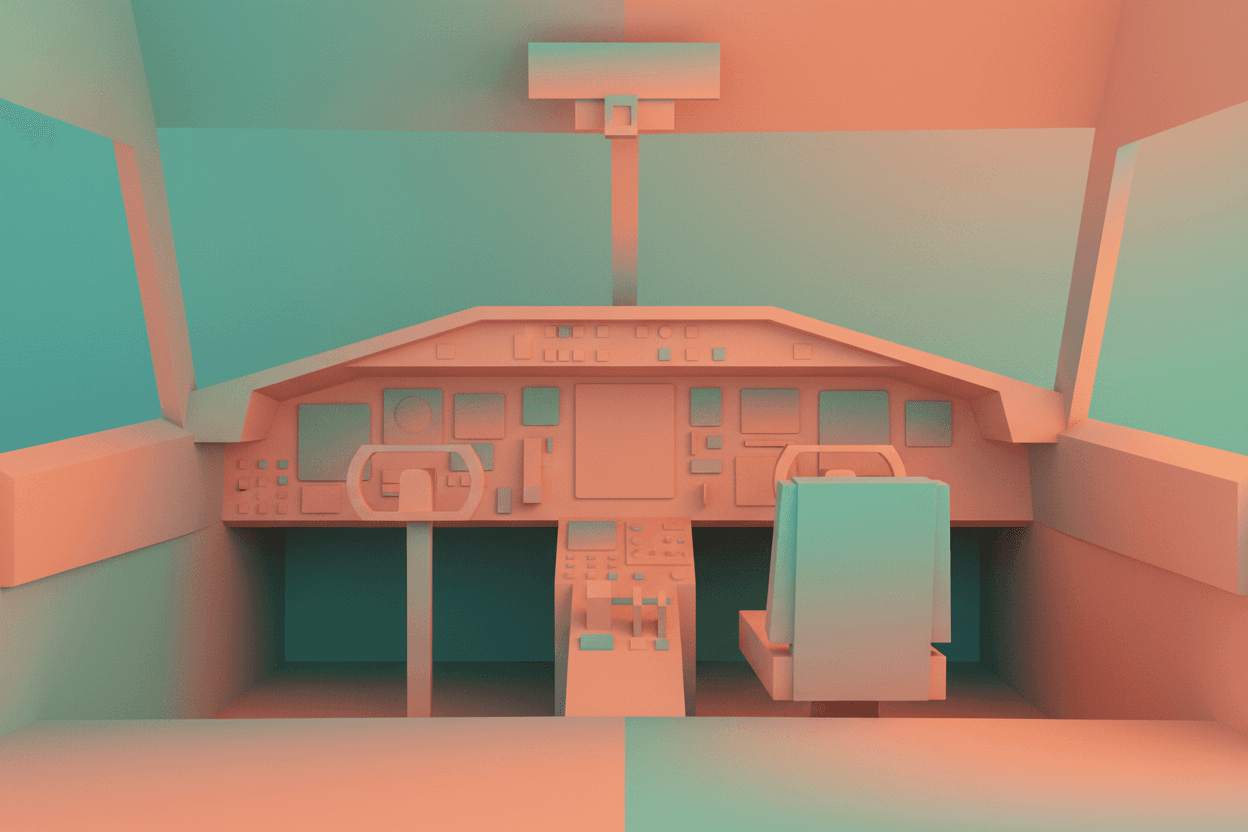
The US Air Force discovered in 1950 that designing cockpits for the 'average pilot' resulted in zero pilots being safe. After years of declining performance and fatal crashes, researchers measured 140 physical dimensions on 4,063 pilots—arm length, torso height, thigh circumference, and more—expecting to identify the standardized human form that could guide aircraft design. When they calculated the average for each dimension and cross-referenced individual pilots against these norms, they found exactly zero pilots who matched the average across all measurements. Not a single one. The 'average pilot' was a mathematical phantom—a convenient fiction that had been killing real people for years.
This revelation forced a radical redesign of military cockpits, replacing fixed seats with adjustable everything. But here's the disturbing question: if designing for the average fails catastrophically in a cockpit, why do we build entire social systems—education, healthcare, workplace policy—around the same phantom? What happens to the people who don't exist in the spreadsheet?
The Birth of the Average Human
The concept of the 'average man' was born in 1835, when Belgian astronomer Adolphe Quetelet published a treatise that would fundamentally reshape how governments understood their populations. Quetelet borrowed a mathematical tool from astronomy—the 'method of averages' used to locate stars—and applied it to human bodies and behaviors.
“"If an individual at any given epoch of society possessed all the qualities of the average man, he would represent all the greatness, beauty, and goodness of that society.”
Quetelet's innovation was deceptively simple: measure a population, calculate the mean, and treat that mean as an ideal type. He called this l'homme moyen—the average man. But Quetelet made a category error that persists to this day. He confused a statistical abstraction with a biological reality.
In astronomy, averaging multiple observations of a single star produces a more accurate measurement of that star's position. In sociology, averaging multiple observations of different humans produces... a fiction. No actual human has average height, average weight, average income, average health outcomes, and average family size simultaneously. The map became the territory.
[!INSIGHT] The 'average' is not a description of reality—it's a simplification tool that becomes dangerous when mistaken for reality itself. When policymakers design for the average, they're designing for no one.
The Tyranny of the Bell Curve
By the early twentieth century, the average had become the dominant framework for understanding human variation. Factory assembly lines were designed for average workers. School curricula were designed for average students. Medical dosages were calculated for average bodies.
This standardization brought efficiency—but at a hidden cost. In 1952, the Air Force commissioned Gilbert Daniels, a young Harvard-trained anthropologist, to finally settle the question of cockpit design. Daniels's study produced the stunning zero-match result that launched the adjustable cockpit revolution.
But Daniels's findings should have reverberated far beyond aviation. They proved that designing for the average doesn't just slightly miss the mark—it systematically excludes nearly everyone.
When Policy Meets Phantom
Consider how this plays out in contemporary social systems.
Education: The Standard Student
The modern educational system was shaped profoundly by the efficiency movements of the early 1900s. Age-based grade levels, standardized curricula, uniform assessments—all designed around an imagined average learner. But research increasingly shows that 'average' learning trajectories match almost no actual students.
A 2017 study of 10,000 students found that when measured across multiple dimensions of academic performance, 94% showed significant variation between their strongest and weakest areas. A student might be in the 90th percentile for reading comprehension but the 30th for processing speed. The 'average' student is not just rare—they don't exist.
Healthcare: The Standard Patient
Clinical trials and treatment protocols are overwhelmingly designed around average responses. But this creates systematic blind spots. Women experience heart attacks differently than the 'standard' (male-based) symptoms that dominate medical education. Drug dosages calibrated for average body weights can be toxic for outliers.
A 2020 analysis found that only 4% of clinical trials reported results disaggregated by sex, age, and ethnicity simultaneously. The vast majority of medical knowledge describes a composite patient who doesn't exist—and patients who deviate from this phantom suffer the consequences.
Economics: The Standard Household
Policy interventions frequently target 'average households' or 'median income families.' But household composition, regional cost of living, and wealth distribution vary so dramatically that policy designed for averages routinely fails those it intends to help.
During the COVID-19 pandemic, stimulus payments based on income thresholds missed millions of the most vulnerable Americans—those who didn't file taxes, who worked in cash economies, or whose income fluctuated too wildly to be captured by annual averages.
[!NOTE] The mathematical concept of 'average' is not the problem—it's a powerful tool for describing populations. The problem is when we treat the average as prescriptive rather than descriptive, as a design target rather than a summary statistic.
The Architecture of Invisibility
What Daniels discovered in 1950 was not just a cockpit problem—it was an epistemological problem. When you design systems around a statistical fiction, you create structural invisibility. People who don't match the average don't just get poor service; they become literally unthinkable within the system's logic.
The philosopher Ivan Illich called this 'radical monopoly'—when a dominant system makes alternatives impossible. If all cockpits are designed for the average, there is no cockpit for you. If all schools teach to the average, there is no education for you. If all healthcare protocols assume the average body, there is no treatment for you.
This invisibility compounds across systems. A child who learns differently from the 'standard' student may be labeled as having a learning disability—not because something is wrong with them, but because the system's definition of 'normal' excludes them. A patient whose symptoms don't match the 'typical' presentation may be misdiagnosed or dismissed.
“"There is no such thing as an average pilot, an average student, or an average patient. There is only the individual, with all their glorious, inconvenient variation.”
Beyond Average: Designing for Edges
The Air Force's solution to the cockpit problem offers a template. Rather than designing for the phantom average and accepting casualties at the margins, they designed for the edges of human variation—and discovered that systems built for extremes accommodate everyone in between.
Adjustable seats weren't a compromise; they were an upgrade. They didn't just solve the safety problem—they improved performance across the entire pilot population. The lesson translates: systems designed for the full range of human variation don't merely avoid harm—they work better for everyone.
This principle—sometimes called 'universal design' or 'design for extremes'—has begun to influence fields from architecture to digital interfaces. But it remains radical in policy circles, where 'average' thinking is so embedded that alternatives seem utopian or impractical.
Sources:
- Daniels, G. S. (1952). The Average Man? Wright Air Development Center Technical Report.
- Quetelet, A. (1835). Sur l'homme et le développement de ses facultés, ou Essai de physique sociale.
- Rose, T. (2016). The End of Average: How We Succeed in a World That Values Sameness. HarperOne.
- Illich, I. (1973). Tools for Conviviality. Harper & Row.
- National Center for Education Statistics (2017). Variation in Student Learning Patterns.