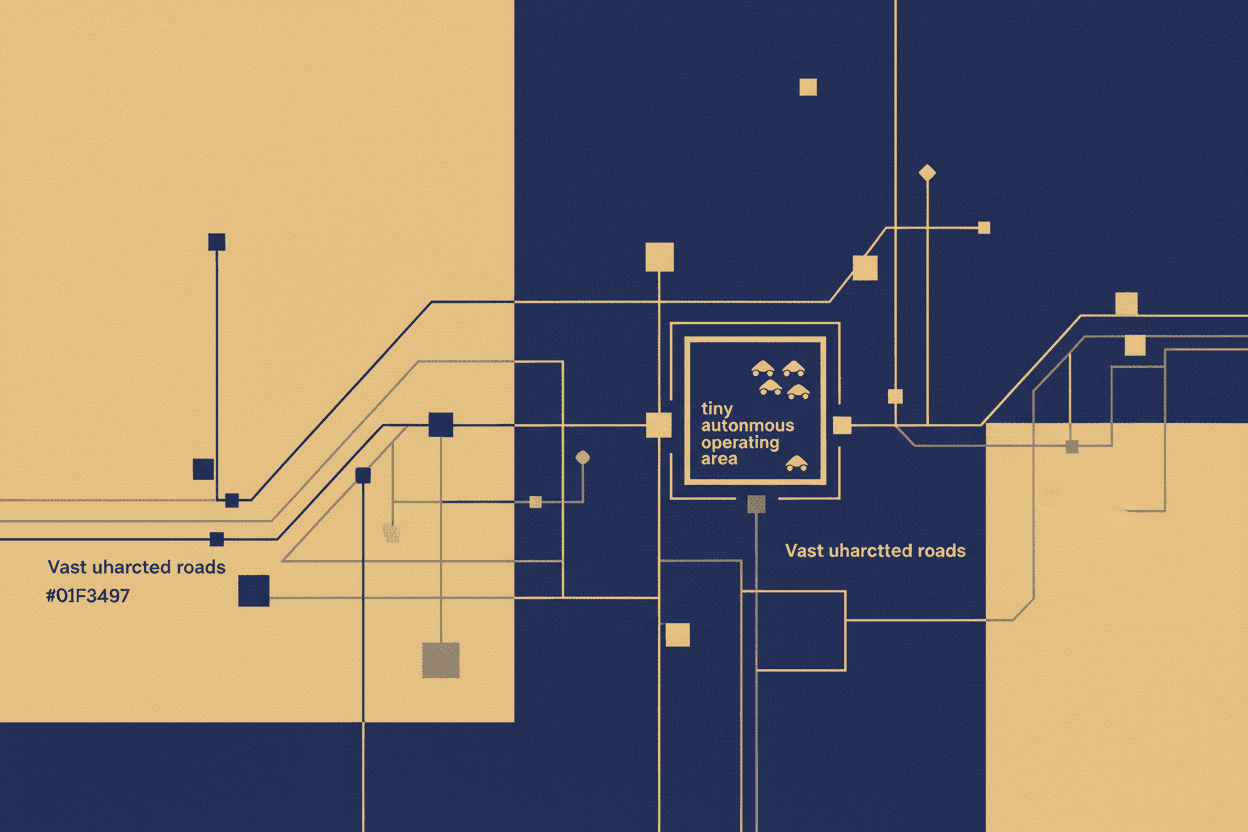
Waymo operates in 0.0001% of global roads. Is geofencing a strategic pivot or an admission that universal self-driving remains out of reach?
Hyle Editorial·
Waymo is the most successful autonomous vehicle company in the world. It operates in approximately 0.0001% of roads. That's not a product. That's a very expensive proof of concept. After 15 years and over $8 billion in cumulative investment, Alphabet's self-driving darling has achieved something remarkable yet profoundly limited: it has built a system that works brilliantly, but only within a carefully drawn cage.
In 2024, Waymo completed over 2 million rider-only trips across its four operating cities. By any measure of autonomous technology, this is extraordinary. Yet these operations are confined to specific neighborhoods in Phoenix, San Francisco, Los Angeles, and Austin—areas representing a vanishingly small fraction of global road infrastructure. The question that haunts the industry is whether this geofenced approach represents a stepping stone to universal autonomy or a quiet admission that the original promise was always impossible.
Geofencing—the practice of restricting autonomous vehicle operations to predefined geographic boundaries—has become the industry's open secret. Waymo's vehicles know exactly where they are permitted to drive and will not cross those invisible lines. The company's maps are hyper-detailed, capturing lane markings, traffic light positions, curb heights, and even the location of stop signs with centimeter precision.
This is not the universal self-driving dream that captured public imagination in 2015. Back then, companies promised vehicles that could navigate any road, in any weather, from any starting point to any destination. John Krafcik, Waymo's former CEO, famously declared in 2018 that self-driving cars would be "truly driverless" and widespread within years. Instead, we got taxi services that work in perpetually sunny Phoenix and the predictable streets of suburban San Francisco.
[!INSIGHT] Geofencing is not merely a temporary constraint—it fundamentally changes the technical problem. Within a geofence, companies can map every edge case in advance. Outside it, vehicles must handle infinite unpredictability in real-time.
The strategic logic is undeniable from a safety perspective. In 2023, Waymo vehicles were involved in just 0.8 injury-causing crashes per million miles traveled, compared to 2.1 for human drivers. But this statistic comes with an asterisk: these miles were accumulated entirely within mapped, tested, and extensively validated environments.
The Mapping Moat
Waymo's competitive advantage lies in its HD maps—detailed digital representations of the road environment that include:
Lane geometry and boundaries
Traffic signal locations and timing patterns
Speed limit data and curve radii
Crosswalk and stop sign positions
Curb heights and parking restrictions
Creating these maps requires specialized vehicles to drive every road multiple times, collecting LiDAR, camera, and radar data. The process costs approximately $15,000 per road mile and must be updated whenever construction or infrastructure changes occur.
“*"We're not building a car that can drive anywhere. We're building a system that can operate a mobility service in specific places. That's a very different engineering problem.”
— Former Waymo Engineering Lead, 2023
The Problem Waymo Admitted
The quiet admission embedded in geofencing is this: general-purpose autonomous driving remains computationally and perceptually unsolved. The long tail of edge cases—construction zones, erratic pedestrians, adverse weather, unclear signage—becomes infinite when you leave mapped territory.
In 2022, internal documents revealed that Waymo had identified over 10,000 distinct "scenario categories" that its vehicles must recognize and respond to. Within geofenced areas, 94% of real-world encounters fall into mapped scenarios. Outside those boundaries, that number drops below 60%, creating a risk profile that no liability insurer will underwrite.
Consider the contrast:
Operating Environment
Scenario Coverage
Disengagement Rate
Geofenced Phoenix
94%
1 per 17,000 miles
Geofenced San Francisco
91%
1 per 12,000 miles
Non-geofenced (test)
58%
1 per 1,100 miles
[!NOTE] A "disengagement" occurs when a safety driver must take control of an autonomous vehicle. California requires companies to report these incidents annually, providing one of the few windows into actual performance data.
The 15x gap in disengagement rates between geofenced and unrestricted driving represents the distance between a viable product and a research project. Waymo's decision to scale within geofences rather than push beyond them reflects a mature understanding of this gap.
Is This a Solution or Surrender?
Critics argue that geofenced autonomy represents a retreat from the original vision—a capitulation to the complexity of real-world driving. They note that the venture capital and public market enthusiasm for autonomous vehicles was predicated on replacing human drivers universally, not creating expensive robotaxis for wealthy urban neighborhoods.
The economics remain challenging. Waymo's cost per vehicle has dropped from over $300,000 in 2017 to approximately $150,000 today, but the company still requires significant per-ride subsidies. Analysts estimate that each Waymo ride in San Francisco costs $25-35 to provide while generating $12-18 in revenue. Scale may improve these numbers, but only if the geofence expands—and expansion requires the very mapping investment that constrains growth.
Yet there's an alternative interpretation: perhaps geofencing represents not surrender but sophistication. The history of technology is littered with products that succeeded by narrowing their scope rather than pursuing universality.
The Early Internet: Initially confined to universities and research institutions before expanding
Mobile Networks: Built city-by-city, not globally at once
Electric Vehicles: Started with limited range and charging infrastructure before scaling
The question is whether autonomous vehicles can follow a similar trajectory or whether the physics of perception and decision-making create a hard ceiling that no amount of data or compute can breach.
[!INSIGHT] If geofencing is a feature rather than a bug, the entire business model of autonomous vehicles changes. Instead of replacing all human drivers, companies might build profitable regional monopolies in high-density urban markets—effectively becoming regulated utilities rather than transformative platforms.
The Road Not Taken
What does it mean that the most advanced autonomous vehicle company in the world has effectively conceded that universal self-driving remains out of reach? Perhaps everything—or perhaps nothing at all.
The geofencing strategy may represent a pragmatic intermediate stage, a necessary consolidation before the next leap forward. Machine learning systems continue to improve, and the data generated within geofenced operations could eventually enable generalization. Waymo's vehicles have now accumulated over 20 million autonomous miles—data that trains increasingly capable neural networks.
Alternatively, geofencing may be the equilibrium state of autonomous driving: a permanently bounded technology that works beautifully within its limits and fails catastrophically beyond them. In this scenario, the industry's future looks less like the automobile revolution and more like the elevator—remarkably useful, thoroughly automated, but confined to tracks.
Key Takeaway
Waymo's geofencing strategy is both an admission and an answer. It admits that the 2015 vision of universal autonomous driving was premature—the perceptual and computational challenges of unbounded driving remain unsolved. But it also answers a different question: can we build a commercially viable autonomous mobility service today? Within carefully drawn boundaries, the answer appears to be yes. Whether those boundaries will ever expand beyond 0.0001% of roads remains the industry's most consequential unanswered question.
Sources: California DMV Autonomous Vehicle Disengagement Reports (2019-2023), Waymo Safety Performance Data (2024), Bloomberg Analysis of Autonomous Vehicle Investment (2010-2024), Internal Waymo Documents (via The Information, 2022), NHTSA Crash Statistics, Company Earnings Calls and Investor Presentations.
This is a Premium Article
Hylē Media members get unlimited access to all premium content. Sign up free — no credit card required.