The $91 Million Banana: How Art Prices Actually Work
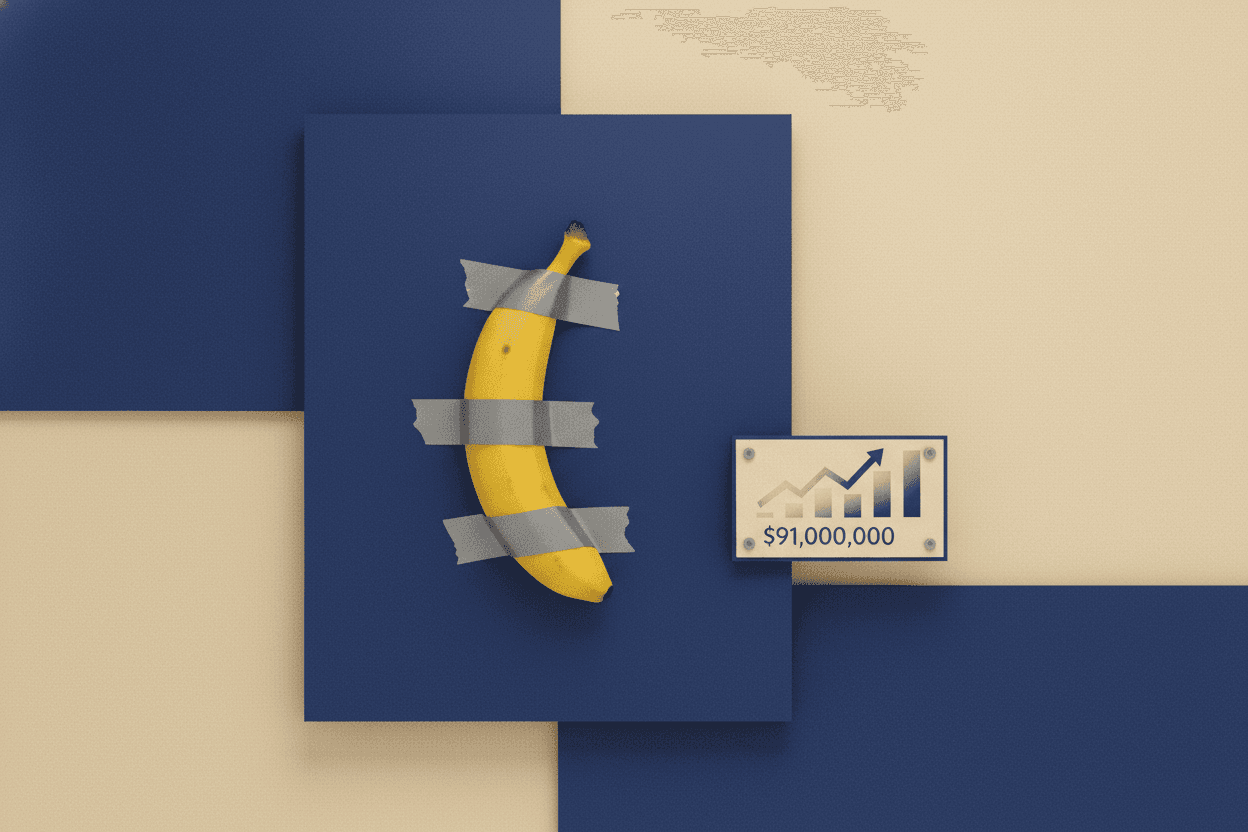
A banana duct-taped to a wall sold for $6.2 million. The buyer wasn't stupid—they understood the real product wasn't the fruit, but the story.
Hyle Editorial·
A banana duct-taped to a wall sold for $6.2 million. The buyer wasn't stupid. You just don't understand the real product. In December 2024, cryptocurrency entrepreneur Justin Sun paid more for Maurizio Cattelan's "Comedian" than most people will earn in their entire lives—for a piece of fruit that rots within weeks.
But here's what makes this even more absurd: this wasn't even the original banana. The $6.2 million purchase included instructions on how to replace the banana when it spoils. The artwork is essentially a certificate granting permission to tape fruit to walls and call it art. So what exactly did Sun buy?
The answer reveals something uncomfortable about the contemporary art market: the artwork itself has become almost irrelevant to its price tag.
The Trinity of Price Inflation
When Sotheby's announced that "Comedian" would hit the auction block with an estimate of $1-1.5 million, industry insiders weren't shocked when it soared to $6.2 million. They understood the mechanics.
[!INSIGHT] The contemporary art market operates as a closed loop where galleries, auction houses, and collectors mutually benefit from ever-rising prices. When a major collector pays a record price, it increases the value of every similar work they own.
This three-party collusion works through strategic signaling. A gallery sells an artist's work to select collectors at controlled prices. Those collectors later consign pieces to auction houses, which generate publicity through headline-grabbing sales. The cycle reinforces itself: high auction prices justify higher gallery prices for new works.
Consider the 2019 sale of Jeff Koons' "Rabbit" for $91 million. The stainless steel sculpture had been aggressively promoted by its seller, Christie's, and purchased by a collector who owned multiple Koons pieces. The record price didn't reflect some objective measure of artistic merit—it reflected a coordinated effort to establish a new price floor.
The Tax Write-Off Game
Perhaps the most sophisticated aspect of art pricing involves tax optimization strategies available only to the ultra-wealthy.
“"The art market is the largest unregulated market in the world. It makes cryptocurrency look like a municipal bond market.”
— Former IRS Art Advisory Panel member
When a collector donates artwork to a museum, they can claim a tax deduction based on the work's "fair market value"—a determination often made by appraisers who work with the same galleries and auction houses that inflated the price in the first place. A painting purchased for $50,000 and "valued" at $5 million generates a substantial tax benefit.
In 2022, the IRS reported that charitable deductions for art exceeded $1.2 billion. The agency's Art Advisory Panel rejected only 4% of valuations presented to them, suggesting either remarkable appraiser accuracy or systemic inflation.
Money Laundering's Favorite Canvas
The anonymity of art transactions makes them ideal for moving illicit funds. Unlike bank transfers, art sales don't trigger automatic reporting to financial authorities in most jurisdictions.
Here's how it works: An entity purchases artwork through a shell company, pays in cash or wire transfer, and stores the piece in a Geneva freeport—a warehouse where goods can sit indefinitely without customs inspection or taxation. Years later, the piece reappears at auction, sold to another buyer. The original illicit funds emerge as legitimate auction proceeds.
A 2020 Senate subcommittee investigation found that major auction houses had accepted payments from sanctioned individuals and entities with minimal due diligence. One documented case involved a $4.8 million Basquiat purchase traced to a Brazilian money launderer.
[!NOTE] Following increased regulatory pressure, Christie's and Sotheby's implemented enhanced anti-money-laundering protocols in 2022. However, private gallery sales and freeport storage remain largely unregulated, creating ongoing vulnerabilities.
The banana, by contrast, cannot be stored in a freeport. Its ephemerality is precisely the point—"Comedian" mocks the entire system by presenting something literally worthless as something financially significant.
Status Signaling at Scale
Beyond financial engineering, astronomical art prices serve a social function. In a world where luxury goods have become democratized—a Tesla in every driveway, a designer bag on every arm—the ultra-wealthy need new ways to signal status.
Paying $6.2 million for a banana announces something no Lamborghini can: "I have so much money that I can burn it on absurdity." It's competitive altruism's dark twin—competitive wastefulness.
Thorstein Veblen identified this dynamic in 1899, coining "conspicuous consumption" to describe purchases made specifically to display wealth. The contemporary art market has refined this into an investment vehicle. Your banana doesn't just signal wealth—it potentially appreciates.
The Authentication Premium
The certificate that accompanies "Comedian" represents what economists call an authentication premium. The banana itself costs 30 cents. The duct tape runs about $5. The certificate? Millions.
[!INSIGHT] In contemporary art, value resides not in the physical object but in its verified provenance and institutional validation. The same banana without Cattelan's certificate is garbage; with it, it's culture.
This explains why art forgery remains such serious business. A perfect copy of a Rembrandt is worthless without authentication. The entire art market rests on faith in a certification chain maintained by institutions with strong incentives to maintain price levels.
The Complete Decoupling
The "Comedian" saga illustrates the final decoupling of artistic value from artistic price. No one seriously argues that Cattelan's conceptual piece advances aesthetic theory or demonstrates technical mastery. Its artistic merit is irrelevant to its market performance.
What the $6.2 million purchased was:
Attention — worldwide media coverage worth far more in publicity
Social positioning — instant credibility within certain circles
Financial optionality — an asset that may appreciate
Self-aware absurdity — participation in an elaborate joke
When Justin Sun ate the banana at a press conference, he completed the performance. The artwork's consumption became part of the artwork. Whether this adds or subtracts value remains deliberately, deliciously unclear.
Key Takeaway
The contemporary art market has evolved into a financial instrument where aesthetic merit is optional and price is determined by a self-reinforcing network of galleries, auction houses, and collectors. The $6.2 million banana isn't a bubble—it's a mirror reflecting how wealth, status, and tax policy have transformed culture into commerce. The real product isn't art; it's access to a system designed to preserve and multiply concentrated wealth.
Sources: Art Basel & UBS Global Art Market Report 2024; IRS Art Advisory Panel Annual Report 2022; U.S. Senate Subcommittee on Investigations, "The Art Industry and U.S. Policies that Undermine Sanctions" (2020); Sotheby's auction records; Thompson, Don, "The $12 Million Stuffed Shark" (2012); Interviews with gallery directors and auction specialists conducted 2022-2024.
This is a Premium Article
Hylē Media members get unlimited access to all premium content. Sign up free — no credit card required.