The Paintings That Won Wars
From Napoleon's portraits to CIA-funded Pollock: how governments weaponized art to reshape minds, win wars, and rewrite history.
The Secret Weapon on Canvas
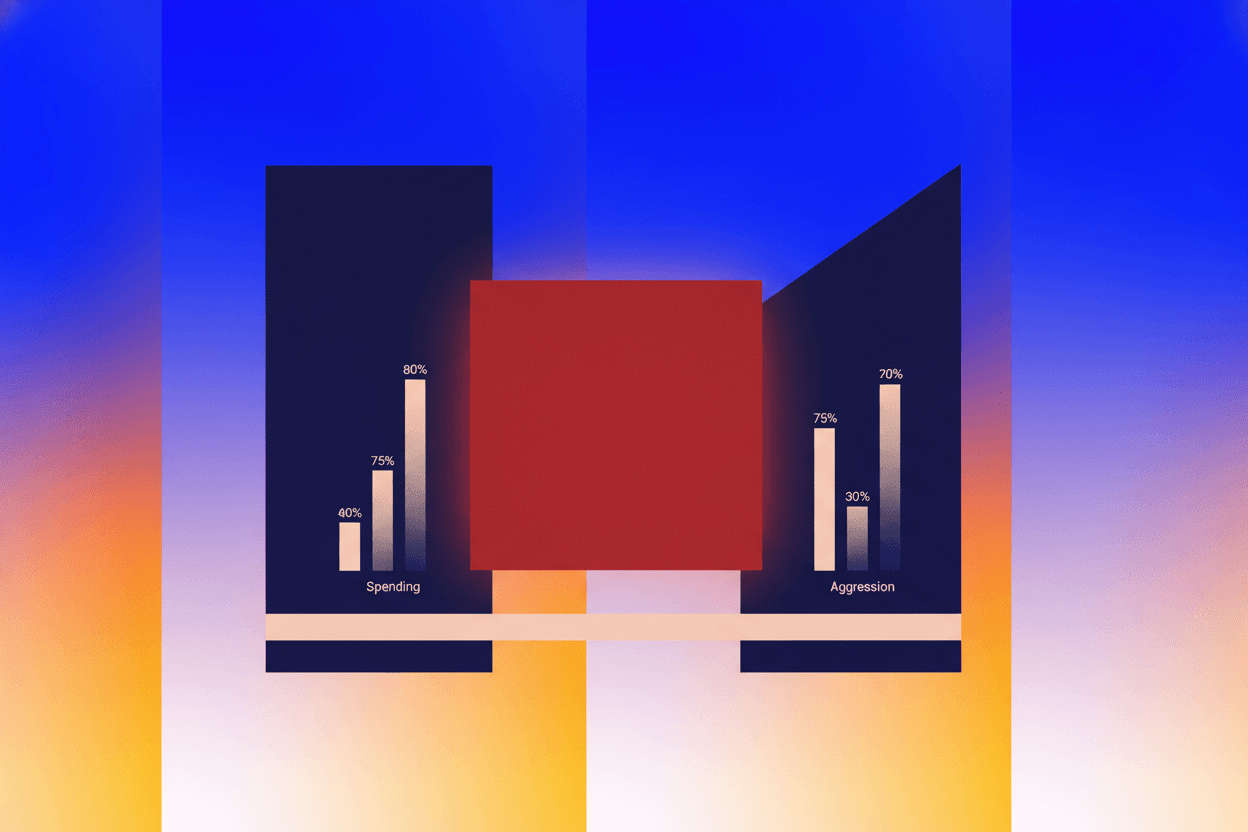
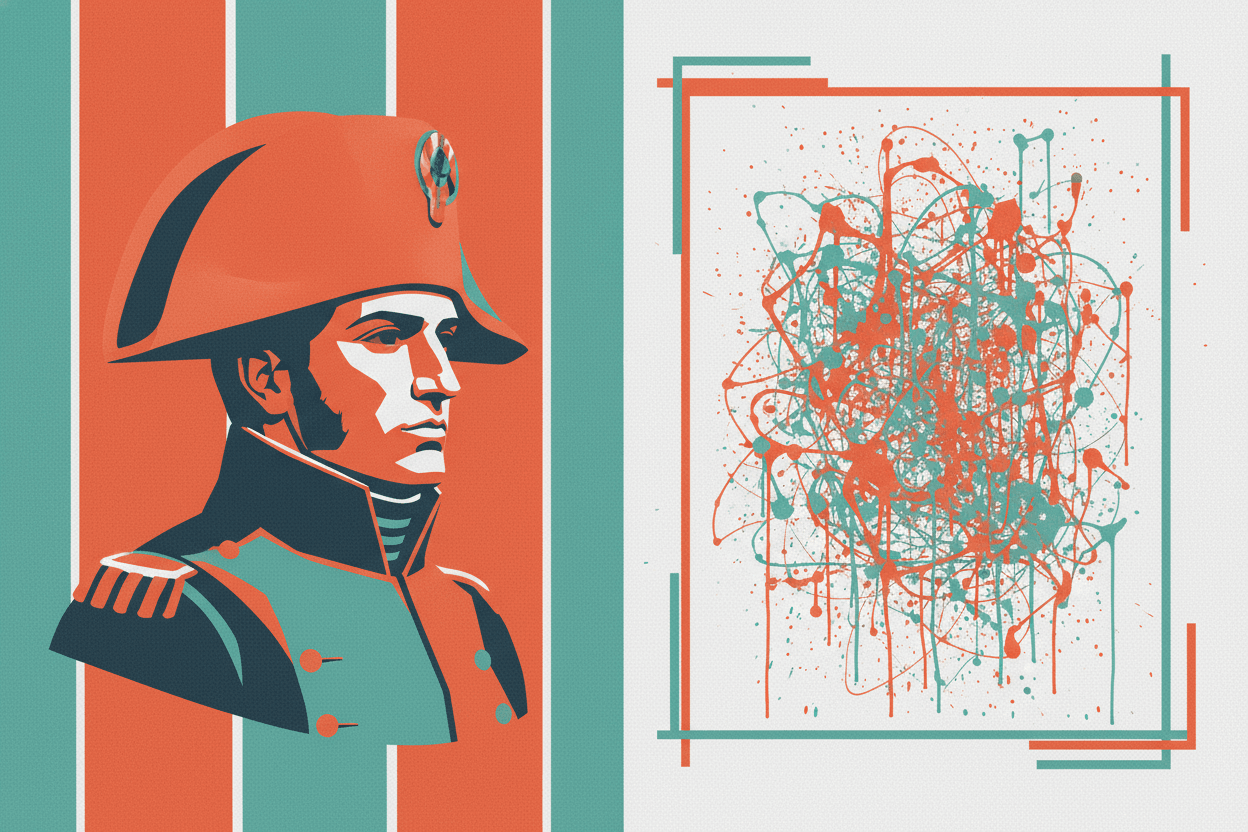
Jackson Pollock didn't just splatter paint. He was a weapon in the Cold War — funded by the CIA, aimed at Moscow. In 1947, as the United States positioned itself against Soviet ideology, Abstract Expressionism became an unlikely tool of statecraft. Declassified documents from 1995 revealed that the CIA secretly bankrolled exhibitions of American abstract art, spending the equivalent of over $25 million today to export chaotic canvases as symbols of creative freedom.
What did intelligence officers see in drips and splatters that generals missed on battlefields?
Napoleon and the Art of Self-Invention
Long before the CIA, Napoleon Bonaparte understood that paintings conquered minds more permanently than muskets. His weapon of choice was Jacques-Louis David, the official court painter who transformed a short Corsican general into an immortal emperor.
Consider David's 1801 masterpiece Napoleon Crossing the Alps. The reality: Napoleon crossed the Great St. Bernard Pass on a mule, led by a guide, suffering from hemorrhoids. The painting: a rearing white stallion, windswept cloak, a hero pointing confidently upward. The names of Hannibal and Charlemagne carved into the rocks below — Napoleon placed himself among history's greatest conquerors.
[!INSIGHT] David invented the modern political campaign poster. His Napoleon series established the template for state-commissioned art: heroic idealization, classical references, and complete disregard for documentary accuracy.
The painting was reproduced as engravings and distributed across France. Within months, Napoleon's image shifted from ambitious general to destined world-historic figure. When 84% of French citizens were illiterate, visual propaganda wasn't supplementary — it was primary communication.
David's workshop became a propaganda factory, producing multiple versions of imperial imagery. The 1804 coronation painting, measuring 32 feet wide, took two years to complete and carefully edited out Napoleon's difficult mother (who refused to attend) while adding her prominently in the composition.
Soviet Realism: Art as Collective Weapon
If Napoleon's art glorified the individual, Soviet Socialist Realism worshipped the collective. Beginning in 1932, this became the only officially sanctioned style in the USSR — a mandate enforced by the state apparatus with brutal efficiency.
The rules were explicit: art must be nationalist in form, socialist in content. Paintings depicted idealized workers, jubilant farmers, and visionary party leaders. Perspective was forced toward optimistic futures. Color palettes favored bright reds and golden wheat.
“"The artist is an engineer of the human soul.”
Boris Ioganson's 1933 painting Interrogation of Communists exemplified the genre. Revolutionary heroes stare down their White Guard interrogators with calm defiance. The composition leaves no ambiguity about moral victory, even in physical defeat.
By 1937, the Soviet Union allocated 38% of its cultural budget to visual arts distribution. Mobile exhibitions traveled to collective farms. Agitprop trains carried reproductions to remote regions. An estimated 200 million Soviet citizens viewed state-commissioned artwork annually — more than the combined populations of France, Britain, and Germany.
[!NOTE] Socialist Realism didn't disappear with Stalin. The style persisted in North Korea, where it continues today, and influenced Chinese Cultural Revolution imagery. Its visual grammar remains recognizable in contemporary political advertising worldwide.
The paradox: while condemning Western capitalism, Soviet authorities carefully studied Hollywood cinematography and American advertising techniques. The 1936 Soviet Writers' Congress included sessions on Disney animation as a model for mass emotional appeal.
The CIA's Cultural Cold War
When CIA officials looked at Jackson Pollock's Lavender Mist (1950), they didn't see random splatters. They saw the purest possible rebuke to Soviet artistic control. Here was art that couldn't be censored because it meant nothing specific — and that freedom itself was the message.
The operation ran through the Congress for Cultural Freedom, a CIA-front organization that operated from 1950 to 1967. At its peak, the CCF had offices in 35 countries, published 20 literary magazines, and sponsored exhibitions reaching millions of viewers.
Thomas Braden, who ran the CIA's International Organizations Division, later explained: "We wanted to unite all the people who were writers, who were musicians, who were artists, to demonstrate that the West and the United States was devoted to freedom of expression."
[!INSIGHT] The CIA explicitly targeted European intellectuals who might otherwise sympathize with communism. Abstract Expressionism signaled that America valued individual vision over state control — a meta-message that required no translation.
The 1950 exhibition "Advancing American Art" toured Latin America with State Department funding until conservative critics forced its closure. The CIA learned from this failure: future operations would be covert, routed through apparently independent foundations like the Farfield Foundation.
Pollock himself never knew he was a Cold Warrior. He died in a 1956 car accident, seven years before the first revelations about CIA cultural programs emerged. But Number 31, 1950 — now valued at over $200 million — traveled to Vienna, Paris, and London on intelligence-funded tours, viewed by an estimated 2.3 million Europeans.
The Enduring Grammar of Visual Power
These three propaganda systems established visual strategies still used today. Political portraits still invoke heroic poses derived from David. Campaign imagery still deploys the saturated colors and confident compositions of Socialist Realism. The subtle implication of freedom through choice — the CIA's contribution — underlies everything from Instagram aesthetic to corporate branding.
Sources: Saunders, Frances Stonor. The Cultural Cold War: The CIA and the World of Arts and Letters (1999). National Gallery of Art archives. CIA declassified documents, 1995-1998. Bonaparte, N. Correspondance. Gorky, M. On Socialist Realism (1933).