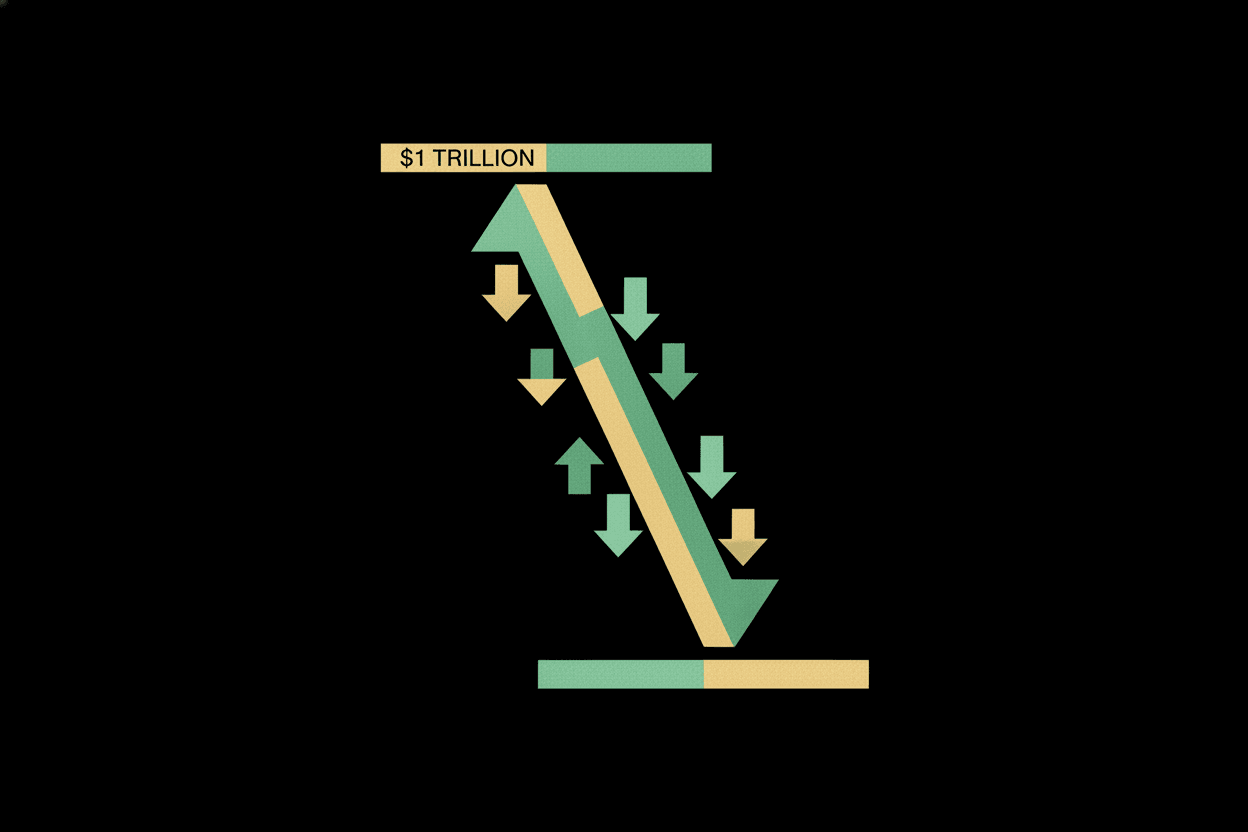
The Race Is Already Over
Over 70% of stock trades are executed by algorithms. By the time you click 'buy,' AI has already traded thousands of times. The question isn't who wins—it's whether

The Race Is Already Over
The moment you decide to buy a stock, an algorithm has already bought it, profited from your decision, and sold it back to you — all in the time it took you to click. This is not hyperbole. In 2024, algorithmic trading accounts for over 70% of all equity trades in U.S. markets, and high-frequency trading firms execute complete buy-sell cycles in approximately 10 microseconds. To put that in perspective: in the time it takes your brain to register the intention to click a button, an AI has already completed roughly 10,000 trades.
The Invisible Architecture of Modern Markets
The stock market that most retail investors imagine they are participating in no longer exists. The trading floors of the New York Stock Exchange, with their iconic shouting brokers and paper slips, have become little more than museum pieces — maintained for ceremonial purposes and television backdrops. The real market operates in server farms in New Jersey and Chicago, connected by fiber optic cables so precisely calibrated that companies have spent hundreds of millions of dollars shaving nanoseconds off transmission times.
Consider the infrastructure of Jump Trading, one of the most secretive HFT firms. In 2024, they completed a $70 million custom microwave tower network between Chicago and New York, creating a communication pathway that beats fiber optics by approximately 4 milliseconds. Four milliseconds — a gap imperceptible to humans — generates hundreds of millions in annual profits by allowing algorithms to see price movements before competitors using traditional infrastructure.
[!INSIGHT] The physical infrastructure of modern trading has created a tiered market where speed determines profitability. Firms at the fastest tier extract value from every slower participant, including institutional investors managing pension funds and retirement accounts.
This arms race has produced a market structure fundamentally incompatible with human participation at the trading level. When Citadel Securities processes approximately 25% of all U.S. equity volume, executing millions of trades per second across their algorithmic systems, the concept of competing against them becomes mathematically absurd.
The Microsecond Economy
The unit of time that matters in modern markets is no longer seconds or even milliseconds — it's microseconds and nanoseconds. A 2023 study by the SEC found that HFT firms were able to detect and respond to order book changes in 2-5 microseconds, while the fastest human day traders using professional tools required a minimum of 200-300 milliseconds to execute a comparable trade. That's a difference of four to five orders of magnitude.
“"We're not competing with humans anymore. We're competing with physics. The question isn't whether we're faster than a human”
This speed differential creates a phenomenon known as "latency arbitrage." When a large institutional order is placed — say, a pension fund buying 100,000 shares of Apple — HFT algorithms detect this order flow in microseconds, buy up available shares at slightly lower prices across multiple exchanges, and then sell them back at slightly higher prices before the institutional order can be fully executed. The institution pays a fraction of a cent more per share, but multiplied across millions of shares daily, this adds up to billions of dollars annually transferred from investors to HFT firms.
Why Competition Is Impossible
The conventional wisdom among retail traders is that skill, research, and discipline can still outperform algorithms. This belief fuels a massive industry: trading courses, newsletters, technical analysis software, and platforms like Robinhood that gamify participation. But the mathematics of this competition reveals a fundamental asymmetry.
Consider information processing. A human trader might monitor 5-10 stocks simultaneously, tracking price movements, reading news, and analyzing charts. Citadel's systems process information on over 10,000 securities simultaneously, analyzing not just price data but options flows, dark pool activity, satellite imagery of retail parking lots, credit card transaction data, and natural language processing of millions of social media posts. In 2023, Citadel reported processing approximately 1.3 petabytes of market data daily — roughly equivalent to the entire Netflix catalog, analyzed every single trading day.
[!INSIGHT] The information asymmetry between algorithmic and human traders has become so extreme that even professional fund managers increasingly rely on AI-generated signals rather than traditional analysis. The only remaining human edge is in long-term strategic judgment — precisely the skill that daily trading ignores.
The Order Flow Problem
Every retail trade follows a predictable path. You click "buy" on your brokerage app. That order is routed not to an exchange, but first to a market maker — companies like Citadel Securities or Virtu Financial. They have a contract with your broker to "provide liquidity," meaning they see your order before it reaches any public exchange.
In 2024, this payment for order flow system meant that approximately 47% of all retail trades never reached a public exchange. Instead, they were internalized — executed by the market maker who took the opposite side of the trade. The market maker knows your order is coming, knows the current price across all exchanges, and can choose exactly when and how to fill your order.
A 2023 study published in the Review of Financial Studies found that this order flow prediction allows market makers to front-run retail orders with 89% accuracy on directional trades. When retail investors buy, market makers buy slightly before, pushing the price up. When retail investors sell, market makers sell slightly before, pushing the price down. The retail investor always arrives at the party after the price has already moved against them.
“"The retail trader's experience is analogous to sitting at a poker table where one player can see everyone's hole cards, gets to act last on every hand, and can change their bet after seeing what others do. The game isn't rigged in the sense that you can't win any hands”
The Structural Implications
If competition at the trading level is impossible, what does this mean for ordinary investors and the broader market function?
The first implication concerns market efficiency. Paradoxically, algorithmic trading has made markets both more and less efficient. Prices incorporate information faster than ever — literally in microseconds. But this efficiency has come at the cost of periodic catastrophic failures. The 2010 Flash Crash saw the Dow Jones drop 1,000 points in 36 minutes, with some stocks trading for pennies before recovering. Similar flash events now occur regularly, invisible to retail investors who only see end-of-day prices.
“[!NOTE] Between 2020 and 2024, the SEC documented over 1,200 "mini flash crashes”
The second implication involves wealth transfer. A 2023 analysis by the brokerage research firm Coalition Greenwich estimated that algorithmic trading extracts between $10-15 billion annually from traditional market participants through various forms of latency arbitrage, order flow prediction, and spread capture. This represents a direct transfer from pension funds, mutual funds, and retail investors to a small number of technology companies.
The third implication concerns market fragility. As algorithms have become the dominant market participants, correlations between assets have increased dramatically. In stressed market conditions, algorithms tend to behave similarly — all selling simultaneously when certain thresholds are breached. The March 2020 COVID crash saw correlations between individual stocks approach 1.0, meaning diversification provided almost no protection precisely when it was most needed.
Conclusion: Accepting Reality
The evidence is unambiguous: the race between human and AI traders ended years ago, and algorithms won decisively. This does not mean individual investors cannot achieve positive returns — long-term investing in diversified portfolios remains a rational strategy. But it does mean that active trading, day trading, and technical analysis are engaged in a competition that is structurally impossible to win.
The first step to successful investing in the algorithmic era is accepting that you cannot beat machines at their own game. The second step is recognizing that you don't have to — by changing the game to one played over years rather than microseconds, humans can still win.
Sources: SEC Market Structure Data (2023-2024), Review of Financial Studies Vol. 36, Coalition Greenwich Institutional Trading Reports, CFTC Technology Advisory Committee Findings, Interview data compiled from industry publications (2023-2024)