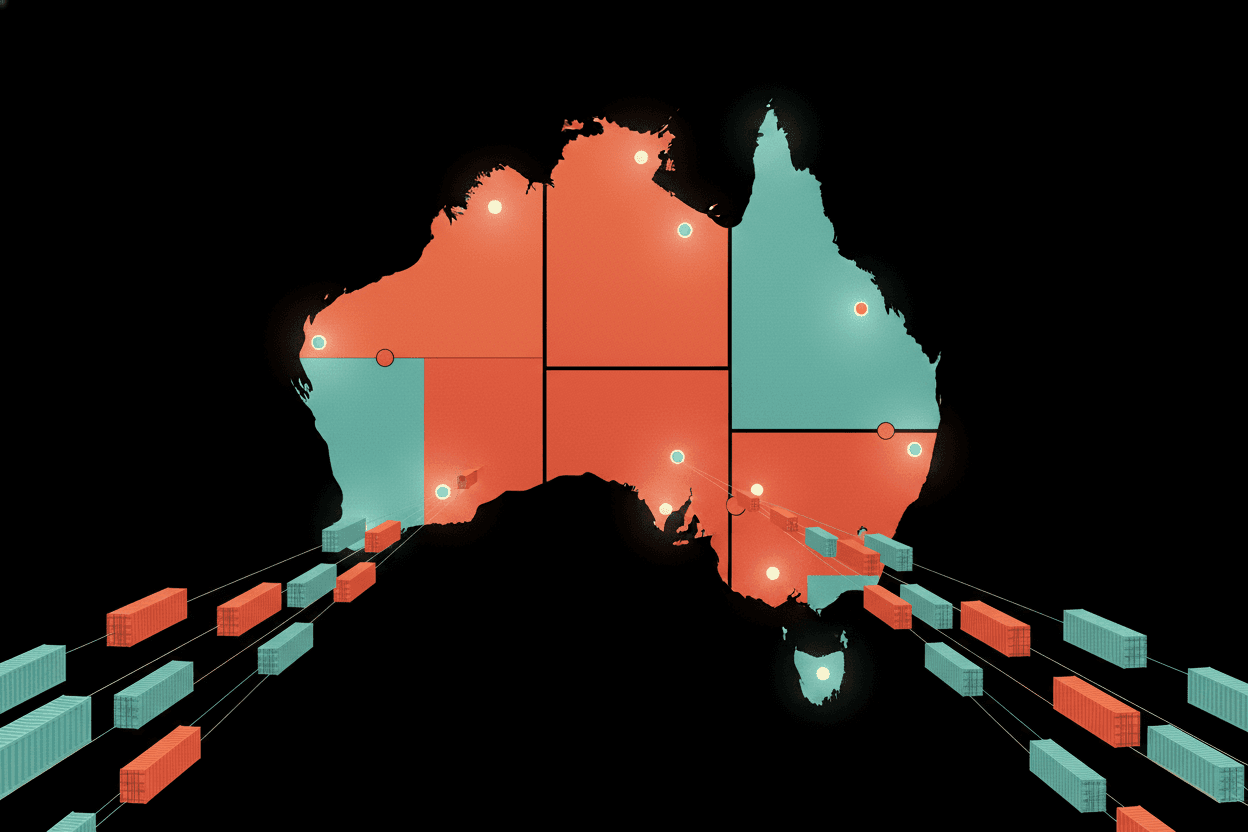
Australia produces 47% of the world's lithium but refines almost none of it. As China dominates processing, can Australia break free without breaking its economy?
Hyle Editorial·
Australia digs up more lithium than anyone on Earth. Then it ships almost all of it to China to be processed. That's not globalization — that's dependency.
In 2023, Australia produced approximately 47% of the world's lithium supply, extracting roughly 86,000 metric tons from the red soils of Western Australia. Yet when the Australian government released its Critical Minerals Strategy that same year, it admitted a startling fact: the country refines less than 1% of its lithium domestically. The ore travels 5,000 kilometers to Chinese refineries in Jiangxi and Sichuan, returning months later as battery-grade lithium hydroxide at ten times the price. This is the raw material trap — owning the resource but not the value chain.
The Pilbara region in Western Australia holds some of the richest hard-rock lithium deposits on the planet. The Greenbushes mine, operated by Talison Lithium, has been called the world's largest and highest-grade lithium mine, with reserves estimated at 178 million tonnes. When China's Tianqi Lithium acquired a 51% stake in Talison in 2014 for $700 million, industry observers called it a steal. They were right.
[!INSIGHT] China's strategy wasn't to own the mines — it was to own the processing technology and capacity. By 2023, Chinese companies controlled 65% of global lithium processing, regardless of where the ore came from.
The numbers reveal a striking asymmetry. Australia exported $18.8 billion worth of lithium spodumene concentrate in 2022-23. But the value of processed lithium compounds that Australia imported for its modest battery industry? That reached $2.3 billion — paying premiums to Chinese refiners for material that originated in Australian soil.
This isn't merely an economic inefficiency. It's a strategic vulnerability that became terrifyingly apparent in late 2022, when lithium prices spiked to $85,000 per tonne, only to crash to $15,000 by early 2024. Australian miners watched their margins evaporate while Chinese refiners, who control the choke point between ore and battery, maintained healthier profits through market timing and vertical integration.
The Resource Nationalism Dilemma
In 2023, the Albanese government announced the "Future Made in Australia" policy, pledging billions in subsidies and tax incentives to build domestic processing capacity. The rhetoric was sharp: Australia would no longer be "just a quarry" for other nations' industrial ambitions.
“"We cannot continue to be a country that just digs things up and ships them offshore. The jobs of the future are in processing, manufacturing, and recycling.”
— Prime Minister Anthony Albanese, 2024
But resource nationalism faces a brutal arithmetic. Building a lithium hydroxide processing plant requires $500 million to $1 billion in capital expenditure. The Kwinana refinery outside Perth, majority-owned by Tianqi, cost over $700 million and took four years to reach commercial production. It currently operates at roughly 50% capacity, struggling against Chinese competitors who benefit from massive scale and integrated supply chains.
The dilemma deepens when considering market dynamics. China processes lithium not just from Australia, but from Chile, Argentina, and Zimbabwe. Chinese refiners can shift feedstock sources based on price, quality, and geopolitical considerations. Australia, building standalone refineries, faces higher per-unit costs and uncertain offtake agreements.
[!NOTE] Western Australia's five operating lithium mines are owned by a mix of Australian, American, Chinese, and Chilean interests. Talison is 51% Tianqi (China) and 49% Albemarle (USA). Pilbara Minerals is Australian. Mineral Resources is Australian. Forcing domestic processing would require either massive subsidies or legally mandating offtake — both politically and economically fraught.
Washington's Shadow
The Inflation Reduction Act changed everything for Australian lithium. Under the IRA's critical minerals provisions, electric vehicles qualify for $7,500 tax credits only if their battery materials come from U.S. free trade agreement partners or are processed in North America. Australia has an FTA with the United States. China does not.
Suddenly, Australian lithium has a potential escape route from Chinese processing dependency. Companies like Albemarle and Lithium Americas are exploring refining partnerships in Australia that would qualify material for the U.S. market. The AUKUS security pact, initially focused on nuclear submarines, has expanded to include critical minerals cooperation.
But this creates a new form of dependency. Instead of shipping raw ore to China for processing, Australia might end up shipping processed lithium to the United States for battery manufacturing. The value captured remains minimal — perhaps 15-20% more than raw ore, but still far from the 70-80% margin captured by companies that produce finished battery cells.
[!INSIGHT] The uncomfortable truth is that midstream processing — refining lithium ore into battery-grade compounds — is the least profitable segment of the battery value chain. The real money lies upstream in mining (when prices are high) and downstream in cell manufacturing and recycling.
The Albemarle Bet
In 2024, Albemarle, the world's largest lithium producer, made a calculated decision. Despite receiving a $90 million grant from the Australian government to expand its Kemerton refinery, the U.S.-based company announced it would pause construction and delay production ramp-up. The official reason: weak lithium prices.
The subtext was clearer. Without guaranteed offtake agreements — binding contracts from battery manufacturers to purchase refined lithium — building processing capacity in Australia remained financially risky. Chinese refiners had those agreements because Chinese battery makers (CATL, BYD, CALB) dominated global production. Australian refineries had no natural customer base.
This exposed the circular trap of the resource curse. To build processing capacity, Australia needed battery manufacturers. To attract battery manufacturers, Australia needed cheap, reliable refined lithium. To produce cheap refined lithium, Australia needed processing scale. The chicken and egg problem that China solved through state-directed industrial policy over fifteen years could not be undone through market mechanisms alone.
Implications: The Sovereignty Calculation
Australia's lithium strategy now sits at a crossroads with implications far beyond its borders. The EU's Critical Raw Materials Act, the U.S. Defense Production Act Title III program, and Japan's resource security initiatives all assume that allied nations will develop processing capacity. Australia is the designated lithium supplier for the non-China world.
But developing that capacity requires choices that markets alone won't make. The estimated $25-30 billion needed to build comprehensive midstream processing for Australia's lithium output exceeds the market capitalization of most mining companies operating in the country. Only sovereign wealth funds, state-backed enterprises, or coordinated Western government action can marshal such capital.
The alternative — accepting Chinese processing dominance while maintaining mining sovereignty — isn't surrender. It's an acknowledgment that different stages of the value chain favor different geographies. China has cheap energy, established infrastructure, and massive domestic demand. Australia has geology and stable governance.
[!NOTE] Chile's nationalization of lithium in 2023, which gave the state majority control over all new lithium projects, offers an alternative model. But Chile's SQM already had processing technology and partnerships. Australia's miners are primarily extraction companies without downstream expertise.
The Hard Truth
Australia can build refineries. It cannot easily build the entire ecosystem — chemical engineering expertise, equipment manufacturing, logistics networks, and customer relationships — that makes Chinese processing competitive. The "quiet coup" mentioned in this episode's title refers not to external conquest but to Australia's gradual awakening: owning the resource means nothing without the capability to transform it.
The next five years will reveal whether Australia chooses strategic autonomy at significant cost or accepts a profitable but dependent role in a China-dominated processing landscape. Neither path offers both maximum profit and maximum sovereignty. The resource nationalist dream crashes against the hard reality of comparative advantage.
Key Takeaway: Australia's lithium dilemma exemplifies the broader Western challenge in critical minerals: geological abundance cannot substitute for industrial capacity. Without coordinated government policy, patient capital, and guaranteed offtake agreements, the gap between digging up lithium and processing it will remain a strategic vulnerability that no amount of mining revenue can fill.
Sources: Australian Department of Industry, Science and Resources Critical Minerals Strategy 2023-2030; U.S. Geological Survey Mineral Commodity Summaries 2024; International Energy Agency Global Critical Minerals Outlook 2024; Company filings from Albemarle, Pilbara Minerals, and Mineral Resources; Australian Bureau of Statistics trade data; Benchmark Mineral Intelligence quarterly reports.
This is a Premium Article
Hylē Media members get unlimited access to all premium content. Sign up free — no credit card required.