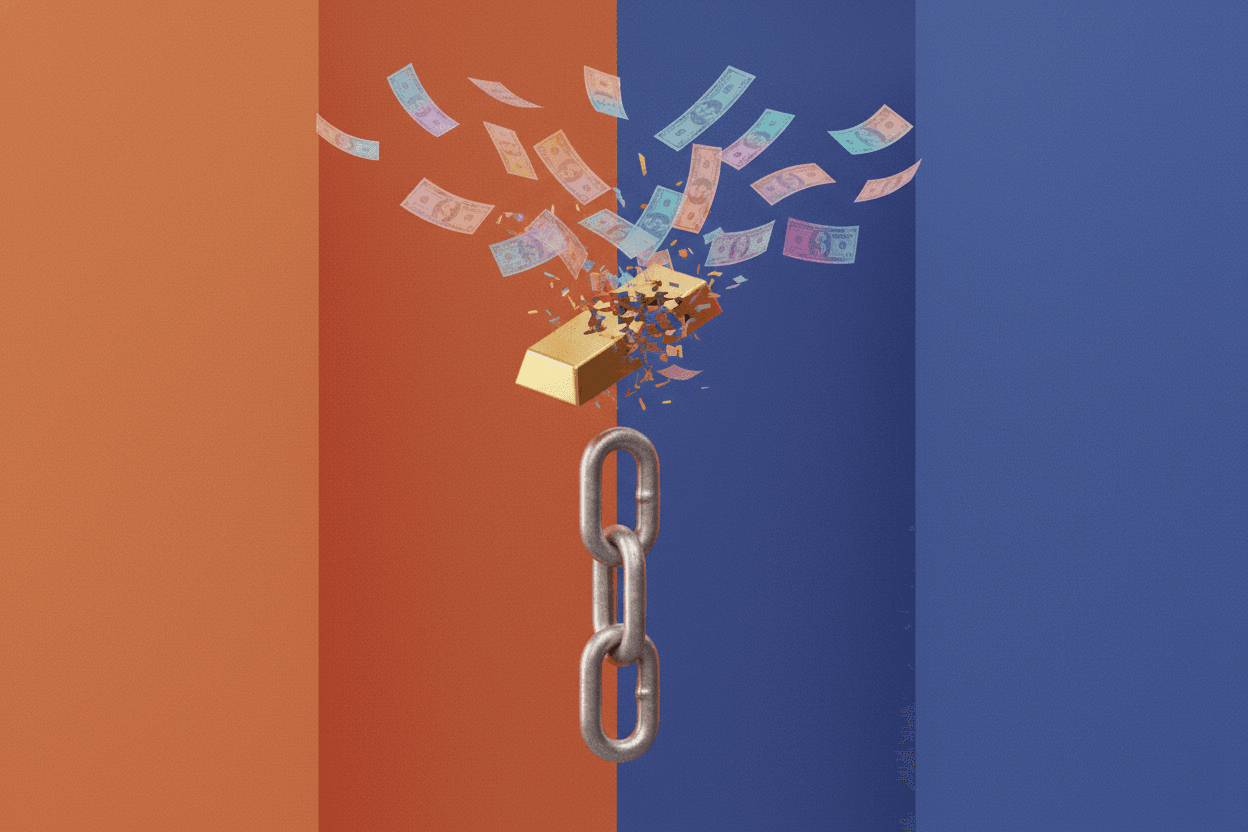
Sanctions have become the West's weapon of choice—but Edward Fishman reveals why this power is fragile, finite, and backfiring faster than anyone predicted.
Hyle Editorial·
Why Chokepoints by Edward Fishman will change how you think about modern conflict. In 2024, the United States and its allies controlled approximately 95% of the world's financial messaging infrastructure—but that dominance is eroding faster than most policymakers realize. Russia's invasion of Ukraine triggered the largest sanctions campaign in history, freezing over $300 billion in central bank assets. Yet two years later, Russia's economy hadn't collapsed. It pivoted. This isn't just about Russia. It's about a fundamental truth that Fishman makes unavoidably clear: the economic weapon the West has wielded with such confidence is far more fragile than anyone admitted.
What makes a chokepoint? It's not merely size or market share—it's irreplaceability. The Strait of Hormuz, where 20% of global oil consumption flows through a channel just 21 nautical miles wide at its narrowest point, is a geographic chokepoint. But SWIFT, the Belgian cooperative that processes cross-border payment instructions for 11,000 institutions worldwide, is an infrastructural chokepoint. The dollar's role in global trade—accounting for 58% of all foreign exchange reserves—is a monetary chokepoint. Fishman's brilliance lies in mapping these pressure points across the global economy and exposing a uncomfortable reality: chokepoints that once consolidated Western power are now becoming liabilities.
Fishman, who served on the State Department's Policy Planning Staff during the Crimea annexation in 2014, brings an insider's granularity to what he terms "economic statecraft." The book's central thesis is that sanctions work—but only when three conditions align: coalition unity, target vulnerability, and credible commitment to enforcement.
[!INSIGHT] The effectiveness of sanctions has less to do with economic magnitude and more to do with the target's ability to find alternatives. A sanction that blocks 40% of trade with one partner fails if the target can redirect that trade elsewhere within 18 months.
The Russia sanctions exposed what Fishman calls the "coalition fragility problem." While the G7 nations maintained remarkable unity, the broader coalition crumbled at the edges. India increased Russian oil imports by 13 times in 2022 compared to 2021. China-Russia trade hit $240 billion in 2023, a 64% increase from the previous year. The sanctions didn't fail—they just failed to be universal.
“"Sanctions are not an alternative to war. They are a form of war”
— economic war—with casualties measured in currency devaluations, medicine shortages, and collapsed pension funds. The question is never whether sanctions hurt. It's whether they hurt enough to change behavior without triggering escalation."
The Dollar Weapon's Expiration Date
Perhaps the most provocative section of Fishman's analysis concerns what he calls "dollar weaponization fatigue." Every time the United States deploys financial sanctions—whether against Iran, Venezuela, or Russia—it sends a signal to other nations: your dollar reserves are not truly yours. The result? A slow but measurable drift toward alternatives.
The numbers are still small but the trajectory is unmistakable. The BRICS bloc—Brazil, Russia, India, China, and South Africa—has expanded to include Egypt, Ethiopia, Iran, Saudi Arabia, and the UAE. In 2024, this expanded bloc accounts for 37% of global GDP at purchasing power parity, compared to the G7's 30%. More significantly, BRICS nations are actively developing non-dollar payment systems. The mBridge project, a cross-border central bank digital currency platform, completed its first real-world transactions in 2024.
Fishman doesn't predict dollar collapse—far from it. But he identifies what statisticians call a "tail risk" that policymakers systematically underestimate: the more you weaponize a chokepoint, the more incentive you create for others to route around it.
The Semiconductor Test Case: Chokepoints in Action
The most detailed case study in Chokepoints concerns the U.S.-led campaign to restrict China's access to advanced semiconductors. This is economic warfare at its most sophisticated—and its most instructive.
In October 2022, the Biden Administration announced export controls that didn't just target specific Chinese companies (as the Trump Administration's Entity List had done) but restricted the sale of any advanced chips to China, regardless of end-user. The logic was elegant: artificial intelligence training runs require massive arrays of GPUs. If China can't buy the chips, it can't compete in AI. QED.
[!NOTE] The controls covered not only chips but also the equipment to make them. The Netherlands' ASML is the only company in the world that produces extreme ultraviolet (EUV) lithography machines—essential for producing chips below the 7-nanometer node. A single machine costs over $150 million and contains over 100,000 components.
But Fishman documents the complications. Within six months of the controls, Chinese firms were accessing restricted chips through cloud providers in Southeast Asia and the Middle East. Huawei, under sanctions since 2019, released the Mate 60 Pro in 2023 with a 7nm chip manufactured by SMIC—China's domestic foundry—defying predictions that such capability was years away. The sanctions slowed China but didn't stop it. They also accelerated China's semiconductor self-sufficiency drive, with government investment exceeding $150 billion.
The lesson isn't that semiconductor sanctions failed—it's that they succeeded partially while generating second-order effects that may prove more consequential than the original problem. Fishman quotes a senior Commerce Department official: "We're playing whack-a-mole on a global scale. Every time we close one channel, three more open up."
The Future of Economic Warfare
Fishman's analysis points toward an uncomfortable strategic reality. The West's chokepoint dominance—geographic, financial, and technological—is a wasting asset. This doesn't mean abandoning sanctions as a tool. It means recognizing their limits and sequencing them more carefully.
[!INSIGHT] The most effective sanctions are those applied gradually with clear off-ramps. Total isolation creates desperation; targeted pressure creates incentives. The Iran nuclear deal (JCPOA) succeeded because it paired unprecedented economic pressure with a credible path to normalization.
The book also highlights emerging chokepoints that Western powers don't control. Rare earth elements—critical for electric vehicles, wind turbines, and defense systems—are 60% processed in China. Cobalt refining is 70% concentrated in a single country. The same interdependence that makes sanctions possible makes the sanctioners vulnerable.
Fishman proposes what he calls "chokepoint resilience theory": nations should map their vulnerabilities with the same rigor they map their weapons. The United States, for instance, imports 100% of its supply of 14 critical minerals from China. That's not a negotiating position—it's a hostage situation.
Implications: The New Geopolitics of Interdependence
The broader significance of Chokepoints extends beyond sanctions policy. Fishman is describing a structural shift in how power operates in a networked global economy. In a world of deeply integrated supply chains and instantaneous capital flows, the capacity to inflict economic harm is widely distributed—but so is vulnerability.
This has profound implications for the technology sector. Every platform, every cloud service, every payment network is now potential infrastructure for economic statecraft. When the U.S. Treasury Department sanctioned Tornado Cash in 2022—a decentralized Ethereum mixing protocol—it signaled that code itself could be designated as a sanctions target. The overlap between cybersecurity policy and sanctions policy is now nearly total.
For business leaders, Fishman's analysis suggests a new category of strategic risk. Geopolitical due diligence can no longer be an afterthought. Companies with supply chains crossing potential fault lines—Taiwan, the South China Sea, the Strait of Hormuz—are operating with latent exposure that traditional risk models don't capture. The CEO who hasn't war-gamed a sanctions scenario involving their primary market or key supplier is flying blind.
Key Takeaway
Economic interdependence created the West's greatest source of leverage—and its greatest vulnerability. Chokepoints documents how sanctions transformed from a niche tool of statecraft into the primary instrument of great power competition, while simultaneously revealing the limits of that power. The nations that thrive in the coming decade will be those that treat economic resilience not as a cost center but as a core strategic capability. The age of assumed dominance is ending. The age of mutual vulnerability has begun.
Sources: Edward Fishman, "Chokepoints: The Politics of Economic Pressure" (2024); International Monetary Fund, Currency Composition of Official Foreign Exchange Reserves (2024); BRICS Summit Joint Declarations (2023-2024); Bureau of Industry and Security, Export Control Framework for Advanced Computing Items; Rhodium Group, China's Semiconductor Self-Sufficiency Tracker; Atlantic Council, Global Energy Sanctions Database.
This is a Premium Article
Hylē Media members get unlimited access to all premium content. Sign up free — no credit card required.