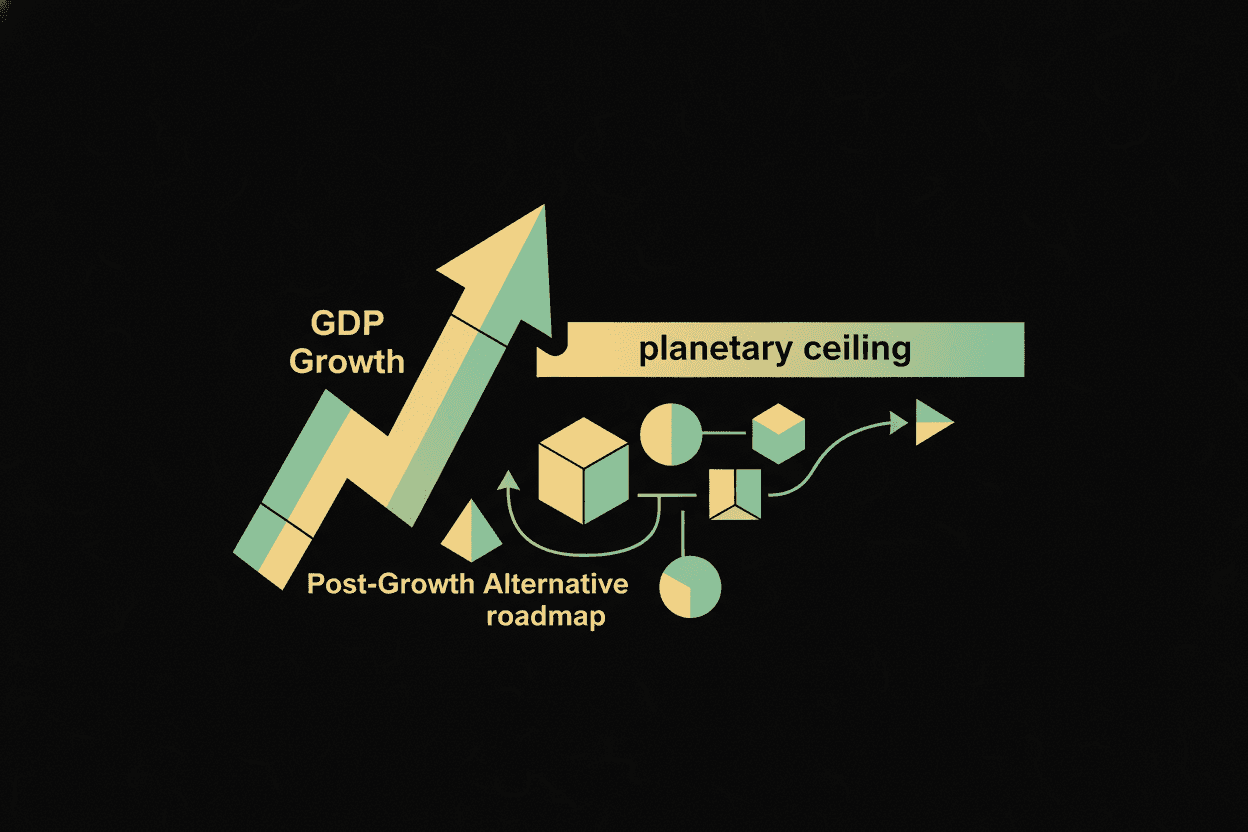
GDP growth cannot continue forever. Daniel Susskind's 'Growth: A Reckoning' explains why we need a new economic compass before it's too late.
Hyle Editorial·
Why Growth: A Reckoning by Daniel Susskind will change how you think about progress. In 2024, global GDP reached approximately $105 trillion—a figure that would have seemed impossible just fifty years ago. But here is the uncomfortable truth that economists have been reluctant to confront: this trajectory cannot continue indefinitely. Susskind's book drops like a depth charge into this willful blindness, arguing that we have been measuring prosperity with a broken compass for nearly a century.
The numbers reveal the strain. Since 1950, global GDP has increased more than twelvefold, while resource extraction has tripled and CO2 emissions have quadrupled. The correlation is not coincidental. What happens when the primary engine of human advancement—the relentless pursuit of economic expansion—collides with the finite boundaries of a planet?
Simon Kuznets, the economist who developed GDP accounting in the 1930s, explicitly warned that his creation should never be used as a comprehensive welfare indicator. "The welfare of a nation can scarcely be inferred from a measurement of national income," he told the U.S. Congress in 1934. We ignored him.
Susskind traces how GDP metastasized from a narrow wartime planning tool into the universal scorecard of national success. The metric captures monetary transactions but systematically excludes:
Unpaid labor: The estimated $16 trillion in global unpaid care work—disproportionately performed by women—registers as economic activity worth exactly zero.
Environmental destruction: A oil spill increases GDP through cleanup costs while a pristine forest contributes nothing.
Digital abundance: Wikipedia destroyed a $60 billion encyclopedia industry while making information free to billions.
[!INSIGHT] The GDP paradox is not that it measures the wrong things, but that we treat it as measuring everything. It was designed to answer "How much can we produce for war?" not "How well are we living?"
Robert Kennedy's 1968 critique remains devastating: GDP "counts napalm and counts nuclear warheads and armored cars for the police to fight the riots in our cities... yet the gross national product does not allow for the health of our children, the quality of their education, or the joy of their play."
The Environmental Accounting Gap
The disconnect becomes existential when confronting climate change. Susskind presents a chilling calculation: if global growth continues at its historical average of 3% annually, the world economy will be ten times larger by 2100. No climate model accommodates this scale of activity without catastrophic warming—regardless of renewable energy deployment.
“"We have an economic system that was designed for a world that no longer exists”
— a planet with empty lands, infinite resources, and a forgiving atmosphere."
The Innovation Trap
The conventional defense of endless growth rests on technological innovation. Decouple economic activity from resource consumption, the argument goes, and expansion can continue sustainably. Susskind calls this "the fantasy of green growth."
The data does not cooperate. A 2023 study in Lancet Planetary Health analyzed 166 countries over three decades and found that while some developed nations achieved relative decoupling (lower emissions per unit of GDP), absolute decoupling—reducing total emissions while growing the economy—remained vanishingly rare. Only a handful of European countries achieved it, and even then, much of their consumption-based emissions were simply offshored to manufacturing nations.
[!NOTE] The term "degrowth" often triggers immediate rejection, but Susskind distinguishes between reactionary anti-technology positions and a reasoned post-growth framework that prioritizes human flourishing over aggregate expansion.
The Jevons Paradox lurks beneath every efficiency breakthrough. When we make energy cheaper through renewables, we use more of it. When we improve agricultural yields, we convert more land to farming. Efficiency gains have historically accelerated rather than constrained resource extraction.
Three Futures, One Choice
Susskind maps three possible trajectories:
Collapse: Growth continues until ecological systems fail, forcing involuntary contraction through disaster.
Contradiction: Growth continues while inequality explodes, as automation displaces workers and concentrates wealth.
Reorientation: We deliberately restructure economic priorities around wellbeing indicators beyond GDP.
The book's central argument is that Option 3 is not merely preferable but necessary—and that it requires abandoning our reflexive association between "more" and "better."
What Comes After Growth?
The most provocative sections explore what a post-growth economy might actually look like. Susskind resists the temptation to offer a simple alternative metric. Instead, he argues for indicator pluralism—tracking multiple measures of societal health rather than collapsing everything into a single number.
Candidate metrics include:
Genuine Progress Indicator (GPI): Adjusts GDP for income distribution, environmental costs, and social factors
Human Development Index (HDI): Combines life expectancy, education, and per capita income
Doughnut Economics framework: Sets a social foundation floor and ecological ceiling
Subjective wellbeing surveys: Self-reported life satisfaction scores
[!INSIGHT] The shift from GDP maximalism to multi-dimensional assessment mirrors the transition from monoculture farming to polyculture. Resilience increases as dependency on a single metric decreases.
The Political Economy Problem
The deepest challenge is not technical but political. Entire institutions—the Federal Reserve, the IMF, electoral cycles—are calibrated to GDP growth. Politicians lose elections during recessions regardless of other indicators. Retirement systems depend on investment returns that assume perpetual expansion.
Susskind acknowledges the difficulty: "Asking a politician to accept slower growth is like asking a fish to accept less water." Yet he identifies signs of shifting consciousness. Younger generations report prioritizing work-life balance, environmental sustainability, and meaning over pure income maximization. The Overton window is moving.
Implications for Business and Technology
For business leaders, Susskind's analysis demands a fundamental reframing of corporate purpose. If aggregate expansion cannot continue, competitive strategy shifts from "grow the pie" to "redistribute the pie" or "bake a different pie entirely."
This manifests in:
Circular economy models that decouple revenue from virgin resource extraction
Platform cooperatives that prioritize member welfare over shareholder returns
B Corporation structures that legally encode multi-stakeholder obligations
Long-term ownership models that resist quarterly growth pressure
The technology sector faces particular scrutiny. The venture capital model assumes exponential returns that become mathematically impossible in a bounded system. The current AI investment frenzy—projected at $200 billion annually by 2025—rests on assumptions about productivity growth that may not materialize in a resource-constrained world.
“"The question is not whether growth will end, but whether we will end it deliberately or have it ended for us.”
— Daniel Susskind
Conclusion
Growth: A Reckoning is not an anti-capitalist manifesto or a prescription for poverty. Susskind is clear that growth has lifted billions from destitution and remains essential for developing nations. His target is the reflexive assumption that more is always better—that the solution to every problem is simply more production, more consumption, more extraction.
The book's power lies in its refusal to offer false comfort. There is no technological deus ex machina waiting in the wings. There is no policy tweak that will allow infinite expansion on a finite planet. The reckoning is not optional; only its timing and character remain uncertain.
Key Takeaway: The age of GDP maximalism is ending—not because we have chosen to end it, but because planetary boundaries are forcing the issue. The governments, companies, and individuals who recognize this first will shape what comes next. Those who cling to the growth-at-all-costs paradigm will find themselves fighting a war against arithmetic itself.
*Sources: Susskind, D. (2024). Growth: A Reckoning. Basic Books. • Kennedy, R. (1968). Remarks at the University of Kansas. • Kuznets, S. (1934). National Income, 1929-1932. U.S. Congress. • Wiedmann, T. & Lenzen, M. (2023). "Environmental and Social Footprints of Nations." Lancet Planetary Health. • World Bank GDP Data (2024)."
This is a Premium Article
Hylē Media members get unlimited access to all premium content. Sign up free — no credit card required.