France Gets 70% of Its Electricity from Nuclear — and Has the Cleanest Grid in Europe
France's 1970s bet on nuclear made it Europe's cleanest grid. Germany did the opposite. The emissions gap between them exposes a brutal energy truth.
The 50-Year Bet That Paid Off
France chose nuclear power in the 1970s as an act of energy independence. Today it has the cleanest electricity grid in Europe. Germany chose the opposite path. You can guess how that went — but the actual numbers are worse than you think.
In 1973, the oil crisis hit France like a sledgehammer. The country depended on imported oil for 80% of its energy. Prime Minister Pierre Messmer announced what would become known as the "Messmer Plan": France would build 80 nuclear reactors in 10 years. Critics called it delusional. Half a century later, France's electricity grid emits just 56 grams of CO2 per kilowatt-hour — less than one-seventh of Germany's 385 grams.
The Numbers Don't Lie
Let's be specific about what France actually achieved, because the scale is staggering.
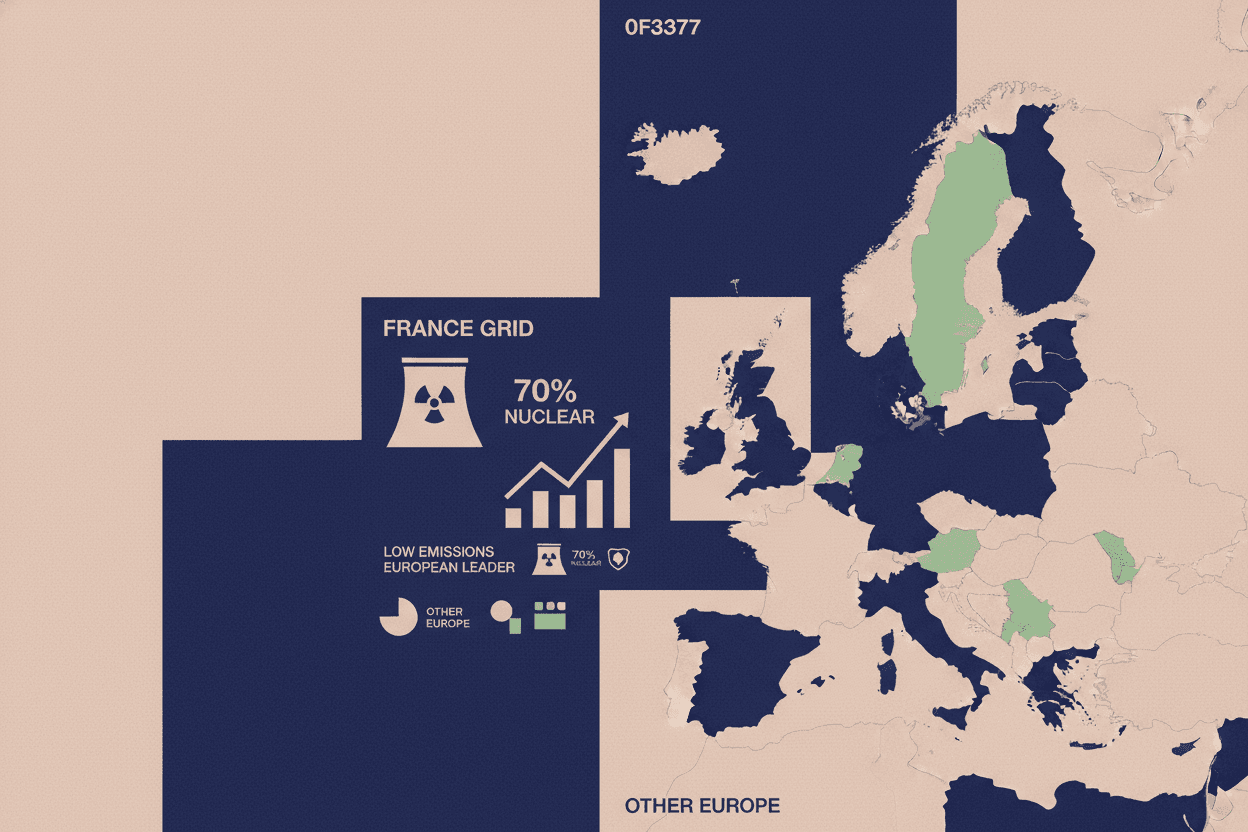
As of 2023, nuclear power provides approximately 70% of France's electricity. Another 15% comes from hydroelectric and wind. Fossil fuels account for barely 7%. The result: France has the lowest carbon intensity of any major European economy's electricity sector — lower than Norway, lower than Sweden, lower than anyone except tiny Iceland with its geothermal abundance.
[!INSIGHT] France's per-capita electricity emissions are roughly one-tenth of the United States' and one-seventh of Germany's — not because French people use less electricity, but because their electricity is dramatically cleaner.
Here's the comparison that matters:
| Country | Nuclear Share | Grid Carbon Intensity (g CO2/kWh) |
|---|---|---|
| France | ~70% | 56 |
| Germany | ~13% | 385 |
| UK | ~14% | 270 |
| Poland | ~0% | 650 |
France didn't stumble into this. It was deliberate industrial policy executed over five decades.
The Messmer Plan: Industrial Policy at Scale
In 1974, France had zero operational commercial nuclear reactors. By 1990, it had 56. The government-owned utility Électricité de France (EDF) standardized on a single reactor design — the Pressurized Water Reactor (PWR) — and built them in assembly-line fashion.
This standardization mattered enormously. Every reactor used the same parts, the same training protocols, the same safety procedures. Engineers could move between plants without retraining. Supply chains achieved economies of scale that fragmented nuclear programs in the United States and United Kingdom never matched.
“*"We chose nuclear because we had no choice. We had no coal, no oil, no gas. We had to import everything. Nuclear was the only path to energy independence.”
The total cost, adjusted for inflation, was approximately €300 billion over 30 years. Expensive? Yes. But consider what France got: 40 years of electricity prices consistently below the European average, and a grid that meets any reasonable definition of "clean."
Germany's Energiewende: The Counterfactual
If you want to understand the value of France's nuclear fleet, look at Germany.
In 2000, Germany launched the Energiewende — an ambitious transition to renewable energy. The goal was noble: phase out nuclear power (accelerated after Fukushima in 2011) and replace it with wind, solar, and efficiency gains.
[!INSIGHT] Germany has spent over €500 billion on its energy transition since 2000. Its electricity is still nearly 7 times dirtier than France's.
Here's what happened:
- Germany shuttered its nuclear plants — emissions-free baseload power that produced 28% of its electricity in 2000
- Renewables grew dramatically, from 6% to 46% of generation
- But coal and gas filled the gap left by nuclear
The result is what energy economists call the "German Paradox": Germany has more solar panels and wind turbines than any country in Europe, yet its electricity emissions remain stubbornly high because it replaced clean nuclear with a mix of renewables AND fossil fuels.
In 2023, Germany emitted 385 grams of CO2 per kilowatt-hour. France emitted 56 grams. Same continent. Similar climate. Similar economy. Vastly different outcomes.
[!NOTE] When Germany phased out nuclear after Fukushima in 2011, its coal consumption actually increased. The nuclear plants weren't replaced by wind and solar alone — they were replaced by lignite, the dirtiest form of coal. German utilities burned MORE coal in 2013 than in 2011.
What France Proves
The France-Germany comparison demolishes several comfortable assumptions about clean energy.
Assumption 1: "Renewables alone can decarbonize quickly." Germany proves otherwise. Despite spending half a trillion euros and deploying renewables at unprecedented scale, Germany's grid remains carbon-intensive because it closed nuclear plants. France achieved a clean grid 40 years ago with nuclear.
Assumption 2: "Nuclear is too expensive." France's nuclear fleet cost roughly €300 billion (adjusted) over 30 years. Germany's Energiewende has cost over €500 billion in 20 years — and counting — for a grid that's still dirty. Which was the better investment?
Assumption 3: "We can decarbonize without nuclear." Maybe eventually. But France did it in the 1980s. Germany, the wealthy poster child for renewables-first policy, still hasn't — and won't for decades.
[!INSIGHT] Every major economy that has achieved a low-carbon electricity grid did so through a combination of nuclear and hydro. No major economy has achieved it with renewables alone. This is not opinion; it's historical fact.
The Implications
France's nuclear success doesn't mean every country should replicate its exact approach. Different geographies have different resources, and nuclear isn't right for every context.
But the France-Germany comparison forces an uncomfortable question: Is ideological opposition to nuclear costing us decades in the climate fight?
France built its nuclear fleet before climate change was widely understood. Energy independence was the original motivation. The low carbon emissions were almost an accident — a happy side effect of a strategic bet on concentrated, domestic energy.
Today, we have the opposite framing. Climate is the motivation. Nuclear is one tool among many. Yet somehow the tool that actually delivered a clean grid at scale — France's 56 reactors — remains controversial while solutions that haven't worked at scale anywhere remain beloved.
Sources: International Energy Agency (IEA), RTE France (Réseau de Transport d'Électricité), Agora Energiewende, World Nuclear Association, European Environment Agency, BP Statistical Review of World Energy 2023