Influence
A waiter increased dessert sales by 400% using one sentence. Discover the six psychological triggers that make us say yes—and how to defend against them.
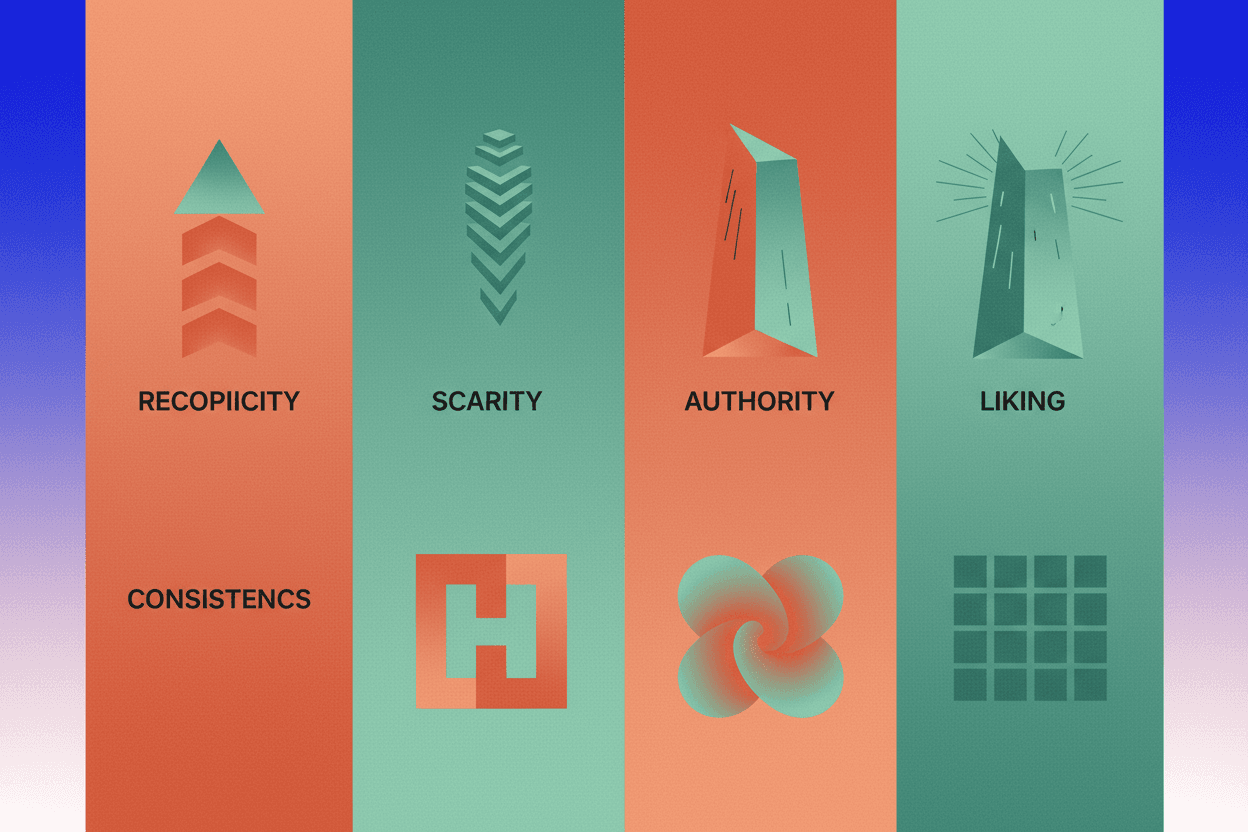
In 1984, a psychology professor at Arizona State University published a book that would become the most cited work in the history of persuasion research. Robert Cialdini's Influence: The Psychology of Persuasion has since sold over three million copies and been translated into 30 languages. But here's what makes it extraordinary: Cialdini didn't just study compliance in laboratories. He spent three years infiltrating training programs for sales organizations, car dealerships, and recruitment cults—going undercover to observe persuasion tactics from the inside.
The results were unsettling. Cialdini discovered that nearly all compliance techniques boil down to just six psychological patterns. These patterns exploit mental shortcuts that evolved to help humans make quick decisions in complex social environments. In 2024, researchers at Stanford estimated that these six principles influence over $10 trillion in annual consumer spending worldwide.
What happens when you understand these hidden levers? And more importantly: who is pulling them on you?
The Architecture of Automatic Response
Cialdini's central insight is that human brains operate on energy-saving autopilot most of the time. We rely on heuristic shortcuts—mental rules of thumb—that usually serve us well but can be systematically exploited.
Consider the study Cialdini cites involving the Reason-Because pattern. A researcher approached people waiting in line to use a photocopier and asked to cut ahead. When she said, "Excuse me, I have five pages. May I use the Xerox machine?" 60% complied. But when she added a reason—"May I use the Xerox machine, because I'm in a rush?"—compliance jumped to 94%. Here's the stunning part: when she said, "May I use the Xerox machine, because I have to make copies?" compliance remained at 93%. The reason was meaningless. The word "because" alone triggered the compliance response.
“[!INSIGHT] The human brain is wired to respond to the structure of justification rather than its content. This "click, whirr" response”
This principle explains why "free trial" offers, money-back guarantees, and "limited time" promotions work so well. They're not rational arguments; they're triggers for pre-programmed responses.
The Six Weapons of Influence
1. Reciprocity: The Ancient Debt Calculator
The reciprocity principle is perhaps the most powerful tool in the persuader's arsenal. Cialdini describes it as "the obligation to give back what you have received from others." It's universal across human cultures—and sufficiently strong that it can override other survival instincts.
The Hare Krishna movement mastered this in the 1970s. Before asking for donations, they would force a flower or a book into a stranger's hand. Even when people didn't want the gift, they felt an overwhelming urge to reciprocate. The technique was so effective that airports began banning the group—not because they were harassing people, but because their method worked too well.
“"The rule possesses awesome strength, often producing a yes response to a request that, except for an existing feeling of indebtedness, would have surely been refused.”
In business, this explains why free samples outperform discounts by 400% in certain product categories. A discount is a transaction; a free sample creates a psychological debt.
2. Commitment and Consistency: The Prison of Past Choices
Once humans make a decision, they experience powerful pressure to behave consistently with that choice—even when the original reasoning was flawed. Cialdini calls this "commitment and consistency."
A chilling example comes from studies of Chinese prisoner-of-war camps during the Korean War. American prisoners were never brutally tortured. Instead, they were asked to write seemingly innocent statements like "America is not perfect." Once they had made this small commitment, they were asked to elaborate. Then to list America's problems. Then to share their statements with fellow prisoners. Eventually, many prisoners ended up collaborating with their captors—not because they were forced, but because they needed to align their actions with their initial, seemingly trivial commitment.
[!INSIGHT] This principle explains why salespeople always try to get you to agree to small statements before the main pitch. Car dealerships ask about your commute, your family, your values. Each yes creates a consistency momentum that makes it harder to say no later.
3. Social Proof: Following the Herd
When people are uncertain, they look to others for guidance. This is especially powerful when the others are similar to us.
Cialdini cites a study on hotel towel reuse. When signs simply asked guests to reuse towels for environmental reasons, compliance was modest. When signs stated that "75% of guests who stayed in this room reused their towels," compliance increased by 33%. The specific social proof—people like me, in my exact situation—was dramatically more effective than general social pressure.
This principle explains:
- Why sitcoms use laugh tracks despite universal hatred for them
- Why websites display "500 people are viewing this hotel room right now"
- Why bartenders seed their tip jars with their own money at the start of a shift
4. Liking: The Beauty Premium
We prefer to say yes to people we like. But what makes us like someone? Cialdini identifies five factors: physical attractiveness, similarity, compliments, familiarity, and association with positive things.
A study of Canadian federal elections found that attractive candidates received more than twice as many votes as unattractive ones—among voters who explicitly claimed that appearance didn't influence their vote. The effect operates entirely below conscious awareness.
[!NOTE] Tupperware's entire business model was built on liking. The parties weren't about demonstrating products; they were about leveraging friendships. Attendees bought not because they needed plastic containers, but because refusing would damage a relationship with someone they liked.
5. Authority: The White Coat Effect
In 1963, Stanley Milgram demonstrated that ordinary people would administer what they believed were lethal electric shocks to strangers when instructed by an authority figure. Cialdini shows how this principle operates in commerce: titles, clothing, and trappings of authority trigger automatic compliance.
Con artists have long known this. The fake IT support scammer, the fraudulent bank investigator, the impersonated CEO—all exploit the deep programming to defer to perceived authority.
In healthcare settings, a study found that nurses administered unauthorized doses of a drug to patients 95% of the time when a doctor they'd never met called with the order. The doctor's title alone overrode their medical training and professional protocols.
6. Scarcity: The Fear of Missing Out
Opportunities seem more valuable when their availability is limited. But Cialdini reveals a crucial nuance: scarcity works best when people fear losing something they already have or could have had.
Real estate agents use this with the "multiple offer" technique. When a buyer learns that another offer exists, their motivation to purchase increases dramatically—even if the other offer is fictional or lower than their own.
A study of death penalty attitudes showed that people became more favorable toward capital punishment when told that most countries were abolishing it. The scarcity of the practice—its potential disappearance—made it more valuable to them.
The Defensive Protocol
Understanding these principles serves two purposes. First, it makes you a more effective communicator. Second, and perhaps more importantly, it provides immunity against manipulation.
Cialdini recommends a two-step defense:
-
Recognition. When you feel an unusually strong urge to comply with a request, pause and ask: Is this feeling legitimate, or am I being played?
-
Separation. If you detect manipulation, consciously separate the request from the trigger. A discounted price doesn't become better because it's "ending soon." A stranger's compliment doesn't make their product superior.
[!INSIGHT] The most dangerous aspect of influence principles is that they work even when you know about them. Recognition is necessary but not sufficient. You must actively interrupt your automatic response patterns.
The Enduring Relevance of Influence
Almost forty years after its publication, Influence remains essential reading for anyone who interacts with other humans—which is to say, everyone. The principles Cialdini identified have only become more relevant in the digital age.
Social media platforms weaponize social proof through likes, shares, and follower counts. E-commerce sites deploy scarcity with countdown timers and low-stock warnings. Email marketers exploit reciprocity by offering free value before making their pitch. Influencer marketing combines authority, liking, and social proof into a single package.
The book's continued relevance raises an uncomfortable question: How much of our behavior is genuinely our own choice, and how much is the output of psychological triggers we never consented to?
Sources: Cialdini, R. B. (2006). Influence: The Psychology of Persuasion (Revised Edition). Harper Business. Milgram, S. (1963). Behavioral Study of Obedience. Journal of Abnormal and Social Psychology. Schultz, P. W. et al. (2007). The Constructive, Destructive, and Reconstructive Power of Social Norms. Psychological Science. National Research Council (2014). The Psychological Foundations of Influence and Counter-Influence.
This is a Premium Article
Hylē Media members get unlimited access to all premium content. Sign up free — no credit card required.