Modularity vs Monumentality: Why Small Beats Big
Solar crashed 90% in cost while nuclear soared. The secret isn't technology—it's modularity. Discover why learning curves favor the small.
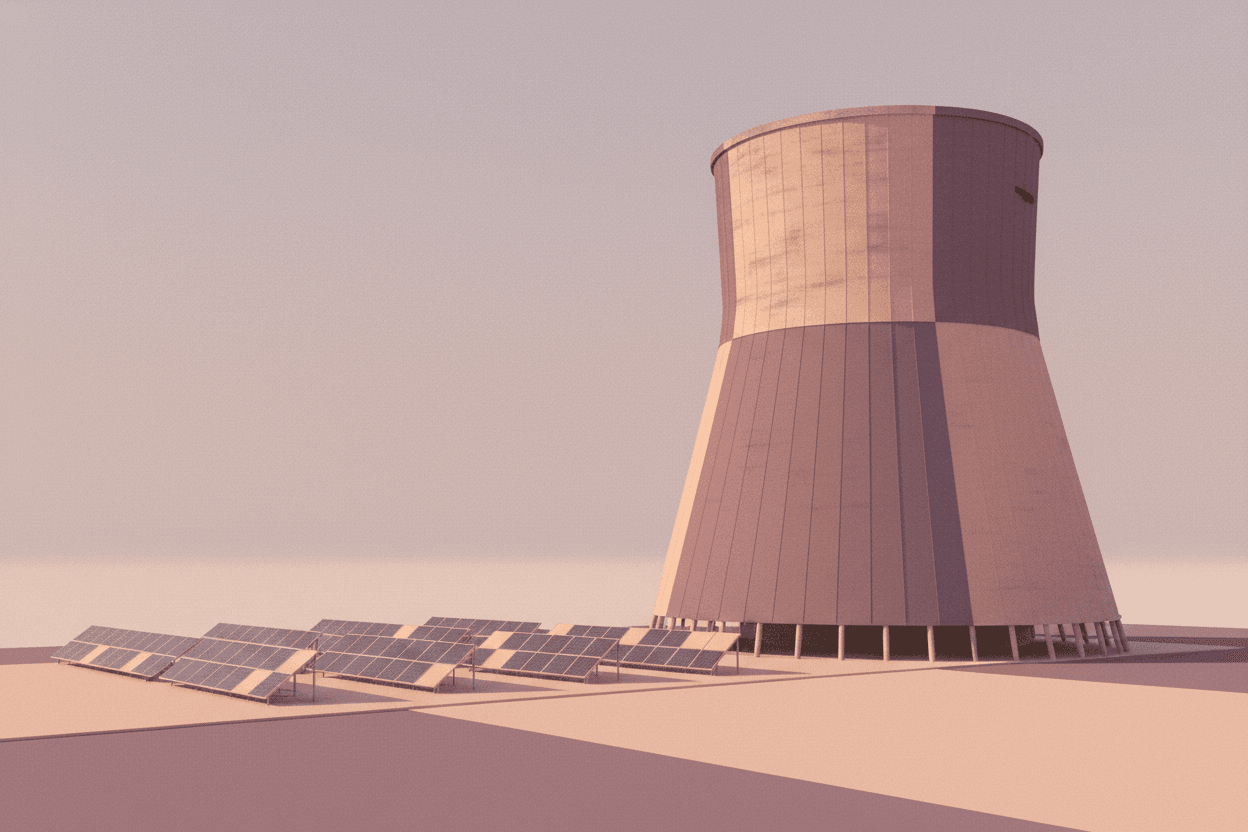
Solar power got 90% cheaper in 10 years. Nuclear power got more expensive. The difference is modularity — solar panels are manufactured in factories and benefit from learning curves. Nuclear plants are hand-built on-site, one at a time.
Between 2010 and 2020, the levelized cost of utility-scale solar plummeted from $0.378 per kilowatt-hour to $0.037—a staggering 90% reduction. During the same period, the cost of nuclear power in the United States increased by approximately 20%, with projects like Vogtle Units 3 and 4 running billions over budget and years behind schedule.
Why does the same technological progress that accelerates one industry seem to bypass another entirely?
The Mathematics of Learning Curves
The answer lies in a deceptively simple formula: the learning rate or experience curve.
$$C_n = C_1 \times n^{-b}$$
Where:
- $C_n$ = Cost of the $n^{th}$ unit produced
- $C_1$ = Cost of the first unit
- $n$ = Cumulative production volume
- $b$ = Learning exponent (derived from the learning rate)
For a technology with a 20% learning rate, every doubling of cumulative production reduces costs by 20%. Solar photovoltaics have demonstrated learning rates of 20-25% consistently since the 1970s. Nuclear power? Effectively zero—sometimes negative.
[!INSIGHT] A learning rate of 20% means that after 10 doublings (1,024 units), costs drop to approximately 10% of the original. But this only works if you actually produce a thousand units—and if each unit is identical enough to learn from.
The Modularity Criterion
Modularity enables learning curves through three mechanisms:
-
Unit Volume: Small, standardized units can be produced in the thousands or millions, generating the doublings needed for cost reduction.
-
Process Standardization: Factory production allows for controlled conditions, automated assembly lines, and continuous improvement.
-
Failure Tolerance: When individual units are cheap, failure is a data point, not a catastrophe. This enables rapid iteration.
Consider the numbers:
| Technology | Unit Size | Global Installations (2023) | Learning Rate |
|---|---|---|---|
| Solar PV Panels | 300-500W | ~1.2 billion panels cumulative | ~23% |
| Wind Turbines | 2-8 MW | ~400,000 turbines cumulative | ~12% |
| Nuclear Reactors | 1,000+ MW | ~440 reactors total | ~0% (negative in West) |
| Small Modular Reactors | 50-300 MW | ~0 commercial deployments | Unknown (theoretical) |
Why Nuclear Failed the Learning Test
Nuclear power plants are among the most complex machines ever built. Each one is essentially a prototype:
- On-site Construction: 80% of nuclear plant construction occurs on location, subject to weather, labor availability, and site-specific conditions.
- Regulatory Heterogeneity: Each country—and often each state—has unique licensing requirements. A reactor design approved in France requires substantial modification for U.S. deployment.
- Megaproject Dynamics: When a single unit costs $10-15 billion and takes 10+ years to build, the financial and political stakes eliminate room for experimentation.
“*"Every nuclear plant is a first-of-a-kind plant.”
The results speak for themselves. Finland's Olkiluoto Unit 3, begun in 2005, was completed in 2023—14 years behind schedule and €5.5 billion over budget. France's Flamanville Unit 3, started in 2007, may finally come online in 2024 after a 12-year delay and €12 billion in cost overruns.
The Modular Revolution: Case Studies
Solar Photovoltaics: A Trillion Dollar Proof
In 1975, solar panels cost approximately $100 per watt. By 2023, that figure had fallen below $0.20 per watt—a 500x reduction. This wasn't magic. It was the learning curve in action:
Phase 1 (1975-2000): Niche applications (satellites, remote telecommunications) drove modest volume. Learning occurred slowly.
Phase 2 (2000-2012): German feed-in tariffs created the first mass market. Production scaled from megawatts to gigawatts annually.
Phase 3 (2012-Present): Chinese manufacturing scaled to terawatts. Each factory produces millions of identical panels per year.
The key insight: a 500-watt panel from 2010 and a 500-watt panel from 2023 are fundamentally similar products. The improvements came in manufacturing efficiency, material usage, and supply chain optimization—not in revolutionary physics.
Small Modular Reactors: The Nuclear Industry's Last Hope?
The nuclear industry has recognized its modularity problem. Small Modular Reactors (SMRs) aim to apply factory production to nuclear power:
- NuScale Power: 77 MW modules, factory-built, transported by rail
- GE Hitachi BWRX-300: 300 MW simplified boiling water reactor
- Rolls-Royce SMR: 470 MW pressurized water reactor
The theoretical economics are compelling:
$$\text{Total Cost}{\text{SMR}} = n \times C{\text{module}} + C_{\text{site}}$$
Where $n$ modules share a single site infrastructure cost $C_{\text{site}}$. If $C_{\text{module}}$ follows a 10% learning rate, a fleet of 100 reactors would cost approximately 40% less per unit than the first deployment.
[!NOTE] As of 2024, no commercial SMR is operating in the Western world. NuScale's first project in Idaho was cancelled in November 2023 due to rising subscription costs. The learning curve remains theoretical until actual deployments generate real data.
Distributed Communications: When Modularity Built the Internet
The telecommunications industry offers a telling parallel. In the 1960s, AT&T's monopoly relied on massive central switches—monumental infrastructure requiring billion-dollar investments.
The packet-switching revolution inverted this model. Instead of one giant switch handling all traffic, thousands of small routers could each make local decisions. The result:
- Exponential capacity growth: Cisco's CRS-1 router in 2004 handled 92 terabits/second. Modern distributed networks handle petabits.
- Continuous cost decline: Bandwidth costs have fallen approximately 30% annually for three decades.
- Resilience: When one node fails, traffic reroutes. The system degrades gracefully rather than collapsing.
The Internet's founding architecture was explicitly modular. Vint Cerf and Bob Kahn's TCP/IP protocol was designed so that "any node could interoperate with any other node without knowing the internal structure of the network."
The Politics of Monumentality
If modularity is so clearly superior, why do megaprojects persist?
The answer lies in the intersection of political psychology and principal-agent problems.
The Ribbon-Cutting Bias
Politicians prefer projects they can cut ribbons for—ideally before the next election. A single $10 billion nuclear plant offers one spectacular ceremony. Ten thousand distributed solar installations offer... none.
This creates a systematic bias:
$$\text{Political Value} \propto \frac{\text{Visibility}}{\text{Timeline}}$$
Megaprojects maximize visibility and compress the timeline into a single, media-friendly event. Distributed infrastructure spreads benefits invisibly across years and jurisdictions.
The Sunk Cost Trap
Once a megaproject begins, stopping it becomes politically devastating. Admitting failure requires more courage than throwing good money after bad. The Sydney Opera House ran 1,400% over budget. The Channel Tunnel ran 80% over budget. Both are now celebrated—but at what opportunity cost?
“*"The four most expensive words in the English language are 'this time it's different.'”
Concentrated Benefits, Diffuse Costs
Megaprojects create concentrated constituencies:
- Construction unions support large projects for jobs
- Engineering firms profit from complexity
- Local politicians claim credit for "bringing investment"
The costs—borne by ratepayers, taxpayers, and future generations—are distributed too broadly to generate opposition.
Implications: Designing for Learning
Understanding the modularity advantage changes how we should approach infrastructure investment:
For Energy Transition
Prioritize technologies with learning potential. Every dollar spent on technologies with demonstrated learning rates (solar, wind, batteries) yields compounding returns. Every dollar spent on bespoke megaprojects yields linear—or negative—returns.
Calculate the learning ROI:
$$\text{Learning ROI} = \frac{\text{Future Cost Reduction}}{\text{Current Investment}} = \frac{\sum_{i=1}^{n} (C_i - C_{i+1}) \times Q_{i+1}}{C_1 \times Q_1}$$
Where $Q$ represents quantity deployed. High-learning-rate technologies can have learning ROIs exceeding 10:1.
For Climate Policy
Support deployment volume over R&D breakthroughs. Solar didn't become cheap because of laboratory breakthroughs. It became cheap because Germany and China subsidized deployment at scale, driving the manufacturing experience that reduced costs.
For Urban Planning
Design systems that can fail gracefully. Modular infrastructure distributes risk. A grid with 10,000 battery installations is more resilient than one with a single giant storage facility.
Sources: IRENA Renewable Cost Database 2023; Lazard Levelized Cost of Energy Analysis; MIT "The Future of Nuclear Energy in a Carbon-Constrained World" (2018); NREL Solar PV System Cost Benchmark Q1 2023; World Nuclear Association; Our World in Data Solar PV Prices vs. Cumulative Capacity; The Breakthrough Institute Nuclear Learning Analysis
Series: The Megaproject Curse — Episode 5 of 8
Next: Episode 6 — "The Permitting Maze: How Environmental Law Kills Green Infrastructure"
This is a Premium Article
Hylē Media members get unlimited access to all premium content. Sign up free — no credit card required.