The Nuclear Waste Problem Is Smaller Than Your Living Room
All U.S. nuclear waste from 60 years fits in one Walmart. Coal plants emit invisible CO2 every 90 minutes forever. The waste problem you fear is already solved.
Hyle Editorial·
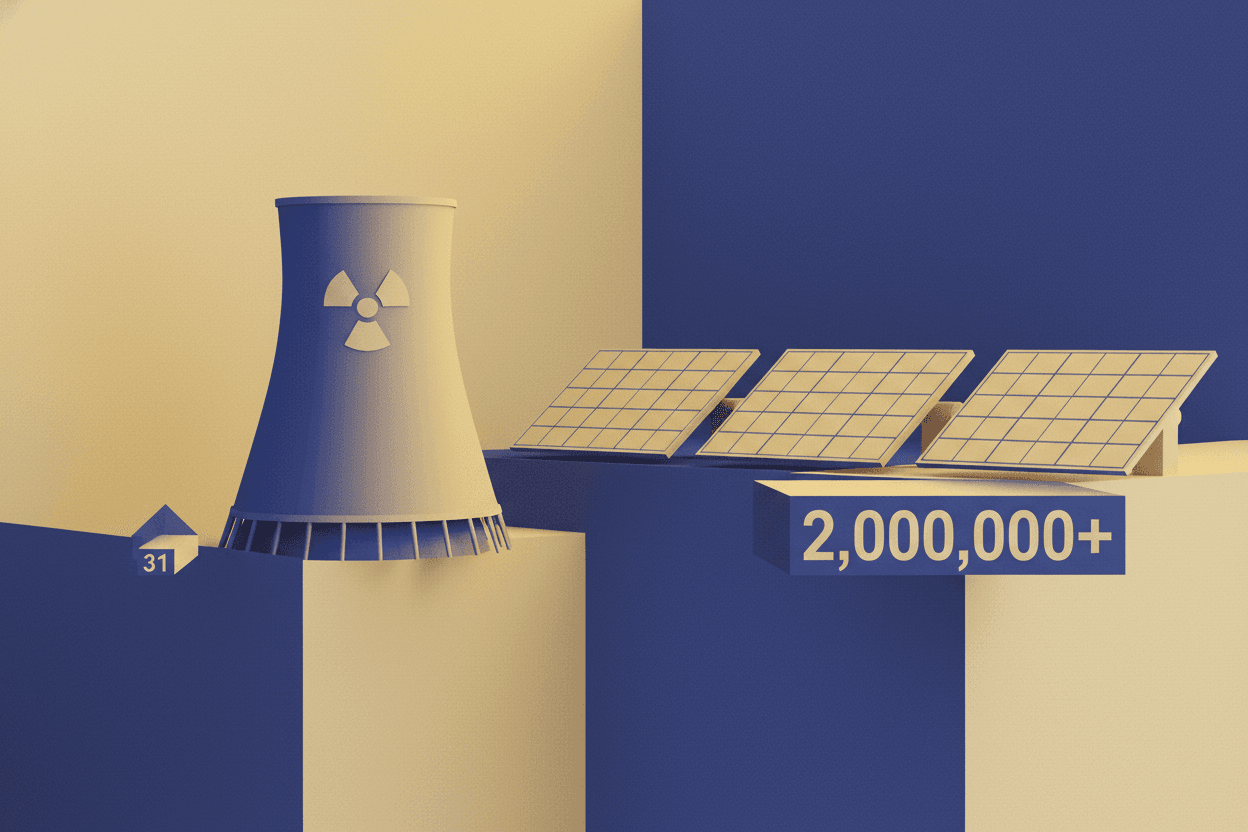
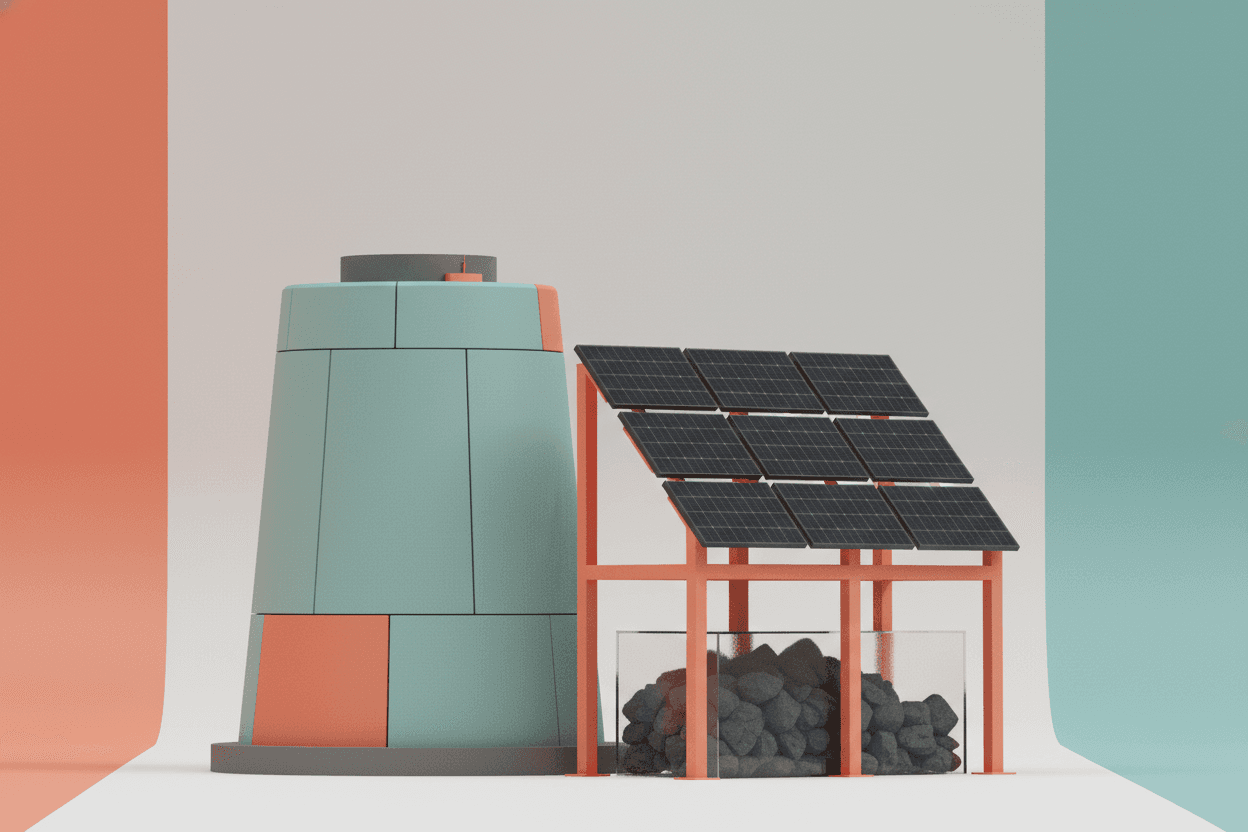
All the high-level nuclear waste ever produced in the United States would fit inside a Walmart. Coal power plants release the equivalent in invisible CO2 every 90 minutes — forever. This is not a rhetorical flourish. It is a concrete, measurable fact that fundamentally reframes how we should think about nuclear power's environmental footprint.
If you gathered every fuel rod, every pellet of spent nuclear material from six decades of American commercial reactor operation, you would have roughly 90,000 metric tons of material. Stack it in a single location, and it would cover a football field to a depth of about 10 yards. Meanwhile, global coal combustion pumps approximately 13 billion tons of carbon dioxide into the atmosphere annually — a volume that cannot be tracked, cannot be contained, and cannot be reversed within any human timescale.
[!INSIGHT] The psychological weight of nuclear waste stems from its tangibility. We can see it, contain it, and point to it. The waste stream from fossil fuels is invisible, dispersed, and therefore somehow more acceptable to our intuitions.
The Mathematics of Containment
Let us examine the numbers more closely, because they reveal something counterintuitive about our energy choices.
The United States has operated commercial nuclear reactors since 1957. In that time, the total inventory of spent nuclear fuel accumulated to approximately 90,000 metric tons as of 2024. This material is stored in concrete and steel casks at reactor sites across the country, waiting for a permanent geological repository that political gridlock has prevented from opening.
Here is what makes this number remarkable: nuclear fuel is extraordinarily energy-dense. A single uranium fuel pellet, roughly the size of a fingertip, contains as much energy as one ton of coal, 149 gallons of oil, or 17,000 cubic feet of natural gas. This density means the waste stream remains small by any industrial standard.
“"If you took all the nuclear waste produced by every nuclear plant in the U.S. for the last 60 years, it would fit on a football field, stacked about 10 yards high.”
— Dr. Steven Chu, former U.S. Secretary of Energy and Nobel Laureate in Physics
Now consider coal. A typical 1,000-megawatt coal plant burns approximately 2.7 million tons of coal annually, producing roughly 7 million tons of CO2. That single plant, operating continuously, creates more waste mass in 18 hours than the entire U.S. nuclear industry has produced in 60 years.
But here lies the critical asymmetry: coal waste disperses globally. Nuclear waste stays where you put it.
The Finland Solution
In 2024, Finland began loading the first permanent geological repository for high-level nuclear waste at Onkalo, near the Olkiluoto nuclear power plant. Buried 400 meters beneath the bedrock, the facility will store spent fuel for at least 100,000 years — the time required for radioactivity to decay to levels comparable to natural uranium ore.
The Onkalo project demonstrates that the technical challenge of nuclear waste isolation has been solved. The remaining obstacles are political and social, not technological.
[!NOTE] Sweden and France have followed similar approaches, with the Swedish repository at Forsmark expected to begin operations in the 2030s. These Nordic successes highlight how consensus-building and technical competence can overcome the "waste problem" that paralyzes other nations.
The Volume Comparison That Changes Everything
To visualize the contrast between nuclear and fossil fuel waste streams, consider this comparison:
Nuclear Waste (U.S., 60 years):
Total volume: ~90,000 metric tons of heavy metal
Physical footprint: One football field, 10 yards deep
Containment status: 100% accounted for, stored in dry casks
Release to environment: Zero
Coal Waste (Global, One Year):
CO2 emissions: ~37 billion tons
Physical volume: If condensed to solid dry ice, would cover Manhattan 40 feet deep
Containment status: 100% released to atmosphere
Atmospheric lifetime: 300-1,000 years for significant removal
The comparison becomes even more stark when accounting for the radioactive waste that coal plants emit directly into the air. Coal contains trace amounts of uranium, thorium, and their decay products. Because coal regulations do not require scrubbing these elements, a coal plant actually releases more radioactive material into the environment per unit of electricity generated than a properly operating nuclear facility.
[!INSIGHT] The Nuclear Regulatory Commission estimates that the population living within 50 miles of a coal plant receives an average radiation dose of 0.3 millirem per year from fly ash. The dose from a nuclear plant's normal operation is essentially zero. The invisible waste stream from fossil fuels includes radioactivity we have chosen not to regulate.
Why the Narrative Persists
If the math so clearly favors nuclear, why does the waste problem dominate public perception?
The answer lies in cognitive psychology, not physics. Nuclear waste triggers what risk researchers call "dread risk" — the fear of catastrophic, unfamiliar, and uncontrollable harm. Radioactivity cannot be seen, smelled, or touched without specialized equipment. Its effects manifest across generations. These characteristics activate deep-seated evolutionary fear responses.
Coal emissions, by contrast, have accompanied industrialization for two centuries. We have normalized the sight of smokestacks and the haze of smog. The mortality statistics — approximately 8 million premature deaths annually from fossil fuel air pollution according to Harvard research — arrive as diffuse epidemiological data, not as singular catastrophic events.
“"The waste from fossil fuels is infinitely more dangerous than the waste from nuclear power. It's just that we've gotten used to it.”
— Dr. James Hansen, climate scientist and former NASA Director
The media amplification effect compounds this bias. A radiation leak makes international headlines. The constant, invisible emission of particulate matter killing thousands daily rarely warrants mention.
The Economic Reality
The nuclear industry has voluntarily funded its own waste management. Since 1982, electricity consumers have paid $0.001 per kilowatt-hour into the Nuclear Waste Fund — accumulating over $45 billion (including interest) to finance a permanent repository that Congress has failed to deliver.
No fossil fuel industry has ever been asked to pre-fund the disposal of its CO2 emissions. The cost of atmospheric carbon — estimated at $185 per ton in social damages by the EPA — remains an externality borne by society, not the polluter.
Implications for Climate Strategy
Understanding the true scale of the nuclear waste problem should recalibrate climate policy in several ways:
Resource Allocation: The billions spent on nuclear waste storage represent a solved technical challenge. The trillions needed for carbon capture and storage remain speculative bets on unproven technology.
Siting Decisions: If we can safely contain nuclear waste in geological repositories for geological timescales, the NIMBY opposition to reactor construction loses its logical foundation.
Intergenerational Ethics: Nuclear waste isolation commits us to stewardship for thousands of years — a responsibility we can actually fulfill. Carbon emissions commit future generations to climate instability we cannot reverse.
Baseload Power: As grids incorporate more intermittent renewables, the dispatchable clean power from nuclear becomes indispensable for maintaining reliability without fossil fuel backup.
[!NOTE] The International Energy Agency's Net Zero scenario requires nuclear capacity to double by 2050. Current trajectories fall far short of this target, partly because waste concerns continue to obstruct new construction in countries that need it most.
The Walmart Test
Return to the opening image: all of America's nuclear waste, contained in a space no larger than a big-box retail store.
This is not an argument for complacency. Nuclear waste requires rigorous management, permanent geological isolation, and sustained institutional memory. The technical community has developed solutions; the political community must implement them.
But it is an argument for perspective. Every energy source produces waste. Nuclear waste is small, solid, trackable, and containable. Fossil fuel waste is massive, gaseous, untraceable, and planetary in scale.
The choice between them is not between risk and safety. It is between a manageable problem we have already solved and an existential crisis we continue to ignore.
Key Takeaway: The nuclear waste "problem" that dominates public discourse is mathematically minuscule compared to the uncontained emissions from fossil fuels. Nuclear waste fits in a Walmart and stays there. Coal waste fills the atmosphere every 90 minutes and cannot be recalled. We have solved the wrong problem first.
Sources: U.S. Nuclear Waste Technical Review Board, 2024; International Energy Agency World Energy Outlook 2023; EPA Inventory of U.S. Greenhouse Gas Emissions; World Nuclear Association; Onkalo Posiva Oy Technical Reports; Harvard School of Public Health fossil fuel mortality study (2023); U.S. Nuclear Regulatory Commission radiation dose assessments; Dr. James Hansen, Columbia University Earth Institute.
This is a Premium Article
Hylē Media members get unlimited access to all premium content. Sign up free — no credit card required.