The P-Value Crisis Nobody Told You About
A third of published psychology findings cannot be reproduced. The culprit? P-hacking, HARKing, and a statistical threshold working exactly as designed.
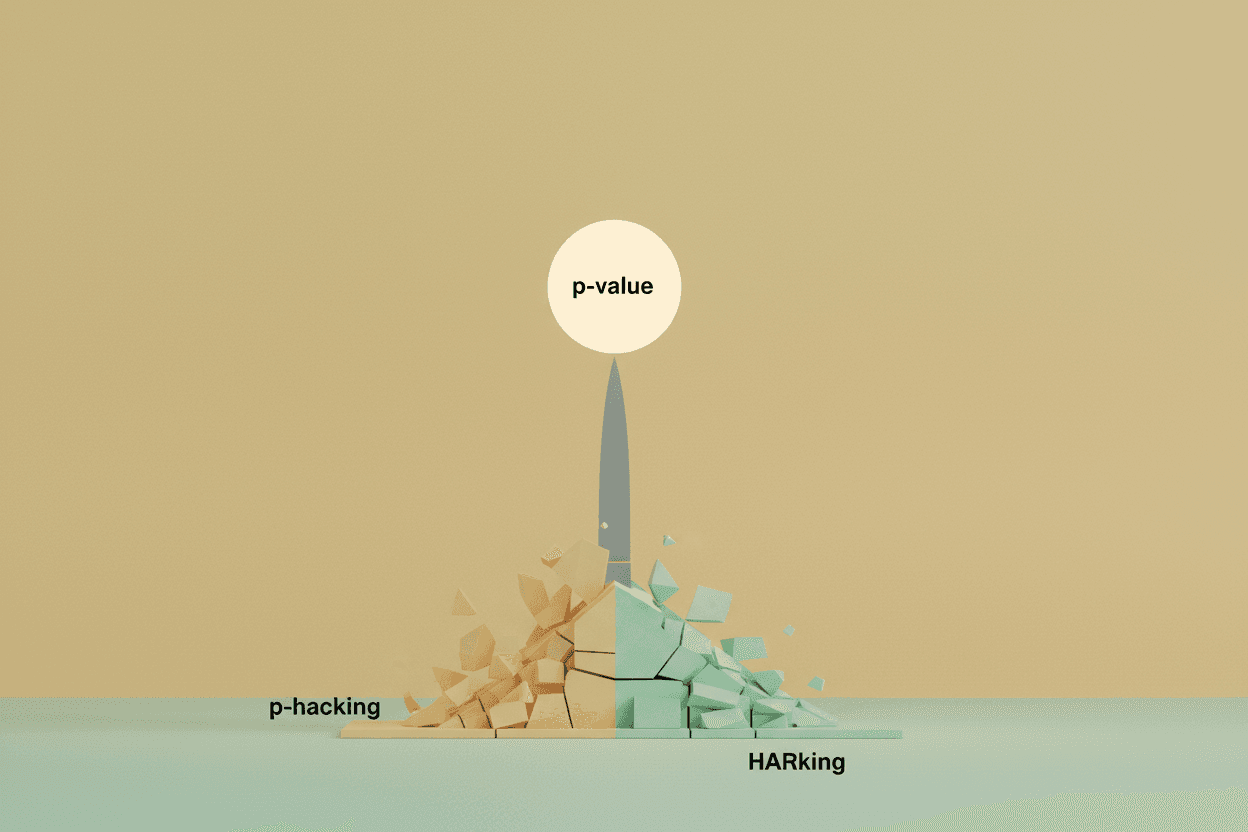
The single most important number in academic research — p < 0.05 — is so routinely manipulated that a third of published psychological findings cannot be reproduced. The number itself is working as designed. The design is broken.
In 2015, the Open Science Collaboration attempted something unprecedented: they tried to replicate 100 studies from three top psychology journals. The results were devastating. Only 36% of replication attempts produced statistically significant results with effect sizes comparable to the originals. Think about that — if you picked up a random psychology paper from a leading journal, there's a 64% chance its central finding would vanish under scrutiny.
But here's what makes this truly disturbing: the researchers who published those original studies weren't frauds. They were following the rules.
What P < 0.05 Actually Means (And What It Doesn't)
The p-value, introduced by Ronald Fisher in 1925, was never meant to be the final arbiter of scientific truth. It answers a specific question: If there were no real effect, how surprising would our data be?
Mathematically, the p-value is defined as:
$$p = P(D \geq d_{observed} \mid H_0)$$
Where $H_0$ is the null hypothesis and $D$ represents the test statistic under the null distribution. A p-value of 0.03 means: assuming nothing is going on, you'd see results this extreme about 3% of the time just by chance.
“[!INSIGHT] The 0.05 threshold was arbitrary from the start. Fisher chose it for convenience”
The Fundamental Misunderstanding
Most researchers — and virtually all laypeople — interpret p < 0.05 as: "There's a 95% chance my hypothesis is correct."
This is catastrophically wrong.
The p-value tells you nothing about:
- The probability your hypothesis is true
- The size or importance of an effect
- Whether a result can be replicated
- Whether a finding is practically meaningful
A 2021 survey of 800 researchers found that 89% could not correctly interpret a p-value when presented with a standard scenario. The people building scientific knowledge don't understand their own foundation.
P-Hacking: The Art of Torturing Data Until It Confesses
P-hacking (also called "data dredging" or "researcher degrees of freedom") occurs when scientists make analytical choices designed to achieve statistical significance rather than discover truth.
Common P-Hacking Techniques
1. Optional Stopping: You run 20 participants. P = 0.08. Not significant. You run 10 more. P = 0.04. You stop and publish. The problem? Your actual Type I error rate is now closer to 15%, not 5%.
2. Cherry-Picking Outcomes: You measured six dependent variables. Only one showed significance. You report only that one and don't mention the others.
3. Flexible Outlier Removal: You remove data points that "don't look right" until significance is achieved. In one simulation, researchers showed that with creative outlier removal, you can manufacture significance from completely random data 60% of the time.
4. Subgroup Analysis: Your main effect isn't significant. But wait — it works for women! It works for people over 40! It works for left-handed introverts! Each subgroup you test is another roll of the dice.
“"The difference between a p-value of 0.051 and 0.049 is the difference between a career and unemployment.”
A 2016 analysis of over 2 million published p-values found a suspicious cluster just below 0.05 — far more than would be expected by chance. The distribution should be relatively smooth. Instead, there's a massive pile-up at 0.049, 0.048, 0.047.
HARKing: Hypothesizing After Results Are Known
HARKing is perhaps more insidious than p-hacking because it leaves no statistical trace.
Here's how it works:
- You collect data exploring whether coffee affects concentration.
- Your results show no effect on concentration, but a strong effect on anxiety.
- You rewrite your hypothesis section: "We hypothesized that coffee would increase anxiety due to caffeine's stimulant properties."
- Reviewers see a clean, hypothesis-driven study with confirmed predictions.
“[!NOTE] One survey found that 30-50% of psychologists admit to HARKing at least once. The actual rate is likely higher, as many researchers don't even recognize they're doing it”
HARKing transforms exploratory fishing expeditions into what looks like rigorous hypothesis testing. It's not malicious fraud — it's human self-deception amplified by a publication system that rewards clean narratives over messy truth.
Publication Bias: The File Drawer Problem
Even if every researcher followed perfect statistical hygiene, the scientific record would still be distorted by publication bias.
Journals prefer positive results. Studies with p < 0.05 are 3-4 times more likely to be published than studies finding no effect. Researchers, knowing this, often don't bother writing up null results — they go into the "file drawer."
The Mathematical Consequence
Imagine 100 studies test a completely false hypothesis (e.g., that purple socks improve IQ). With α = 0.05, about 5 should show significant results by chance.
Those 5 get published. The 95 null results disappear.
Anyone reading the literature now sees 5 studies supporting the purple-sock hypothesis and zero contradicting it. The literature unanimously supports a claim that is 100% false.
Meta-analyses try to correct for this using techniques like funnel plots and trim-and-fill methods, but these can only estimate bias — they can't recover studies that were never written.
The ASA's Unprecedented Intervention
In 2016, the American Statistical Association took an extraordinary step: they issued an official statement warning about p-value misuse. This was the first time in their 177-year history they'd made a public statement on statistical practice.
The ASA's six principles:
-
P-values can indicate how incompatible data are with a specified statistical model.
-
P-values do not measure the probability that the studied hypothesis is true, or the probability that the data were produced by random chance alone.
-
Scientific conclusions and business or policy decisions should not be based only on whether a p-value passes a specific threshold.
-
Proper inference requires full reporting and transparency.
-
A p-value, or statistical significance, does not measure the size of an effect or the importance of a result.
-
By itself, a p-value does not provide a good measure of evidence regarding a model or hypothesis.
“[!INSIGHT] The ASA statement wasn't criticizing p-values themselves”
In 2019, a special issue of The American Statistician went further, with some authors calling for abandoning statistical significance entirely and retiring the p < 0.05 threshold.
Implications: What This Means for Science and Society
The reproducibility crisis isn't just an academic embarrassment — it has real-world consequences.
Medical Research: A 2012 study found that of 53 "landmark" cancer studies, only 6 could be replicated. Companies spent millions developing drugs based on findings that simply didn't hold up.
Policy Decisions: Government programs are evaluated using the same statistical standards. A program showing p = 0.049 gets funded; one showing p = 0.051 doesn't — even though the difference is meaningless.
Public Trust: When high-profile findings get overturned (eggs cause heart disease, then they don't; saturated fat is evil, then it's fine), the public stops trusting science entirely. The failure isn't science itself — it's the machinery of statistical certification.
Emerging Solutions
Several journals now require:
- Pre-registration: Hypotheses and analysis plans must be filed before data collection
- Registered Reports: Peer review happens before results are known; papers are accepted based on methodology, not outcomes
- Full Transparency: All data and code must be shared
- Bayesian Methods: Effect sizes and uncertainty instead of binary significance
These reforms are promising but face resistance from researchers whose careers were built on the old system.
Sources: Open Science Collaboration (2015). "Estimating the Reproducibility of Psychological Science." Science, 349(6251). American Statistical Association (2016). "Statement on Statistical Significance and P-Values." Wasserstein, R.L. & Lazar, N.A. (2016). The American Statistician, 70(2). Head, M.L. et al. (2015). "The Extent and Consequences of P-Hacking in Science." PLOS Biology, 13(3). Kerr, N.L. (1998). "HARKing: Hypothesizing After Results are Known." Personality and Social Psychology Review, 2(3). Begley, C.G. & Ellis, L.M. (2012). "Drug Development: Raise Standards for Preclinical Cancer Research." Nature, 483.
This is a Premium Article
Hylē Media members get unlimited access to all premium content. Sign up free — no credit card required.