Synthetic Life: Playing God With a Laptop
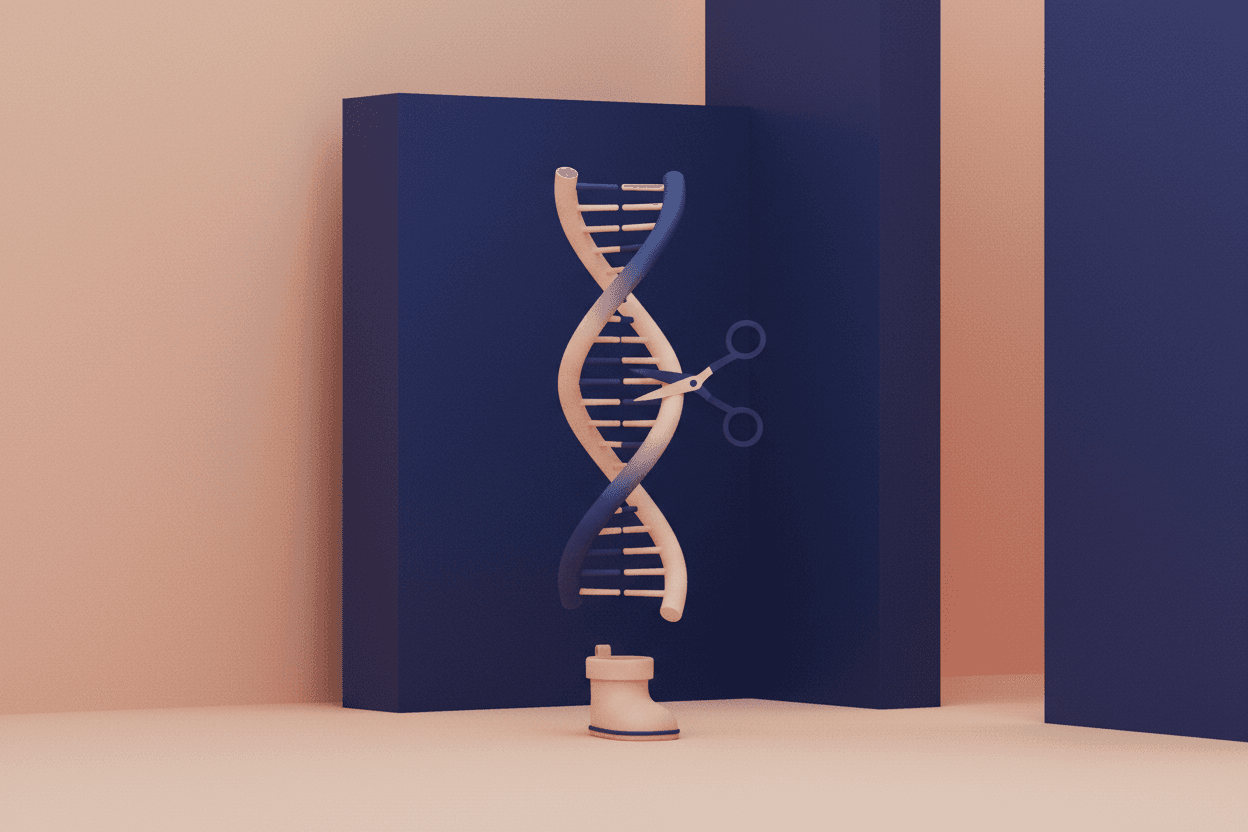
A teenager designed a living organism that evolution never created—using only a laptop. Welcome to synthetic biology, where DNA becomes programmable code.

A 19-year-old undergraduate just designed a living organism that has never existed in 4 billion years of evolution. She used a laptop.
In 2023, over 400 teams of university students gathered in Paris for the iGEM Grand Jamboree, each presenting synthetic organisms they had designed from scratch: bacteria that detect heavy metals, yeast that produce rose fragrance, algae programmed to commit cellular suicide on command. None of these organisms required a wet lab to conceive—just genetic design software, freely available DNA sequences, and a credit card to order synthesized genes online.
The question haunting bioethicists and excited venture capitalists alike is no longer can we create synthetic life, but who gets to decide what forms it takes?
From Reading to Writing the Book of Life
For decades, molecular biology was primarily an exercise in reading. The Human Genome Project, completed in 2003, cost approximately $2.7 billion and took 13 years to sequence one human genome. Today, you can sequence a genome for under $200 in under 24 hours. But reading genetic code was never the endgame.
The Venter Institute Breakthrough
In 2010, the J. Craig Venter Institute announced they had created the first self-replicating synthetic bacterial cell. The team, led by Hamilton Smith and Clyde Hutchison, chemically synthesized the 1.08 million base pair genome of Mycoplasma mycoides—then transplanted it into a recipient cell that booted up the new genetic operating system.
“[!INSIGHT] The Venter team didn't just copy an existing genome. They included "watermarks”
The cost? Approximately $40 million and 15 years of work. But the proof of concept was irrefutable: DNA could be written, synthesized, and booted like computer code.
The Cost Curve That Changed Everything
The exponential decline in DNA synthesis costs mirrors Moore's Law in computing:
| Year | Cost per Base Pair | Time to Synthesize 1M bp |
|---|---|---|
| 2000 | $10.00 | Years |
| 2010 | $0.50 | Months |
| 2020 | $0.05 | Weeks |
| 2024 | $0.03 | Days |
At current rates, synthesizing a bacterial genome costs roughly $30,000—still expensive for a hobbyist but trivial for a university lab or venture-backed startup. The infrastructure of creation is democratizing faster than our frameworks for governing it.
Designing Life Like Software
Synthetic biology applies engineering principles to living systems: standardization, abstraction, and modularity. The goal is to make biology predictable and programmable.
The BioBrick Standard
In 2003, MIT researchers Tom Knight, Drew Endy, and colleagues established the Registry of Standard Biological Parts—a library of genetic "components" with standardized interfaces. These BioBricks function like functions in programming:
- Promoters: Genetic "start buttons" that initiate transcription (input signals)
- Ribosome Binding Sites: Translation initiation sequences (function calls)
- Coding Sequences: Genes that produce proteins (the executable code)
- Terminators: Stop signals (return statements)
The mathematical formalism mirrors electronic circuit design. A genetic toggle switch, first constructed in 2000 by Gardner, Cantor, and Collins, can be modeled using differential equations:
$$\frac{du}{dt} = \frac{\alpha_1}{1 + v^\beta} - u$$
$$\frac{dv}{dt} = \frac{\alpha_2}{1 + u^\gamma} - v$$
Where $u$ and $v$ represent repressor protein concentrations, and $\alpha$, $\beta$, $\gamma$ are parameters controlling system dynamics. The bistability emerges from mutual inhibition—identical to a flip-flop circuit in digital electronics.
The iGEM Revolution
The International Genetically Engineered Machine (iGEM) competition has become the proving ground for synthetic biology. Founded in 2004 with 5 teams, the 2024 competition featured 438 teams from 45 countries. Notable undergraduate projects include:
-
Arsenic Detector (2006, Edinburgh): E. coli engineered to detect arsenic in drinking water, producing visible color change at concentrations as low as 5 ppb—below WHO safety limits.
-
Blood Type Converter (2007, Imperial College): Enzymes to convert Type A and B blood to Type O, potentially universal donor blood.
-
Bacterial Photography (2005, UT Austin): A colony of engineered bacteria acting as a biological camera, responding to light patterns with pigment production at resolution of 100 megapixels per square inch.
“"We're not discovering nature anymore. We're designing it. The question is whether we're wise enough to be the architects.”
The Minimal Genome Problem
One of synthetic biology's deepest questions: What is the minimum genetic instruction set required for life?
Synthia and JCVI-syn3.0
In 2016, the Venter Institute published their design of JCVI-syn3.0—a synthetic organism with only 473 genes. For comparison, E. coli has 4,641 genes. Humans have approximately 20,000.
Of syn3.0's 473 genes, 149 had no known function. These "orphan genes" are essential for life, yet we have no idea what they do. The cell dies without them, but their biochemical role remains a complete mystery.
[!INSIGHT] Even the minimal known genome contains 31% essential genes of unknown function. This humbling statistic reveals how much fundamental biology we still don't understand—despite having sequenced millions of organisms, we cannot yet predict what most genes actually do.
This epistemic gap has profound implications for safety. If we cannot predict the function of 31% of essential genes in the simplest known cell, how can we predict the behavior of entirely novel genetic circuits?
The Governance Gap
Dual-Use Dilemmas
Synthetic biology inherits the same dual-use tensions as nuclear physics: the same technology that produces drought-resistant crops could produce weaponized pathogens.
In 2005, CDC researchers reconstructed the 1918 Spanish Influenza virus from published genomic data. The virus, which killed 50-100 million people, was resurrected using reverse genetics techniques now standard in synthetic biology labs worldwide.
The genomic sequences of deadly pathogens—including smallpox, Ebola, and anthrax—are publicly available in databases like GenBank. DNA synthesis screening protocols exist, but enforcement is inconsistent across the 3,000+ companies now offering gene synthesis services.
Regulatory Frameworks Lag Behind
The current regulatory landscape resembles internet governance in 1995—recognition that transformation is coming, but no consensus on rules:
| Jurisdiction | Framework | Coverage |
|---|---|---|
| USA | Coordinated Framework (1986) | Pre-market review for commercial products |
| EU | Directive 2009/41/EC | Contained use of GMOs |
| International | Nagoya Protocol | Access to genetic resources |
| DIY Bio Community | Self-regulation | Voluntary codes of conduct |
[!NOTE] The Biden Administration's 2022 Executive Order on Biotechnology established a National Biotechnology and Biomanufacturing Initiative, but implementation remains fragmented across FDA, EPA, USDA, and DARPA with overlapping jurisdictions and contradictory incentives.
The Commercial Frontier
Venture capital has noticed. Synthetic biology companies raised $18 billion in 2021 alone, betting that designed organisms will replace petroleum-based manufacturing.
Case Studies in Commercialization
Ginkgo Bioworks (NYSE: DNA): The "organism design platform" operates cell factories producing designer proteins for fragrances, flavors, and pharmaceuticals. Their foundry can screen 10,000 genetic designs per week—more than traditional labs test in a year.
Bolt Threads: Engineered yeast producing spider silk proteins, spun into fibers stronger than Kevlar. The military applications are obvious, as are sustainable textiles.
Zymergen (acquired by Ginkgo, 2021): Used machine learning to explore the "genetic design space"—the estimated $1.3 quadrillion possible protein sequences humans have never tested.
What Comes Next
The trajectory points toward increasingly sophisticated design capabilities:
-
AI-Driven Protein Design: DeepMind's AlphaFold and similar systems can now predict protein structures from sequence alone, enabling rational design of enzymes that never evolved naturally.
-
Cell-Free Systems: Synthesizing proteins without living cells eliminates biosafety containment concerns—and enables manufacturing in environments where cells cannot survive.
-
Xenobiology: Designing organisms with alternative genetic alphabets (XNA instead of DNA) or expanded codon systems, creating "orthogonal life" that cannot exchange genes with natural organisms.
The 19-year-old with a laptop is no longer hypothetical. She's competing in iGEM this year, her team's project aiming to engineer gut bacteria that break down microplastics. Her generation will inherit tools of creation that previous generations reserved for deities.
Sources: Venter Institute (2010) "Creation of a Bacterial Cell Controlled by a Chemically Synthesized Genome"; iGEM Foundation Annual Reports; National Academies (2018) "Biodefense in the Age of Synthetic Biology"; Endy (2005) "Foundations for Engineering Biology"; Gardner et al. (2000) "Construction of a Genetic Toggle Switch in E. coli"; Hutchison et al. (2016) "Design and Synthesis of a Minimal Bacterial Genome"; Synthetic Biology Leadership Council (2023) National Vision Framework
This is a Premium Article
Hylē Media members get unlimited access to all premium content. Sign up free — no credit card required.