The CRISPR Children
In 2018, He Jiankui created the first gene-edited babies. The world condemned him—then quietly continued down the same path. What happens now?
In 2018, a Chinese scientist edited two human embryos. The world condemned him. Then quietly started doing the same thing.
On November 25, 2018, He Jiankui, a researcher at the Southern University of Science and Technology in Shenzhen, uploaded a YouTube video that would detonate across the scientific world. He announced the birth of twin girls—Lulu and Nana—whose DNA he had deliberately altered using CRISPR-Cas9 technology. The girls, he claimed, carried a modified CCR5 gene designed to confer resistance to HIV. They were the first gene-edited humans in history. Within days, 122 Chinese scientists signed a condemnatory open letter calling the experiment "crazy." Within months, He was sentenced to three years in prison. Case closed?
[!WARNING] The numbers no one discusses As of 2024, clinical trials using CRISPR on human embryos have been registered in at least seven countries. The UK's Human Fertilisation and Embryology Authority approved CRISPR research on human embryos in 2016. China updated its Civil Code in 2021 to explicitly prohibit germ-line gene editing—but research on embryos younger than 14 days remains legal.
The scientific community's public outrage masked an uncomfortable reality: He Jiankui's sin was not the technology itself, but the premature and sloppy application of it. The question that should haunt us is not whether he failed—but whether someone else will succeed.
What Actually Happened in Shenzhen
The Experimental Design
He Jiankui's experiment targeted the CCR5 gene, which encodes a co-receptor used by HIV to enter immune cells. The rationale was medically defensible: individuals with naturally occurring CCR5 mutations (specifically CCR5-Δ32) show remarkable resistance to HIV infection. He attempted to replicate this mutation using CRISPR-Cas9.
The technical execution, however, revealed catastrophic flaws:
-
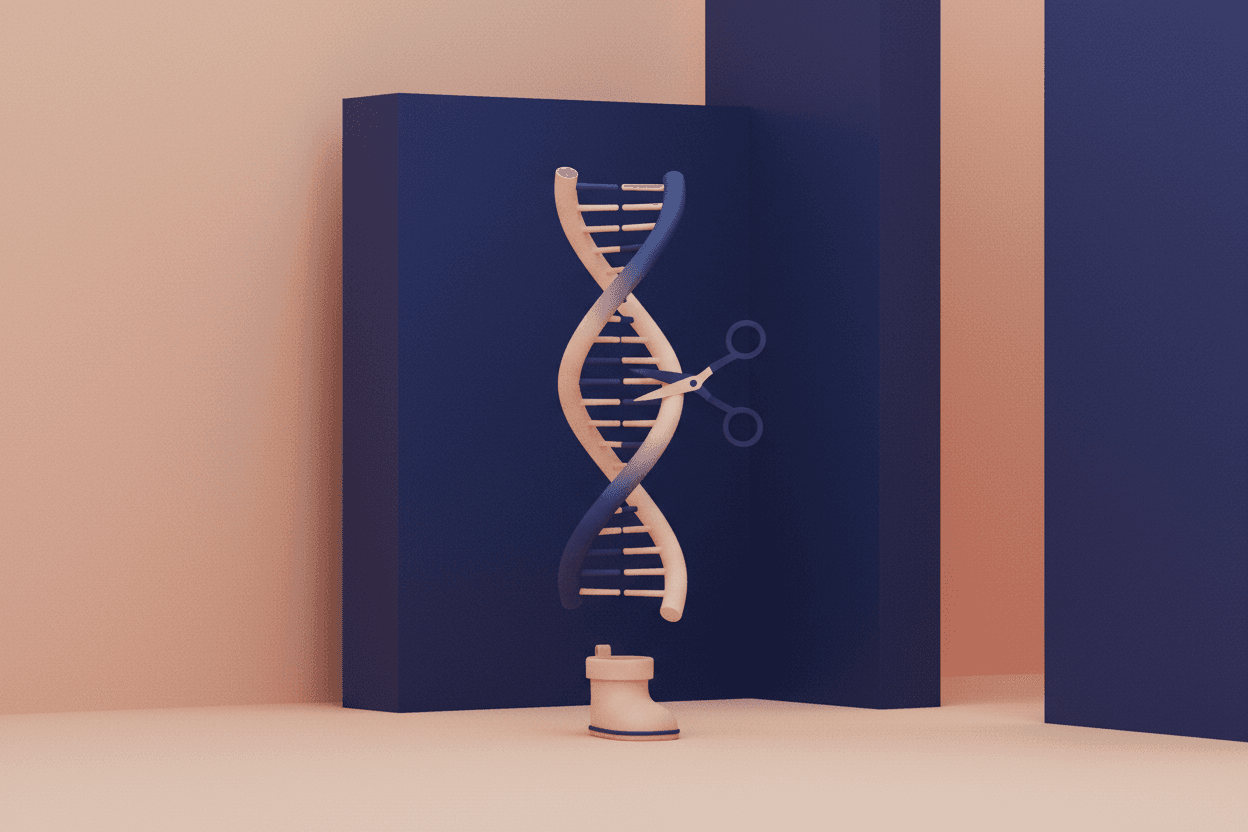
Off-target effects: CRISPR-Cas9 acts as molecular scissors, guided by a ~20-nucleotide RNA sequence to cut specific DNA locations. The system can mistakenly cut similar sequences elsewhere in the genome. Whole-genome sequencing of the embryos revealed potential off-target mutations at sites with partial homology to the guide RNA.
-
Mosaicism: When CRISPR edits occur after the first cell division, the resulting organism contains a mixture of edited and unedited cells. Analysis suggested Lulu and Nana were mosaic—meaning the edit was not uniformly present across all their cells.
-
Incomplete editing: One twin had both copies of CCR5 modified, but the edits did not precisely match the natural Δ32 mutation. The other twin had only one copy modified, meaning she was heterozygous and would likely retain HIV susceptibility.
The mathematical probability of achieving precise, biallelic editing without mosaicism in a human embryo can be expressed as:
$$P_{success} = P_{on-target} \times P_{biallelic} \times (1 - P_{mosaicism}) \times (1 - P_{off-target})$$
Given current technology, this probability remains unacceptably low for clinical application—likely below 10% for any given embryo.
[!INSIGHT] The central unresolved question Neither Lulu nor Nana has been independently examined by scientists outside China. We do not know their current health status, whether the edits conferred the intended HIV resistance, or what long-term consequences the off-target mutations may have caused. The twins are now approximately six years old.
The Ethical Breach
He Jiankui violated multiple ethical principles simultaneously:
-
Non-therapeutic indication: The father was HIV-positive, but modern antiretroviral therapy allows HIV-positive men to father healthy children with near-zero transmission risk. The procedure was medically unnecessary.
-
Informed consent failure: The consent documents described the procedure as an "AIDS vaccine" and did not clearly explain the germ-line editing component.
-
Irreversibility: Unlike somatic cell editing (which affects only the treated individual), germ-line edits are heritable. Lulu and Nana's children will carry these modifications.
-
Technical inadequacy: The risk-benefit calculus assumed precision that the technology could not deliver.
“"I feel a strong responsibility that it's not just to make a first, but also make it an example for the society.”
The Global Response: Condemnation and Continuation
Public Outrage, Private Progress
The immediate response to He's announcement was uniformly condemnatory. The Second International Summit on Human Genome Editing in Hong Kong—conveniently scheduled days after the news broke—became a stage for scientific leaders to denounce the experiment. Francis Collins, then director of the U.S. National Institutes of Health, called it "shocking." The World Health Organization established a global registry for human genome editing research.
Yet behind the condemnations, the infrastructure for human germ-line editing continued to develop:
| Country | Embryo Research Status | Germ-Line Editing Status |
|---|---|---|
| United Kingdom | Legal up to 14 days | Research only, no implantation |
| China | Legal up to 14 days | Prohibited for reproductive purposes (2021) |
| United States | No federal law; NIH moratorium on funding | FDA barred from reviewing clinical applications |
| Japan | Legal up to 14 days | Research only, no implantation |
| Russia | No specific legislation | Unregulated |
“[!NOTE] The 14-day rule under pressure The internationally accepted limit for embryo research”
The Underground Continues
In 2023, The MIT Technology Review obtained documents suggesting that at least five additional pregnancies involving CRISPR-edited embryos had been initiated in undisclosed locations. None resulted in confirmed births, but the attempts confirm that He Jiankui was not an isolated actor—he was merely the first to get caught.
The economic incentives are too powerful to ignore. The global gene editing market is projected to reach $17.4 billion by 2030. A successful, safe germ-line editing protocol for disease prevention would be worth exponentially more.
“"The technology is too powerful, and the stakes are too high, for us to simply hope that scientists will exercise restraint.”
The Real Danger: Not Design, But Accident
Popular fears about germ-line editing focus on "designer babies"—children engineered for intelligence, athleticism, or aesthetic traits. This concern is premature. Complex traits are polygenic, involving hundreds or thousands of genes with small individual effects. Height alone is influenced by over 3,000 genetic variants that collectively explain only 40-50% of phenotypic variation.
The immediate danger is not eugenic design but unintended consequences:
-
Loss of genetic diversity: The CCR5-Δ32 mutation He attempted to engineer may confer HIV resistance, but it also increases susceptibility to West Nile virus and severe influenza. Removing genetic variants without understanding their evolutionary trade-offs could have population-level consequences.
-
Insertional mutagenesis: CRISPR's double-strand breaks can trigger chromosomal rearrangements, large deletions, and integration of exogenous DNA. A 2020 study in Cell found that CRISPR editing in human embryos caused unintended DNA loss in 16% of cases.
-
Epigenetic disruption: DNA is not merely a sequence—it exists in a regulatory environment. CRISPR editing can disrupt methylation patterns and chromatin structure with unpredictable effects on gene expression.
The technical formula for off-target risk assessment remains imperfect:
$$\text{Specificity Score} = \frac{\text{On-target cutting efficiency}}{\sum_{i=1}^{n} \text{Off-target cutting efficiency}_i}$$
High specificity scores (>1000) are achievable in vitro, but embryonic environments introduce variables that laboratory conditions cannot fully replicate.
[!INSIGHT] The precautionary paradox The longer we delay germ-line editing for serious diseases (Huntington's, Tay-Sachs, cystic fibrosis), the more children will be born with devastating conditions. But premature application risks introducing new, heritable problems that could propagate through the human population indefinitely.
The Constitutional Moment We Missed
He Jiankui's experiment should have triggered a global constitutional moment—a reevaluation of the governance frameworks for transformative biotechnology. Instead, it produced a year of headlines, a few policy tweaks, and business as usual.
What we needed, and still lack:
-
International enforcement mechanisms: The WHO registry is voluntary. There is no global body with authority to investigate or sanction rogue researchers.
-
Universal technical standards: What level of off-target risk is acceptable? What constitutes adequate informed consent for procedures with multigenerational consequences? There is no consensus.
-
Longitudinal monitoring: Lulu, Nana, and any future gene-edited humans will require lifetime medical surveillance. Who funds this? Who has access to the data? How do we track effects across generations?
-
Equity frameworks: If germ-line editing becomes safe and effective, who gets access? Will genetic enhancement become another axis of inequality?
[!NOTE] The Francis Fukuyama warning In Our Posthuman Future (2002), political scientist Francis Fukuyama argued that human nature itself is at stake: "The first victim of transhumanism might be equality... If we start transforming ourselves into something superior, what rights will these enhanced creatures claim, and what rights will they possess when compared to those left behind?"
Where We Stand Now
As of 2024, the landscape of human germ-line editing is characterized by hypocrisy and hope:
-
Hypocrisy: Western scientists condemn He Jiankui while advocating for expanded embryo research. The UK permits CRISPR editing of embryos for research purposes; the U.S. maintains a funding moratorium but no legal prohibition on privately funded research.
-
Hope: CRISPR-based therapies for somatic cells have achieved remarkable successes. In 2023, the FDA approved Casgevy, the first CRISPR therapy for sickle cell disease and beta-thalassemia. These interventions affect only the treated patient and represent the responsible application of gene editing.
The fundamental tension remains unresolved. Every breakthrough in precision, safety, and delivery efficiency makes germ-line editing more feasible. The technical barriers that once seemed insurmountable are falling, one by one. The question is no longer whether we can edit the human germ line—it is whether we should, and who gets to decide.
Lulu and Nana are real children, now in primary school, carrying edited genomes into an uncertain future. They did not consent to be pioneers. They are the first, but they will not be the last.
Sources: He Jiankui et al., "CRISPR/Cas9-mediated Gene Editing in Human Tripronuclear Zygotes" (retracted); National Academies of Sciences, Engineering, and Medicine, "Human Genome Editing: Science, Ethics, and Governance" (2017); WHO Expert Advisory Committee on Developing Global Standards for Governance and Oversight of Human Genome Editing (2021); MIT Technology Review, "The CRISPR Revolution" series (2023-2024); Jennifer Doudna & Samuel Sternberg, "A Crack in Creation" (2017); Cell, "Allele-Specific Chromosome Removal After Cas9 Cleavage in Human Embryos" (2020).
This is a Premium Article
Hylē Media members get unlimited access to all premium content. Sign up free — no credit card required.