The Corporation in the 21st Century
Why shareholder primacy failed—and what replaces it. John Kay rethinks corporate purpose for an era of systemic risk and stakeholder capitalism.
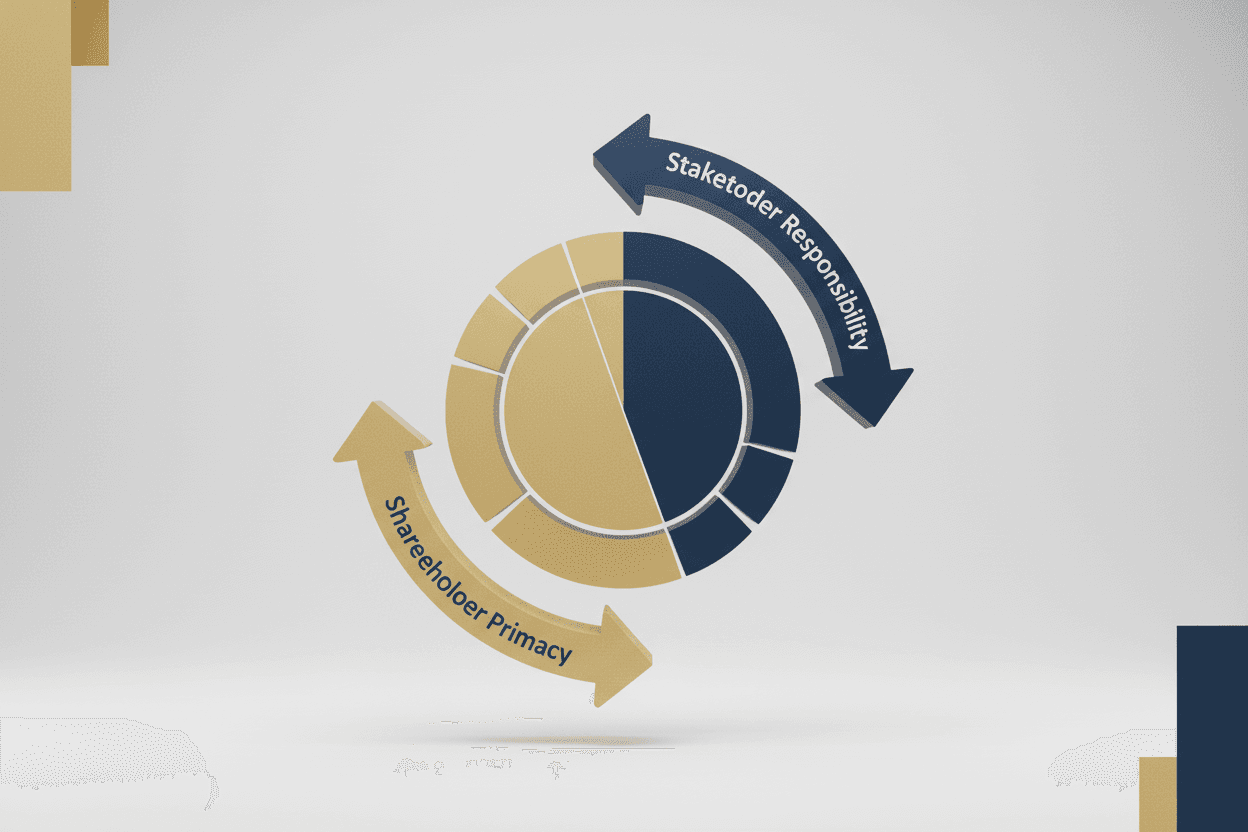
In 2019, the Business Roundtable—a coalition of 192 CEOs from America's largest corporations—signed a statement declaring that shareholder primacy was dead. Yet three years later, the same companies spent over $1 trillion on stock buybacks while median wages stagnated. The disconnect between rhetoric and reality reveals a deeper confusion: we no longer know what corporations are for.
John Kay's The Corporation in the 21st Century doesn't just diagnose this crisis—it dismantles the intellectual scaffolding that built it. What emerges is nothing less than a fundamental rethinking of why firms exist at all.
The doctrine that corporations exist solely to maximize shareholder returns dominated business thinking for nearly five decades. Milton Friedman's famous 1970 dictum—that a company's only social responsibility is to increase its profits—became orthodoxy, taught in every business school and enforced by activist investors.
Kay traces how this ideology transformed corporate behavior. Between 1950 and 1980, American corporations retained roughly 50% of earnings for reinvestment. By the 2010s, that figure had collapsed to below 20%, with the remainder funneled to shareholders through dividends and buybacks. The consequences were predictable: suppressed R&D, eroded worker training, and supply chains optimized for quarterly returns rather than resilience.
[!INSIGHT] The shareholder value revolution didn't make corporations more efficient—it made them more fragile. By treating firms as financial instruments rather than productive organizations, we systematically underinvested in the capabilities that generate long-term value.
The 2008 financial crisis exposed these vulnerabilities. Banks had optimized for short-term returns by leveraging balance sheets to suicidal levels. When the crisis hit, institutions that had spent decades returning capital to shareholders suddenly required trillion-dollar taxpayer bailouts. The system had privatized gains while socializing catastrophic risks.
What Firms Actually Do
Kay's central insight draws on a neglected tradition in economics: the theory of the firm developed by Ronald Coase and extended by Oliver Williamson. Corporations exist, they argued, because markets are imperfect. When transaction costs are high—when it's expensive to write complete contracts, verify quality, or coordinate complex activities—hierarchical organizations outperform market mechanisms.
This isn't an abstract distinction. It explains why Apple doesn't simply contract out iPhone production through a series of market transactions, but instead maintains tight control over design, software, and supplier relationships. The firm coordinates activities that markets cannot efficiently orchestrate.
“"The firm is not a nexus of contracts. It is a cooperative venture pursued through relationships which are not contractual at all.”
The implications are profound. If corporations exist to solve coordination problems that markets handle poorly, then the relevant question isn't "how do we maximize returns to shareholders?" but rather "how do we build organizations capable of complex cooperation?"
The Architecture of Trust
Kay argues that successful corporations depend on what he calls "architecture"—the routines, cultures, and relationships that enable people to work together effectively. This architecture is built through patient investment over decades. It cannot be bought, contracted for, or replicated overnight.
Consider the contrasting fates of Nokia and Apple in the smartphone era. Nokia had dominated mobile phones through manufacturing excellence and global distribution. But when the iPhone arrived in 2007, Nokia's architectural strengths—its hierarchical decision-making, its hardware-centric culture, its Symbian operating system—became liabilities. The company had optimized for a world that no longer existed.
Apple, by contrast, had spent decades cultivating a different architecture: tight integration between hardware and software, a design-centric culture, and an ecosystem of developers built around carefully maintained platform standards. When smartphones emerged, Apple's architecture was perfectly adapted to capture the opportunity.
[!INSIGHT] Competitive advantage resides not in assets that can be bought and sold, but in organizational capabilities that must be built. This explains why private equity firms—despite access to capital and management expertise—so often destroy the companies they acquire. Financial engineering cannot substitute for architectural competence.
The erosion of corporate architecture has measurable consequences. Research by economists including Jan Eeckhout demonstrates that rising corporate concentration and declining business dynamism correlate directly with the shareholder value era. As firms prioritized financial extraction over capability building, the economy became less innovative, less competitive, and less resilient.
Stakeholder Capitalism Reconsidered
If shareholder primacy failed, what replaces it? The fashionable answer—"stakeholder capitalism"—suggests that corporations should balance the interests of shareholders, employees, customers, suppliers, and communities. But Kay is skeptical of this formulation.
The problem isn't the goal of considering multiple stakeholders; it's the implied framework of trade-offs and compromises. Stakeholder capitalism, as commonly practiced, often becomes an exercise in public relations—vague commitments unsupported by genuine changes in corporate governance or resource allocation.
Kay proposes a different approach. Rather than asking corporations to balance competing interests, we should ask what makes corporations effective at their core functions. A company that builds valuable products, treats employees well enough to attract talent, maintains trustworthy supplier relationships, and earns customer loyalty will generate returns for shareholders as a byproduct of doing these things well.
[!NOTE] This inverts the stakeholder capitalism framework. Instead of treating employee welfare, environmental responsibility, and customer satisfaction as constraints on shareholder value, Kay argues that they are preconditions for sustainable value creation. You cannot maximize long-term returns while degrading the capabilities that generate them.
The policy implications are significant. Kay advocates for corporate governance reforms that shift power away from short-term investors toward long-term stakeholders. This might include:
- Tax reforms that penalize short-term trading and encourage long-term holding
- Governance changes that give employees board representation, as in Germany's codetermination model
- Reporting requirements that mandate disclosure of long-term investments in capabilities, not just financial results
- Competition policy that treats market concentration as a threat to innovation and resilience, not just consumer prices
Beyond the Financialized Corporation
Kay's analysis arrives at a moment of institutional crisis. Trust in corporations has declined steadily for decades. Younger workers increasingly reject the bargain that previous generations accepted—exchanging job security and purposeful work for loyalty and effort. The environmental costs of corporate externalities, from carbon emissions to plastic pollution, can no longer be ignored.
“"The modern corporation has become a vehicle for financial extraction rather than productive capability. Reversing this requires not just new regulations, but a new understanding of what firms are for.”
The path forward isn't nostalgia for some golden age of corporate responsibility. Mid-20th-century corporations had their own pathologies: complacency, discrimination, environmental disregard. But they also possessed a sense of institutional purpose that contemporary financialized firms have largely lost.
Kay's contribution is to show that this purpose wasn't an accident—it was embedded in the legal, cultural, and economic frameworks that governed corporate behavior. Rebuilding it requires changing those frameworks, not simply exhorting CEOs to behave better.
Rethinking the Firm
The Corporation in the 21st Century is ultimately a work of institutional imagination. Kay asks us to consider: what kinds of organizations do we need to address the challenges of this century—climate change, technological disruption, inequality, democratic backsliding? The answer cannot be corporations optimized for short-term financial extraction.
The book's power lies in connecting institutional design to civilizational stakes. How we organize economic activity shapes what becomes possible—for individuals, communities, and societies. The question isn't whether corporations will change, but whether they will be reformed deliberately or collapse under the weight of their own contradictions.
Sources: John Kay, The Corporation in the 21st Century (2024); Business Roundtable Statement on the Purpose of a Corporation (2019); Jan Eeckhout, The Profit Paradox (2021); Ronald Coase, "The Nature of the Firm" (1937); Oliver Williamson, Markets and Hierarchies (1975)
This is a Premium Article
Hylē Media members get unlimited access to all premium content. Sign up free — no credit card required.