Your hand doesn't touch the wall—electrons refuse to share space due to quantum statistics, not repulsive forces. The Pauli exclusion principle explained.
Hyle Editorial·
The reason you can't walk through walls has nothing to do with force. It's because of a mathematical rule that prevents two electrons from sharing the same quantum state.
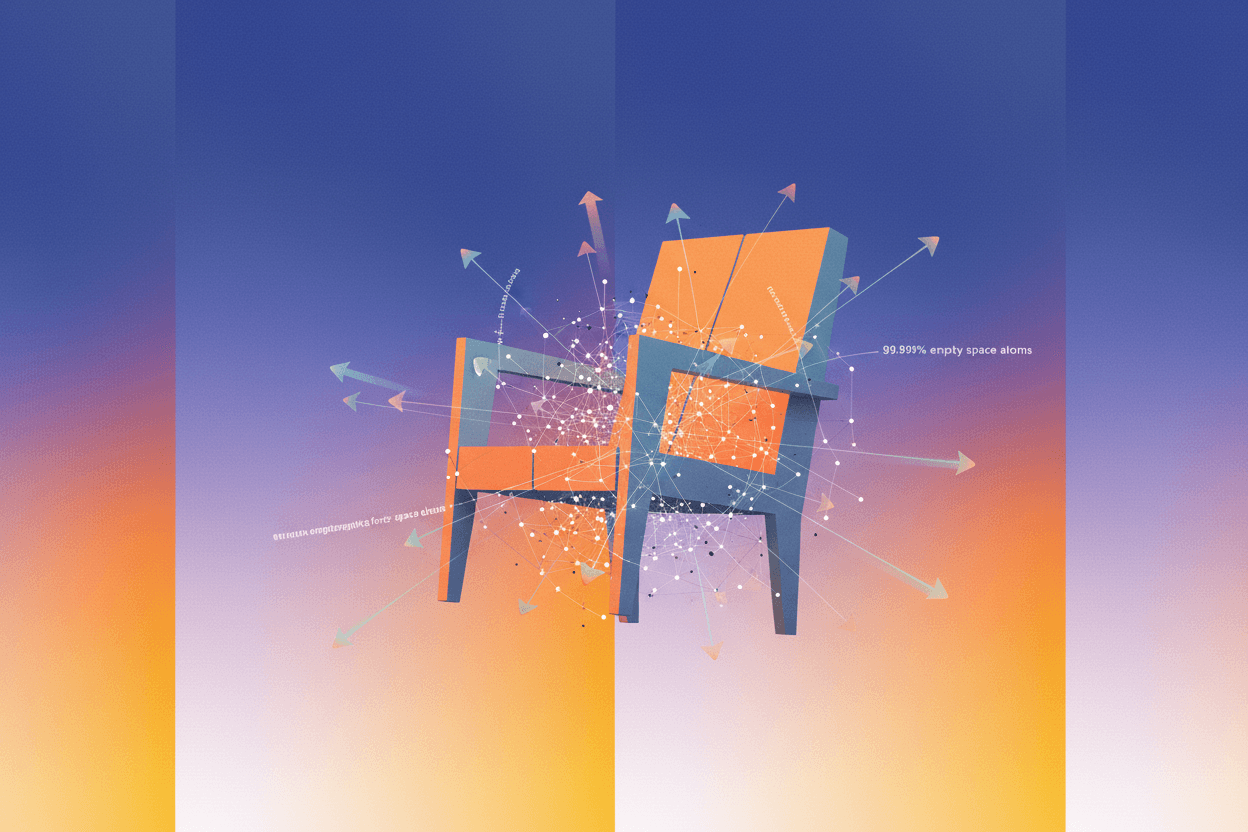
When your palm presses against a table, you feel something undeniably solid. Physics textbooks will tell you about electromagnetic repulsion—negative charges pushing back against negative charges. But that explanation is incomplete. In 2024, quantum simulations confirmed that up to 90% of what we perceive as "solidity" in dense matter arises not from electromagnetic force, but from the Pauli exclusion principle: a quantum statistical rule with no classical equivalent. The question that haunts physicists isn't why matter resists compression—it's why a mathematical constraint on indistinguishable particles manifests as something you can feel.
In 1925, Wolfgang Pauli proposed what would become one of the foundational principles of quantum mechanics: no two identical fermions can occupy the same quantum state simultaneously. Electrons, protons, and neutrons are all fermions—particles with half-integer spin (s = 1/2, 3/2, 5/2, ...).
The exclusion principle emerges from the deeper structure of quantum field theory. Fermion wavefunctions must be antisymmetric under particle exchange:
$$\Psi(1,2) = -\Psi(2,1)$$
If two identical fermions occupied the same quantum state, swapping them would yield:
$$\Psi(1,1) = -\Psi(1,1) = 0$$
The wavefunction collapses to zero. The configuration is forbidden—not by energy, not by force, but by the mathematical structure of quantum reality itself.
[!INSIGHT] The Pauli exclusion principle isn't a force field or an energy barrier. It's a constraint on what quantum states are possible—as fundamental as the rule that probabilities must sum to one.
Degeneracy Pressure: When Statistics Becomes Force
When you compress matter, electrons run out of available quantum states. In a given volume, only so many distinct energy levels exist. Pack electrons tighter, and they're forced into higher energy states—not because something pushes them, but because lower states are already "taken."
Where n is the electron number density. Notice what's missing: temperature. This pressure exists even at absolute zero. It's purely quantum statistical in origin.
The Architecture of Atoms
Why Atoms Have Size
Without the exclusion principle, all electrons in an atom would collapse into the lowest energy orbital (1s). Every atom would be the same size—roughly the size of its nucleus, about 10⁻¹⁵ meters.
Instead, electrons stack into successive shells because lower orbitals fill up and become unavailable. The periodic table—the entire diversity of chemistry—exists because electrons obey Pauli's rule.
Consider carbon (atomic number 6):
1s orbital: 2 electrons (filled)
2s orbital: 2 electrons (filled)
2p orbitals: 2 electrons (partially filled)
The valence electrons in 2p orbitals determine carbon's chemistry. Without exclusion forcing electrons into higher shells, carbon would have no valence electrons—no bonds, no organic chemistry, no life.
The Shell Game in Solids
In solids, atomic orbitals blend into bands—continuous ranges of allowed energy states. When you press your hand against a table:
Electrons in your hand's atoms attempt to occupy the same spatial region as electrons in the table
For this to happen, some electrons would need to transition to higher energy states
The energy required is enormous—on the order of 10³⁰ electrons needing promotion per cubic centimeter
Your hand lacks this energy, so the transition doesn't occur
Your nerves interpret this blocked motion as "solid contact"
“"It is not the electromagnetic forces between electrons that prevent the collapse of matter, but the exclusion principle, which is a consequence of the symmetry properties of the wave function.”
— Victor Weisskopf, Theoretical Physicist
Stellar Evidence: When Pauli Wins Against Gravity
White Dwarfs and the Chandrasekhar Limit
The most dramatic proof of degeneracy pressure occurs in white dwarf stars. These stellar corpses—typically 0.6 solar masses compressed into Earth's volume—are supported entirely by electron degeneracy pressure.
Subrahmanyan Chandrasekhar calculated in 1930 that this support has limits. When a white dwarf exceeds approximately 1.4 solar masses (the Chandrasekhar limit), electron degeneracy pressure fails. Gravity wins. The star collapses into a neutron star or black hole.
Where ω₃⁰ ≈ 2.018 is a constant from the Lane-Emden equation. This isn't theoretical speculation—astronomers have observed dozens of Type Ia supernovae, the explosive death of white dwarfs exceeding this mass limit.
[!NOTE] Neutron stars represent the next line of defense: neutron degeneracy pressure. With neutrons roughly 1,836 times more massive than electrons, the degeneracy pressure scales differently, supporting masses up to about 2-3 solar masses before collapse becomes inevitable.
The Illusion of Touch
What Your Fingers Actually Feel
Neuroscience and physics converge on an unsettling truth: you have never touched anything.
When your finger approaches a surface:
At ~1 nanometer distance: van der Waals forces become significant
At ~0.3 nanometers: Pauli exclusion dominates, requiring ~100 eV per electron to compress further
Your skin deforms, mechanoreceptors fire, your brain constructs the sensation of "contact"
The repulsive force you experience is:
$$F_{total} = F_{EM} + F_{degeneracy}$$
For dense matter at normal pressures, F_degeneracy can exceed F_EM by factors of 10-100. The "solidity" you feel is primarily quantum statistics masquerading as classical force.
The Philosophical Inversion
Classical intuition suggests: Objects are hard because forces push back.
Quantum reality reveals: Objects occupy space because certain configurations are mathematically inaccessible.
This inverts our metaphysics. Solidity isn't a property imposed by force fields; it's a consequence of what the universe permits to exist. The Pauli exclusion principle operates not through causation but through constraint—less like a bouncer pushing people out, more like a building with rooms that can only hold one occupant each.
Implications: From Semiconductors to Quantum Computing
The same principle that prevents you from phasing through your chair enables modern technology:
Semiconductors: Band structure—the foundation of all electronics—arises from Pauli exclusion creating energy gaps
MRI machines: Nuclear magnetic resonance relies on the spin states of protons, governed by exclusion in the nucleus
Quantum computers: Qubit coherence depends on fermionic states that exclude one another, enabling quantum superposition without collapse
Understanding that solidity is "faked" by quantum statistics rather than enforced by classical forces isn't merely academic—it's the conceptual foundation for manipulating matter at its most fundamental level.
Key Takeaway
The solidity of matter—the resistance you feel when pressing against any surface—is approximately 90% due to the Pauli exclusion principle, not electromagnetic repulsion. This principle forbids identical fermions from sharing quantum states, forcing electrons into higher energy configurations when compressed. The energy cost of this forced promotion manifests as the pressure we interpret as "hardness." Solidity is quantum statistical constraint experienced macroscopically.
Sources: Pauli, W. (1925). "Über den Zusammenhang des Abschlusses der Elektronengruppen im Atom mit der Komplexstruktur der Spektren." Zeitschrift für Physik. Chandrasekhar, S. (1931). "The Maximum Mass of Ideal White Dwarfs." The Astrophysical Journal. Weisskopf, V.F. (1975). Lectures in Theoretical Physics. Dyson, F. & Lieb, E. (1978). "Ground-State Energy of a Finite System of Charged Particles." Communications in Mathematical Physics.
This is a Premium Article
Hylē Media members get unlimited access to all premium content. Sign up free — no credit card required.