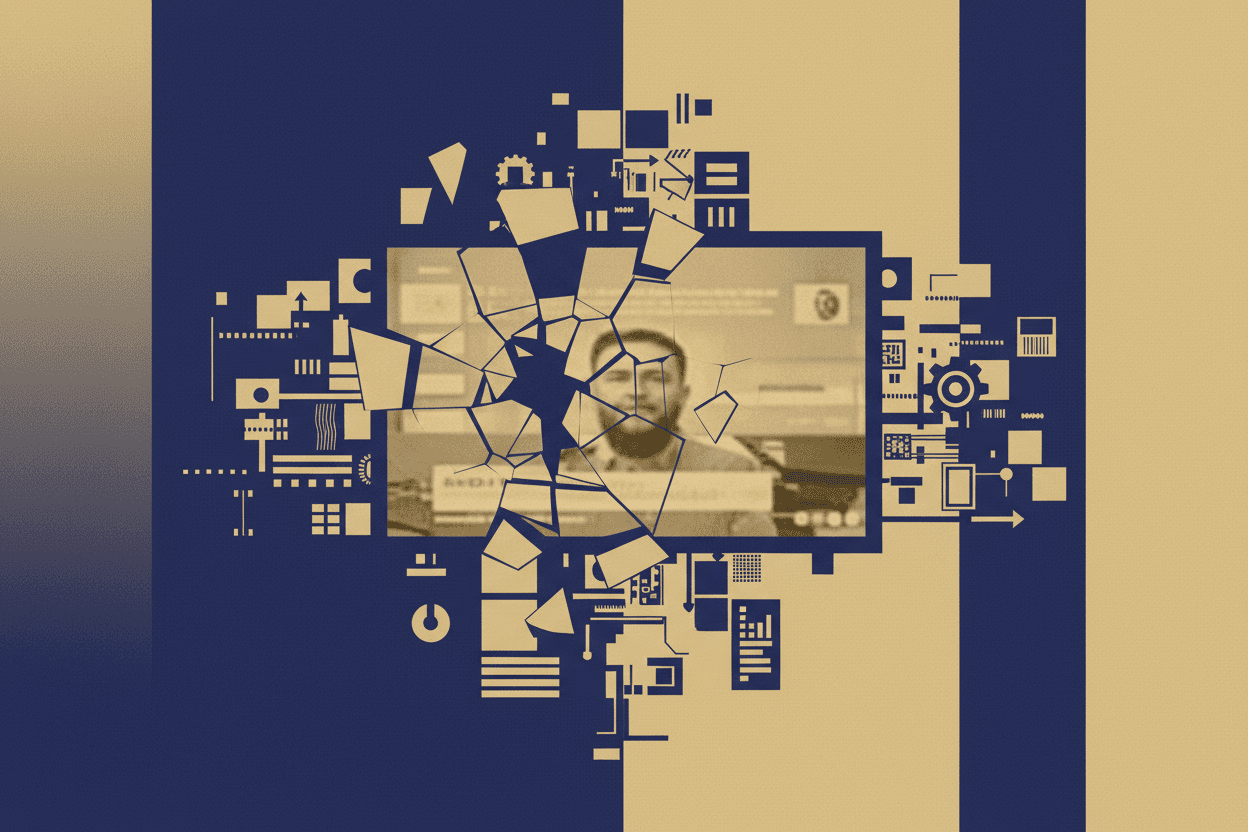
The Liar's Dividend: When Truth Becomes Worthless
Deepfakes do not just create false evidence — they let the guilty claim real evidence is fake. Welcome to the Liar's Dividend, where truth itself becomes optional.
Deepfakes do not just create false evidence. They destroy real evidence — because now any video can be dismissed as 'probably fake.' That's the part nobody planned for.
In 2023, a chilling statistic emerged from researchers at the University of Munich: 27% of surveyed judges reported that defense attorneys had already attempted to challenge authentic video evidence by claiming it was manipulated. The technology meant to entertain and innovate has armed every liar with plausible deniability.
But here is what keeps legal scholars awake at night: this problem will get exponentially worse before it gets better.
The Birth of a Dangerous Concept
Professors Bobby Chesney and Danielle Citron at the University of Texas coined the term "Liar's Dividend" in their landmark 2019 paper. The concept describes a perverse outcome of deepfake technology: as the public becomes aware that synthetic media exists, bad actors gain a powerful new defense — simply claim that authentic evidence is fabricated.
The dividend pays out in courtroom victories, political survival, and escaped accountability. And unlike deepfakes themselves, which require technical sophistication to create, the Liar's Dividend costs nothing to claim.
[!INSIGHT] The Liar's Dividend inverts the burden of proof. Where video once served as near-definitive evidence, it now demands authentication that may be technically impossible or prohibitively expensive.
The mechanics are straightforward. Traditional defamation law assumed that false statements could be identified and corrected. But when reality itself becomes contestable, the legal system lacks tools to distinguish signal from noise.
Real-World Cases Already Emerging
In 2022, a child custody case in Washington state became one of the first documented instances of the Liar's Dividend in action. A mother presented audio recordings of her ex-husband making violent threats. His attorney argued the recordings could be AI-generated. The judge admitted the evidence but noted in his ruling that "the authenticity of audio recordings will soon become a standard point of contention."
“*"The most dangerous aspect of deepfakes is not the lies they tell”
By 2024, the phenomenon had spread to criminal courts. A murder trial in Florida saw defense attorneys successfully introduce doubt about surveillance footage by citing deepfake technology. The defendant was ultimately convicted on other evidence, but legal observers noted the strategy would only become more effective as synthetic media improves.
The Geopolitical Weaponization
If the Liar's Dividend distorts domestic justice, its international implications are terrifying.
War crimes investigators have long relied on smartphone footage from conflict zones. Videos captured by civilians and journalists have documented atrocities in Syria, Ukraine, and Myanmar. But the rise of deepfakes provides authoritarian regimes and military forces with a ready-made defense.
In March 2024, researchers at the Atlantic Council documented a coordinated campaign by state actors to dismiss verified war footage as "Western deepfake propaganda." The campaign did not need to create actual deepfakes — merely invoking the possibility was sufficient to seed doubt.
[!INSIGHT] The Liar's Dividend operates as an asymmetric weapon. State actors with resources can create both deepfakes and denial campaigns, while victims and journalists lack equivalent authentication infrastructure.
The United Nations has begun grappling with this challenge. A 2023 report from the Special Rapporteur on extrajudicial killings warned that "the erosion of trust in visual evidence represents a fundamental threat to accountability for mass atrocities."
The Authentication Crisis
Technical solutions exist, but they face fundamental limitations:
-
Digital Signatures: Cameras can embed cryptographically signed metadata proving a video's origin. But adoption remains minimal, and metadata can be stripped.
-
Forensic Analysis: AI-based detection tools exist but remain locked in an arms race with generation technology. No detector achieves 100% accuracy.
-
Blockchain Provenance: Systems like the Content Authenticity Initiative track edit history, but cannot verify the original scene's authenticity.
The uncomfortable truth is that perfect authentication may be impossible. Every technical solution creates new attack vectors, and the cost of forgery continues to drop.
The Social Trust Erosion
Beyond courts and conflict zones, the Liar's Dividend corrodes the foundation of shared reality.
A 2024 Pew Research study found that 67% of Americans now believe it is "very or somewhat likely" that political videos they see online have been manipulated. This baseline skepticism represents a fundamental shift in how citizens process information.
The consequences extend in multiple directions:
- Whistleblower Suppression: Leaked videos of corporate or government misconduct can now be dismissed as fabrications without evidence
- Journalistic Verification Costs: News organizations now spend 3-5x more resources verifying user-generated content than in 2019
- Social Movement Undermining: Activist footage documenting police brutality or human rights abuses faces automatic skepticism
[!NOTE] The Liar's Dividend disproportionately harms marginalized communities. Those already disbelieved by institutions — abuse survivors, minorities, political dissidents — face an additional layer of doubt when they present video evidence.
Perhaps most insidiously, the Liar's Dividend creates a self-reinforcing cycle. As skepticism grows, authentication demands increase. As authentication costs rise, fewer legitimate videos get properly verified. As verification rates drop, skepticism deepens further.
Living in a Post-Trust World
The Liar's Dividend cannot be solved by technology alone. No detection algorithm can restore what synthetic media has broken: the assumption that seeing is believing.
Legal systems are slowly adapting. Some jurisdictions now allow expert testimony on deepfake detection. The U.S. National Institute of Standards and Technology released preliminary guidelines for digital evidence authentication in 2024. But procedural changes move slowly, while synthetic media improves rapidly.
The technology that was supposed to democratize creativity may end up accomplishing something far more profound: the democratization of lying.
Sources: Chesney, B. & Citron, D. (2019). "Deep Fakes: A Looming Challenge for Privacy, Democracy, and National Security." California Law Review; Atlantic Council Digital Forensic Research Lab (2024); Pew Research Center (2024); University of Munich Law & Technology Study (2023); NIST Digital Evidence Guidelines (2024)
This is a Premium Article
Hylē Media members get unlimited access to all premium content. Sign up free — no credit card required.