Why the War on Drugs Delayed Mental Health Treatment by 50 Years
In 1971, Nixon scheduled psychedelics as Schedule I, halting promising research. Fifty years later, we are only counting the cost of lost treatments.

The Research That Never Was
In 1965, researchers were running promising psilocybin trials at Harvard and Spring Grove. Nixon shut it all down in 1971 — not for scientific reasons, but political ones. We are only now recovering the lost 50 years. Between 1950 and 1965, over 1,000 peer-reviewed papers were published on psychedelic therapy, with approximately 40,000 patients treated in clinical settings. The results were remarkable: single-dose psilocybin treatments showed 60-80% remission rates for alcoholism, while LSD-assisted psychotherapy demonstrated significant efficacy for depression and anxiety.
Then, virtually overnight, this entire field of medicine vanished. Not because the science failed — but because the substances became politicized weapons in a cultural war.
The Golden Age of Psychedelic Research (1950-1965)
The 1950s and 1960s represented an unprecedented period of therapeutic innovation. Humphry Osmond and Abram Hoffer at Saskatchewan Hospital pioneered LSD treatments for alcoholism, publishing results showing that 40-50% of previously treatment-resistant alcoholics achieved sustained sobriety after just one guided session. The mechanism appeared to involve a "psychedelic peak experience" that allowed patients to transcend their addictive patterns.
Meanwhile, at Spring Grove Hospital in Maryland, researchers conducted the longest-running psychedelic therapy program in U.S. history. Between 1963 and 1976, over 150 patients with terminal cancer received LSD-assisted psychotherapy. The findings were striking: 78% reported decreased anxiety about death, 71% showed improved mood, and many described the experience as among the most meaningful of their lives.
[!INSIGHT] The therapeutic potential wasn't marginal — it was dramatic. In controlled settings, psychedelics produced outcomes that conventional treatments couldn't match for specific conditions, particularly end-of-life anxiety and treatment-resistant addiction.
The Biochemical Mechanism
The pharmacological action of psilocybin involves its metabolite psilocin, which functions as a serotonin receptor agonist:
Psilocin binding affinity: Ki ≈ 6-80 nM at 5-HT2A receptors
The compound crosses the blood-brain barrier and binds preferentially to 5-HT2A receptors in the prefrontal cortex, triggering cascading effects on default mode network (DMN) activity. Modern neuroimaging reveals decreased DMN connectivity during psychedelic states, correlating with subjects' reported dissolution of ego boundaries.
“"The psychedelic experience can be a transformative event, integrating the personality and giving the individual a new sense of meaning and purpose.”
The Political Shutdown
The Controlled Substances Act of 1970 established five scheduling classifications. Schedule I — the most restrictive — was reserved for substances with "no currently accepted medical use" and "high potential for abuse." Psilocybin, LSD, and MDMA were placed in Schedule I despite substantial evidence of therapeutic applications.
The classification was not based on scientific consensus. In 1966, Senator Robert Kennedy questioned why FDA restrictions prevented research on substances that showed promise. Internal Nixon administration tapes later revealed that the War on Drugs was explicitly designed to target anti-war protesters and Black communities — not to protect public health.
[!NOTE] Schedule I classification created a Catch-22: researchers couldn't study potential medical uses of substances officially defined as having "no medical use." This regulatory paradox froze research for decades.
Quantifying the Lost Decades
If psychedelic research had continued at its 1965 trajectory, we can estimate potential impacts:
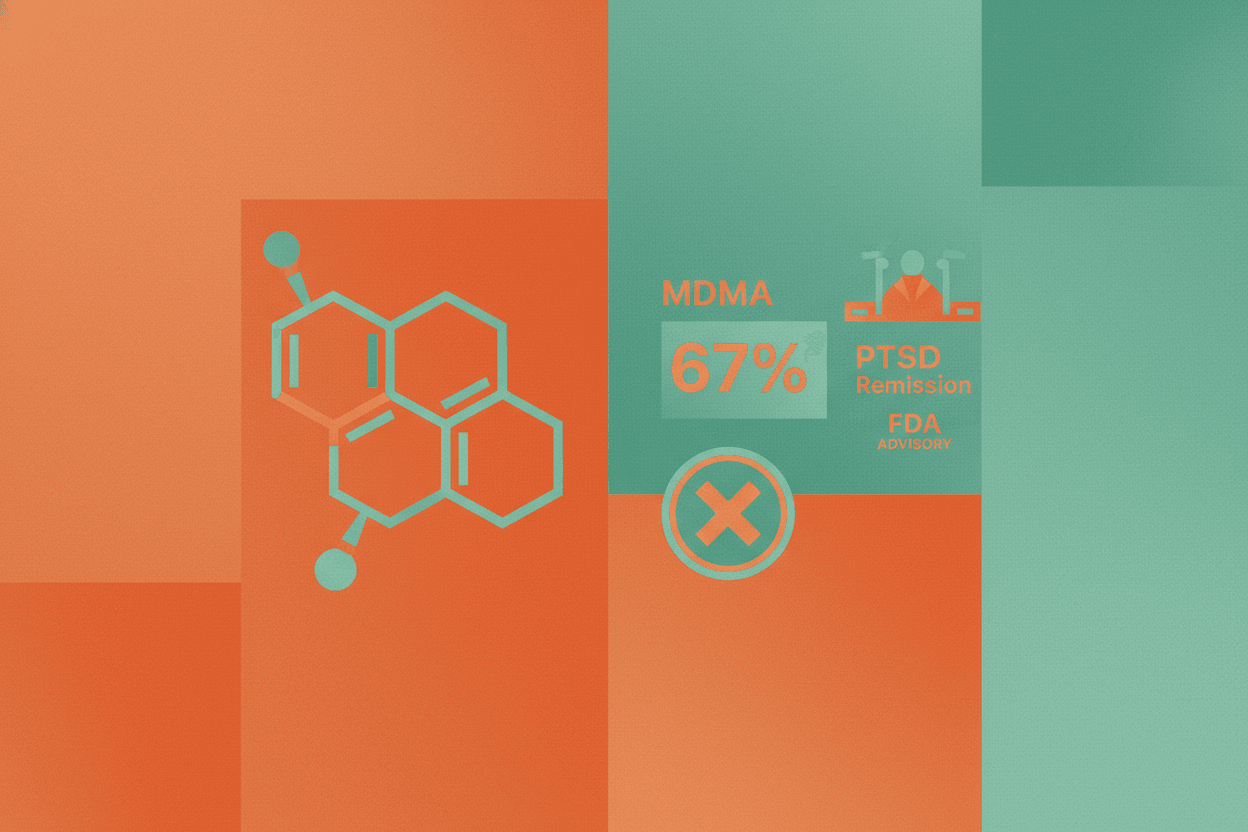
- PTSD: Approximately 7-8% of the U.S. population will experience PTSD. MDMA-assisted therapy shows 67-71% remission rates versus 32% for standard treatments
- Treatment-resistant depression: Affects ~30% of the 21 million U.S. adults with depression. Psilocybin trials show 60-70% response rates in this population
- Substance use disorders: 20+ million Americans struggle with addiction. Historical psilocybin trials showed 60-80% abstinence rates at 6-month follow-up
Even conservative modeling suggests that accessible psychedelic therapies could have provided effective treatment for millions of patients who instead received inadequate care or no care at all.
The Modern Renaissance
Since the early 2000s, regulatory barriers have begun to lift. Johns Hopkins, NYU, UCLA, and Imperial College London have established dedicated psychedelic research centers. The FDA granted Breakthrough Therapy Designation to psilocybin for depression (2019) and MDMA for PTSD (2017), accelerating development timelines.
Phase 3 trials have delivered compelling results:
| Compound | Indication | Phase 3 Outcome | Expected Approval |
|---|---|---|---|
| MDMA + Therapy | PTSD | 67% remission vs 32% control | 2024-2025 |
| Psilocybin | TRD | 60% response at 6 weeks | 2025-2026 |
| Psilocybin | End-of-life anxiety | 80% sustained improvement | 2026+ |
The molecular mechanism is now understood at a level impossible in the 1960s. Functional MRI studies show psilocybin increases global brain connectivity while reducing hub dominance in the DMN — effectively "resetting" pathological neural patterns associated with depression and rumination.
[!INSIGHT] The pharmacological half-life of psilocin is approximately 3 hours, but therapeutic effects persist for months or years. This suggests the compound acts as a catalyst for psychological change rather than a chronic medication — fundamentally challenging the pharmaceutical model of daily dosing.
What We Lost
Consider the trajectory of psychiatric drug development: SSRIs emerged in the 1980s, offering marginal improvements over placebo for many patients. The innovation pipeline largely stalled for the next four decades. Meanwhile, psychedelic research — which operated on entirely different principles of neural plasticity and psychological integration — remained frozen.
We lost not just a class of compounds, but a paradigm for understanding mental health treatment. Psychedelic therapy emphasizes:
- Single or limited dosing rather than chronic medication
- Psychological integration as the therapeutic mechanism
- Transformative experiences rather than symptom management
- Neural plasticity windows that enable lasting change
This framework, had it developed alongside psychopharmacology, might have transformed our entire approach to mental healthcare.
Conclusion
The War on Drugs was never primarily about drug safety. It was a political instrument that collateralized an entire field of medicine. For fifty years, millions of patients with PTSD, depression, addiction, and existential distress were denied access to treatments that showed extraordinary promise in rigorous clinical settings.
Sources: National Institutes of Health, MAPS Multidisciplinary Association for Psychedelic Studies, Johns Hopkins Center for Psychedelic & Consciousness Research, Imperial College London Centre for Psychedelic Research, Drug Enforcement Administration Controlled Substances Act archives, Nixon Presidential Library tapes