Why Luxury Brands Deliberately Make You Feel Excluded
Hermès won't sell you a Birkin on your first visit. The waiting list isn't logistics—it's the product. Exclusion is the most profitable marketing strategy ever invented.
The $12,000 Rejection
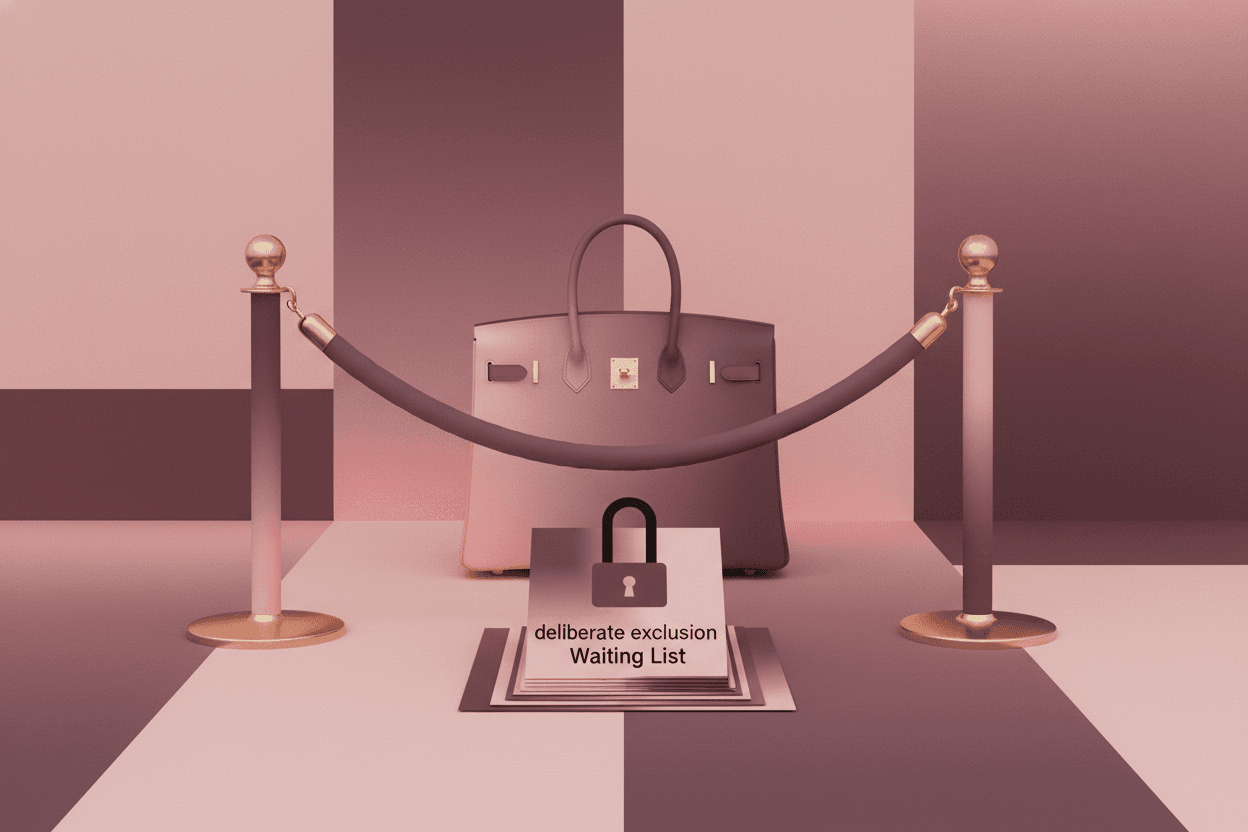
Hermès will not sell you a Birkin bag on your first visit to the store. Sometimes not the second. The waiting list is not a logistics problem — it's the product. The thing they're selling is the experience of being the kind of person who eventually gets in.
In 2024, a Birkin 25 retails for approximately $12,000, yet the average wait time for a first-time buyer stretches to 18–24 months across major markets. Here's what's remarkable: Hermès produces roughly 70,000 leather bags annually and could easily scale production. They choose not to. The rejection you feel when told "we don't have that in stock" is not a supply chain failure — it's a meticulously engineered psychological trigger that has helped the brand achieve a valuation exceeding $220 billion.
Why would any company deliberately turn away customers with money in hand? The answer reveals something uncomfortable about human psychology: we don't want things. We want to be the kind of people who are allowed to have them.
The Architecture of Artificial Scarcity
The modern luxury rejection machine was not invented by Hermès. It was systematized by streetwear.
Supreme, the skateboarding brand turned cultural phenomenon, perfected what analysts now call the "drop model." Every Thursday at 11 AM, limited products appear online and in stores. Within 60 seconds, 98% of inventory disappears. In 2024, Supreme's parent company reported that products routinely sell out in under 30 seconds, with resale markups averaging 400–700% on secondary platforms like StockX.
[!INSIGHT] The drop model transformed shopping from a transaction into an event. The trauma of missing out became more emotionally resonant than the satisfaction of acquiring.
Rolex operates on a different timescale but identical psychology. The Rolex Daytona, retailing around $15,000, carries a waiting list of 5–10 years at authorized dealers. Industry insiders report that the allocation system rewards "relationship building" — a euphemism for purchasing other jewelry, watches, or building purchase history over time. One collector spent $40,000 on auxiliary products before receiving the call that his Daytona was available.
The common thread across these brands is not quality or heritage. It's controlled rejection.
The Three Stages of Luxury Exclusion
-
The Gatekeeper Moment: A sales associate informs you the desired item is unavailable. No timeline is given. The ambiguity is deliberate.
-
The Qualification Period: You must demonstrate loyalty through peripheral purchases, brand knowledge, or patience. You are being evaluated.
-
The Acceptance Ritual: When finally granted access, the purchase becomes a celebration rather than a transaction. You've been chosen.
“"The best marketing is when your customer feels lucky to give you money.”
Identity Economics: Buying Membership, Not Products
Behavioral economists have documented a phenomenon called "effort justification" — we value things more when we suffer to obtain them. A 2023 study in the Journal of Consumer Psychology found that participants who completed a difficult task to earn a reward rated its value 47% higher than those who received it effortlessly.
Luxury brands have internalized this research at an institutional level.
When a Hermès client finally receives the call that a Birkin is available, the bag arrives in an elaborate unboxing ritual. White gloves. Orange ribbon. A personal consultation. The experience communicates: You have been selected. The bag is evidence of membership, not merely an accessory.
[!INSIGHT] The product being sold is not leather and hardware — it's social identity. The bag proves you belong to a club that rejects most applicants.
This explains why luxury brands rarely advertise availability. You've never seen a Hermès billboard saying "Birkin bags in stock now." That message would undermine the entire psychological architecture. Scarcity must feel organic, even when it's entirely manufactured.
The Counterintuitive Mathematics of Rejection
Consider the numbers: Hermès operates roughly 300 stores globally. If each store sold just two more Birkins per month — entirely feasible given production capacity — annual revenue would increase by an estimated $86 million. Yet they don't.
Why? Because flooding the market would collapse the secondary market premium, which currently sees Birkins resell for 30–80% above retail. More importantly, it would eliminate the exclusion narrative that drives all other product categories. The waiting list for a $12,000 bag creates desire for the $300 scarf you can buy today.
What Mass Market Brands Get Wrong
Mainstream companies consistently misunderstand luxury strategy. They see the waiting lists and attempt to replicate them through artificial scarcity — limited editions, countdown timers, "only 3 left in stock" notifications.
These tactics fail because they copy the mechanics without understanding the psychology.
[!NOTE] True luxury exclusion requires what strategists call "earned access." The barrier must feel meaningful, not manufactured. A countdown timer on Amazon feels like manipulation. A five-year wait for a Rolex feels like a test of character.
The difference lies in narrative justification. Hermès justifies exclusion through "craftsmanship" — each bag allegedly takes 48 hours of artisan labor. Rolex cites "demand exceeding production capacity." Whether these explanations are literally true matters less than whether they feel authentic to the brand story.
Mass market attempts at scarcity fail because consumers instantly recognize the inauthenticity. A sneaker brand producing 5,000 limited-edition shoes while manufacturing 50 million standard pairs isn't creating exclusivity — it's creating a lottery. The emotional resonance is fundamentally different.
The Broader Implication: Exclusion as Business Model
The luxury strategy reveals something uncomfortable about consumer psychology that extends far beyond handbags and watches.
We are social animals wired to interpret rejection as a signal of value. When a club won't let us in, we assume the people inside must be extraordinary. When a university rejects 94% of applicants, we assume its education must be transformative. When a dating app feels exclusive, we assume its users must be higher quality.
“*"The desire to belong to the group that doesn't let you in is the entire business model.”
The most profitable companies in any category are often those who figure out how to say "no" to customers convincingly. Not because they lack capacity, but because selective acceptance creates more value than universal availability.
This raises an ethical question that luxury brands prefer to avoid: Is engineering feelings of exclusion to sell products manipulative? Perhaps. But it's also remarkably effective.
Sources: Journal of Consumer Psychology (2023), "Effort Justification and Perceived Value"; Business of Fashion/McKinsey State of Fashion Report 2024; StockX Big Facts Report 2024; Hermès Annual Report 2023; Lindstrom, M. "Brandwashed" (2011); Company filings and market analysis from Bernstein Research.