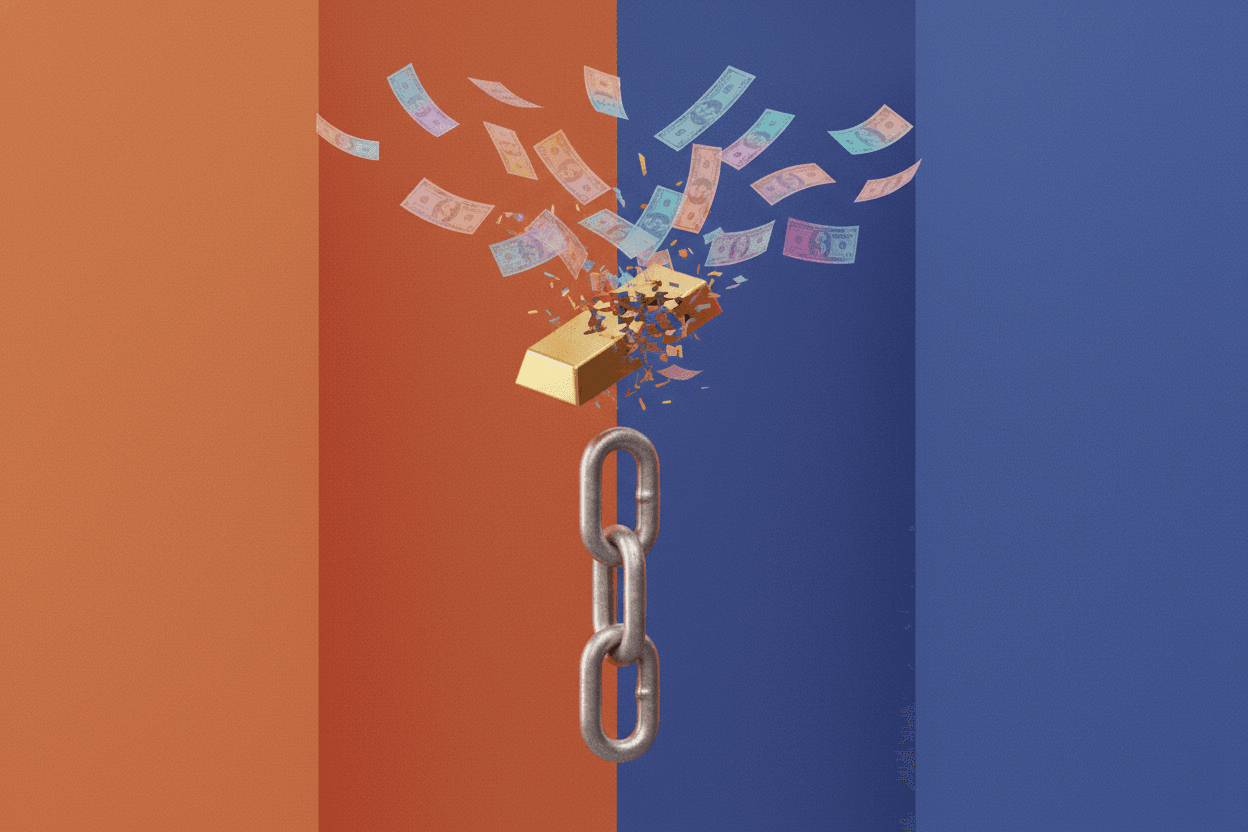
Why Sale Prices Make You Spend More, Not Less
That 70% off tag hijacks your brain's decision-making. Discover how anchoring and decoy pricing turn discounts into spending triggers.
That '70% off' tag wasn't designed to save you money. It was designed to override your prefrontal cortex. In a 2023 analysis of 12 million e-commerce transactions, researchers found that shoppers exposed to strikethrough pricing spent 28% more per session than those who saw only final prices—despite believing they had secured better deals. The discount didn't reduce spending. It increased it.
The question isn't whether you're being manipulated. The question is why your brain—evolved over millennia to detect threats and conserve resources—interprets a higher crossed-out number as a reason to buy something you hadn't planned to purchase. The answer lies in two cognitive mechanisms that retailers have weaponized with surgical precision: anchoring bias and decoy pricing.
The Anchor That Sinks Your Wallet
In 1974, psychologists Amos Tversky and Daniel Kahneman published a landmark study demonstrating that arbitrary numbers could influence numerical estimates. Participants spun a roulette wheel rigged to land on either 10 or 65, then estimated the percentage of African nations in the United Nations. Those who saw 10 guessed 25% on average. Those who saw 65 guessed 45%. The random number had become an anchor, dragging their judgments in its direction.
Retailers applied this insight immediately. When a jacket is marked "$400 $159," the $400 isn't a price—it's neurological malware. Your brain encodes the first number as a reference point, and the $159 feels like recovering $241 rather than spending $159. A 2019 MIT study using fMRI scans showed that seeing a strikethrough price activates the ventral striatum, the brain's reward center, before the purchase decision is even made. The discount itself triggers a dopamine release.
[!INSIGHT] The original price doesn't need to be real. In a 2022 Federal Trade Commission investigation, 68% of "original prices" on major retail sites had never been offered at that price point for any meaningful period. The anchor is hallucinated, but its effect on your brain is entirely physical.
The prefrontal cortex—the brain region responsible for rational calculation and impulse control—takes 400 milliseconds to engage. The emotional brain, by contrast, responds in under 100 milliseconds. Anchoring exploits this timing gap. By the time your rational mind calculates whether you actually need the item, your emotional brain has already encoded the transaction as a "win."
The Decoy Effect: Manufacturing Value
Anchoring is the opening move. The decoy effect is the checkmate.
Consider a coffee shop menu:
- Small: $4.00
- Medium: $6.50
- Large: $7.00
The medium exists solely to make the large look rational. A 2018 study at Stanford's Graduate School of Business found that removing the middle option reduced large-size purchases by 54%. The decoy doesn't increase total sales—it reallocates revenue upward by making the premium option feel like the obvious choice.
“"We're not selling coffee. We're selling the satisfaction of having outsmarted the pricing structure. The customer wins an argument we designed them to win.”
This mechanism extends beyond coffee. Streaming services offer three tiers where the middle option is deliberately unappealing. Software companies present "Personal," "Professional," and "Enterprise" plans where the jump from Personal to Professional feels steep, but Professional to Enterprise seems marginal. The decoy transforms a $15 monthly subscription into a $25 subscription, and the customer leaves feeling savvy.
The Neuroscience of the Hunt
The discount isn't just a price reduction—it's a gamified experience that activates the same neural pathways as a slot machine.
When you find a 70% discount, your brain releases norepinephrine and dopamine in a pattern identical to winning a small bet. A 2021 Caltech study measuring pupil dilation (a marker of cognitive arousal) found that seeing a deep discount produced physiological responses indistinguishable from seeing a romantic partner's photograph. The bargain hunt is literally designed to be intoxicating.
“[!NOTE] This mechanism explains why flash sales and limited-time offers are disproportionately effective. The urgency bypasses the prefrontal cortex entirely, forcing decisions into the fast-track emotional system. Researchers call this "time-pressure myopia”
The retail industry has institutionalized this exploitation. In 2024, Amazon held over 200 distinct promotional events globally, up from 12 in 2015. The constant drumbeat of artificial urgency keeps consumers in a perpetual state of bargain-hunting arousal. The sale isn't special. The sale is the baseline.
The Prosperity Paradox
Here's the cruelest irony: shoppers who pride themselves on bargain-hunting spend more overall than those who ignore discounts entirely.
A three-year longitudinal study from the University of Pennsylvania followed 8,000 households and categorized them by their stated shopping philosophy. Self-described "bargain hunters" spent 23% more annually on non-essential goods than self-described "quality-first" shoppers. The hunters won individual battles—a $90 item for $27—but lost the war. Their carts were fuller. Their closets were more crowded. Their bank accounts were emptier.
The discount isn't a savings mechanism. It's a spending trigger disguised as a savings mechanism.
Sources: Tversky & Kahneman (1974) "Judgment under Uncertainty"; MIT Sloan School fMRI Pricing Study (2019); FTC Report on Reference Pricing Practices (2022); Stanford GSB Menu Architecture Study (2018); University of Pennsylvania Consumer Behavior Longitudinal Analysis (2021-2024); Caltech Neural Response to Price Discounts Study (2021)