There Are 27,000 Pieces of Garbage Orbiting Earth Right Now
27,000 trackable objects orbit Earth at 17,000 mph. A paint fleck hits like a bowling ball. The tragedy of the commons is unfolding in orbit—above our heads.
A Hidden Crisis Above Our Heads
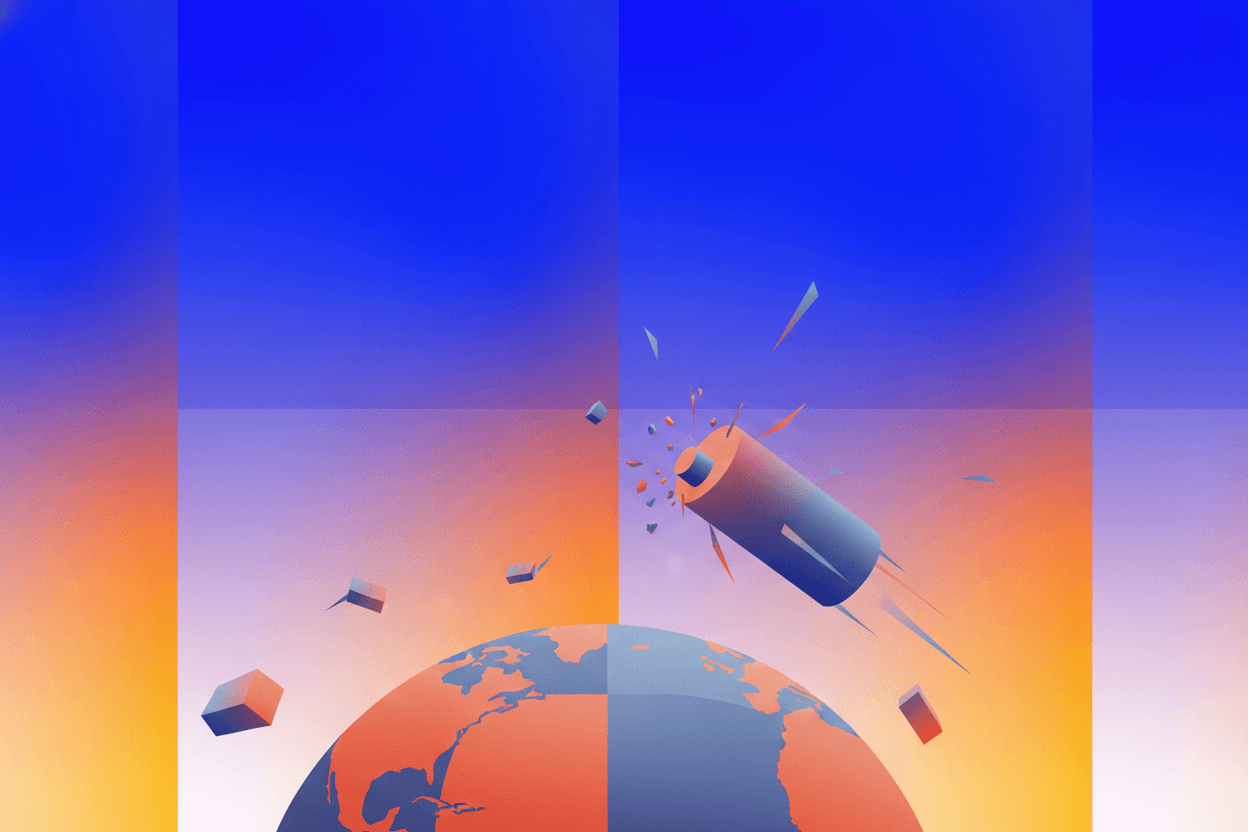
There are 27,000 trackable pieces of space debris orbiting Earth at 17,000 miles per hour. A fleck of paint at that speed hits with the force of a bowling ball dropped from a skyscraper. The International Space Station maneuvers to avoid collision an average of three times per year—and that only accounts for what we can see.
The numbers grow more alarming at smaller scales. While 27,000 objects larger than 10 centimeters are tracked by ground-based radar, estimates suggest over 500,000 marble-sized objects between 1 and 10 centimeters whirl overhead entirely unmonitored. In 2024, the European Space Agency documented a 15% year-over-year increase in catalogued debris objects.
Here is the question that haunts orbital mechanics experts: What happens when two pieces of junk collide at combined speeds exceeding 30,000 miles per hour, creating thousands more fragments in an unstoppable chain reaction?
The Tragedy of the Commons, Orbited
In 1968, ecologist Garrett Hardin described a scenario where multiple individuals, acting independently in their own self-interest, deplete a shared resource—despite it being against everyone's long-term interest. He called it "the tragedy of the commons." Fifty-five years later, that tragedy is playing out 250 miles above Earth's surface.
Low Earth Orbit, or LEO, represents the ultimate shared resource: a finite band of space where satellites provide GPS navigation, weather forecasting, climate monitoring, and global communications. Yet no single nation owns it, no single authority polices it, and every launch adds to the congestion.
[!INSIGHT] The economic principle governing orbital space mirrors 17th-century English commons—unrestricted access leads to resource collapse. The difference: when a grazing commons fails, sheep starve. When orbital commons fail, $700 billion in satellite infrastructure becomes endangered.
The incentives are perversely misaligned. Launch operators benefit from putting satellites up; the cost of congestion is distributed across all users. Debris removal offers no profit. Cleanup missions cost tens of millions while creating no revenue stream. The rational actor launches and abandons.
Case Study: Cosmos 2251 and Iridium 33
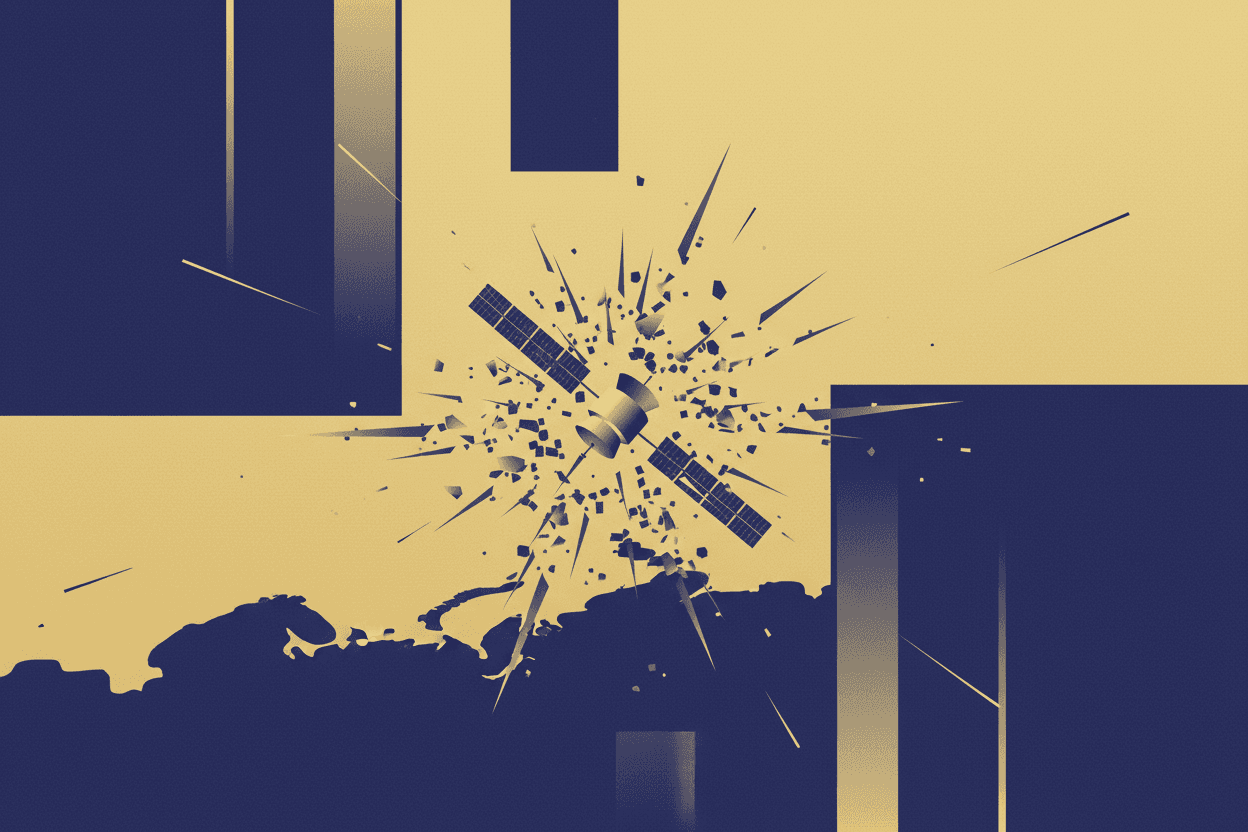
On February 10, 2009, the first catastrophic collision between two intact satellites occurred 490 miles above Siberia. A defunct Russian military communications satellite, Cosmos 2251, struck an operational American commercial satellite, Iridium 33, at nearly 26,000 miles per hour.
The impact generated over 2,300 trackable fragments—each now an independent projectile following its own orbital trajectory. As of 2024, approximately 1,800 pieces from that single collision remain in orbit, circling Earth every 90 minutes.
“*"The collision was the equivalent of a bus hitting a bus at 400 miles per hour, except instead of two wrecks, you get thousands of fragments each capable of destroying another satellite.”
The Iridium-Cosmos event transformed debris theory into debris reality. Before 2009, catastrophic collisions were hypothetical scenarios. After, they became statistical certainties.
When Paint Becomes a Bullet
Understanding the destructive potential of orbital debris requires grasping kinetic energy at hypervelocity speeds. The formula is straightforward: KE = ½mv². Mass matters, but velocity matters squared.
A 1-gram paint fleck—roughly the weight of a paperclip—traveling at 17,500 mph carries kinetic energy comparable to a .50 caliber sniper rifle round. It can punch through aluminum plating. A 10-centimeter object, roughly the size of a softball, carries the energy of 25 sticks of dynamite.
In 2016, British astronaut Tim Peake shared a photograph of a 7-millimeter chip in the Cupola window of the International Space Station. The culprit was likely a paint flake or tiny metal fragment no larger than a grain of sand. Had it struck a spacesuit during extravehicular activity, the outcome could have been catastrophic.
[!INSIGHT] The ISS carries over 400 shields called Whipple Shields—layered defenses designed to disintegrate small debris before it penetrates pressurized modules. They work for objects up to 1 centimeter. Anything larger requires the station to physically move out of the way—burning precious fuel and shortening mission lifespan.
The mathematics are brutal. At 1-centimeter thickness, debris numbers swell to an estimated 100 million objects. At current tracking capabilities, we see approximately 0.027% of the objects capable of mission-ending damage.
The Kessler Syndrome: A Cascade We Cannot Stop
In 1978, NASA astrophysicist Donald Kessler proposed a scenario where the density of objects in low Earth orbit becomes high enough that collisions between objects generate more debris, which in turn causes more collisions. The cascade would eventually render orbital space unusable for decades.
Kessler calculated that this tipping point would be reached when debris density became self-sustaining—when new collisions generated fragments faster than atmospheric drag could clear them.
“*"We've already reached Kessler conditions in certain altitude bands. At 800 to 1,000 kilometers, debris populations are now increasing independently of new launches.”
The implications extend beyond satellite television. Weather prediction relies on polar-orbiting satellites. Climate monitoring depends on LEO observation platforms. Disaster response coordinates through satellite communications. GPS—the backbone of global logistics, financial transactions, and emergency services—requires the medium Earth orbit satellites above the debris zone. But launching replacement satellites through a debris field presents its own hazards.
[!NOTE] China's 2007 anti-satellite test, which destroyed a defunct weather satellite at 530 miles altitude, single-handedly increased the trackable debris population by 25%. Those fragments will remain in orbit for decades, crossing the paths of operational satellites approximately 150 times per year.
The 2021 Russian ASAT Test
On November 15, 2021, Russia destroyed a defunct Soviet-era satellite, Cosmos 1408, with a ground-launched missile. The impact occurred at approximately 480 kilometers altitude—dangerously close to the ISS orbit.
The seven crew members aboard the station took shelter in their docked capsules, prepared for emergency evacuation. Over 1,500 trackable fragments were created instantly. NASA estimated the total debris cloud at over 150,000 objects.
The event forced the ISS to perform two debris-avoidance maneuvers in the following six months. It also accelerated diplomatic discussions on debris mitigation—and exposed the complete absence of enforcement mechanisms.
Why Nobody Is Cleaning Up
The technological capability to remove debris exists. The economic and legal frameworks do not.
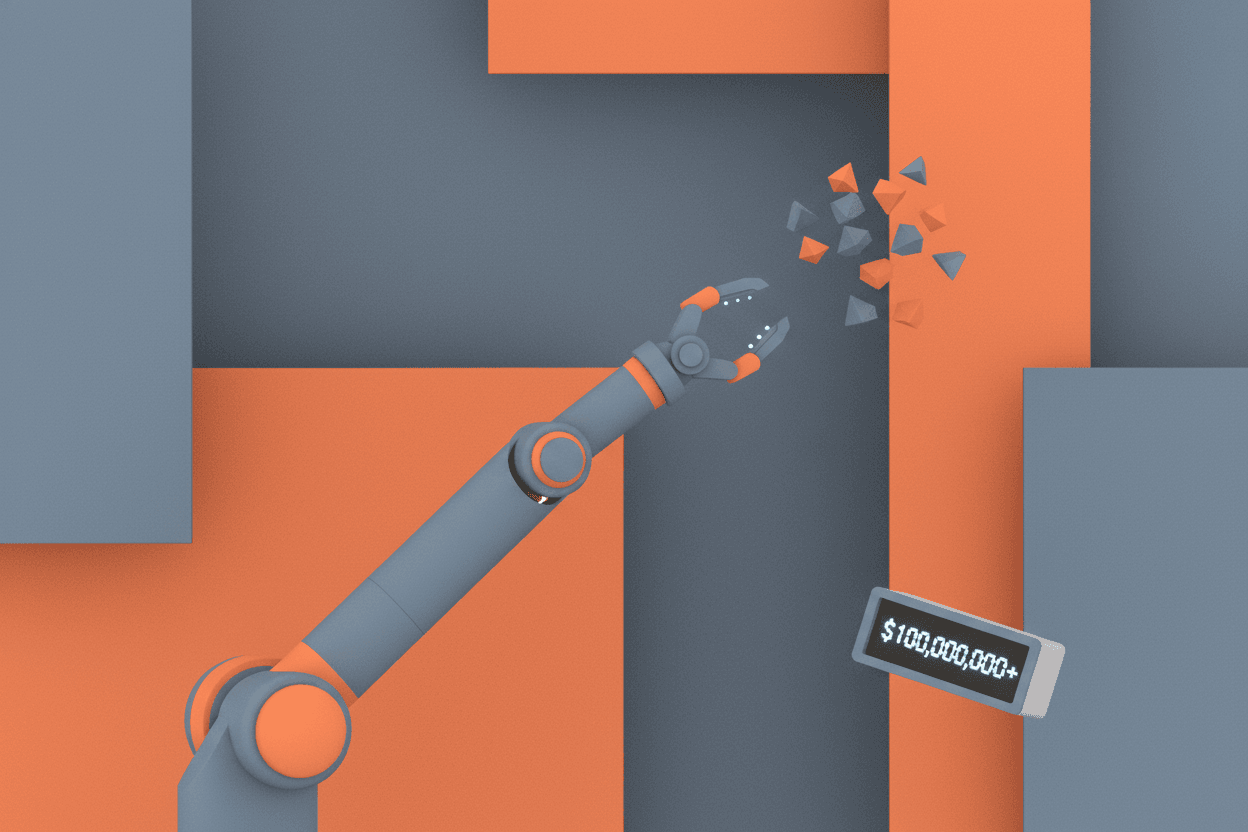
Several companies and agencies have demonstrated debris capture technologies. In 2025, ClearSpace-1, a European Space Agency mission, will attempt to capture a 112-kilogram payload adapter using a robotic arm. Japan's Astroscale has demonstrated magnetic capture capabilities. However, these missions cost $100 million or more and remove single objects.
[!INSIGHT] At current launch costs of approximately $2,700 per kilogram to low Earth orbit, removing the 27,000 trackable debris objects would cost over $70 billion—assuming one-per-mission efficiency. The actual cost would be exponentially higher.
The legal landscape creates additional barriers. The Outer Space Treaty of 1967 states that nations retain jurisdiction and control over objects they launch. A piece of Chinese rocket cannot legally be removed by a Japanese company. A Russian satellite fragment cannot be de-orbited by an American mission. Active debris removal requires diplomatic agreements that do not exist. Furthermore, the liability regime creates perverse incentives. Under the 1972 Liability Convention, a launching state is liable for damage caused by its space objects. But demonstrating which fragment caused damage to which satellite requires tracking capabilities beyond current systems. Enforcement is effectively zero.
The Stakes for Humanity's Future
Space debris is not merely an engineering problem. It represents a constraint on human expansion beyond Earth.
If Kessler Syndrome progresses unchecked, certain orbital bands could become functionally impassable within 30 to 50 years. Launch windows would narrow. Mission insurance would become prohibitive. The satellite infrastructure underpinning modern civilization would require constant replacement—assuming launches remained possible.
More immediately, debris poses existential risks to human spaceflight. Every additional fragment increases the probability of a cascading event. The ISS, the only continuously occupied human outpost beyond Earth, orbits within the debris belt. Its operational lifetime is now determined partly by collision risk calculations.
[!NOTE] The Inter-Agency Space Debris Coordination Committee, comprising 13 space agencies, has established voluntary guidelines: satellites in LEO should be de-orbited within 25 years of mission completion. Compliance remains below 50%. No binding international treaty exists.
The commercial space industry adds acceleration. SpaceX's Starlink constellation alone has deployed over 6,000 satellites, with plans for 42,000. Amazon's Project Kuiper plans 3,236 satellites. OneWeb has launched over 600. Each constellation increases collision probability—and collision probability squared determines collision rate.
Conclusion
The tragedy playing out in Earth orbit follows a familiar pattern: immediate benefits distributed among active participants, long-term costs shared by everyone, delayed consequences that become irreversible. We are treating low Earth orbit as an infinite resource when it is demonstrably finite.
The 27,000 trackable objects represent visible symptoms of systemic dysfunction. The hundreds of millions of untrackable fragments represent invisible accumulations of risk. Neither is decreasing.
The 2020s will likely determine whether Earth orbit remains accessible for the next century or becomes a ballistic shooting gallery that grounds human spaceflight for generations. The garbage is already there. The question is whether we remove it before it removes us from orbit.
Sources: European Space Agency Space Debris Office Annual Report 2024; NASA Orbital Debris Program Office; Inter-Agency Space Debris Coordination Committee; University of Southampton Space Debris Research Group; United Nations Office for Outer Space Affairs; Interview with Dr. Donald Kessler, 2023; ESA ClearSpace-1 Mission Documentation.