The Day Two Satellites Crashed and Nobody Stopped It
In 2009, two satellites collided over Siberia despite warnings. The crash created 2,000+ debris pieces and exposed a fatal gap in space traffic management.
Hyle Editorial·
In 2009, two satellites collided over Siberia. The collision was predicted hours in advance. No one did anything. It created 2,000 new pieces of debris — each of which can now trigger more collisions. The crash wasn't a surprise. U.S. space surveillance tracked both satellites. Yet nobody picked up the phone to warn Iridium, the American company whose $50 million telecommunications satellite was about to be destroyed.
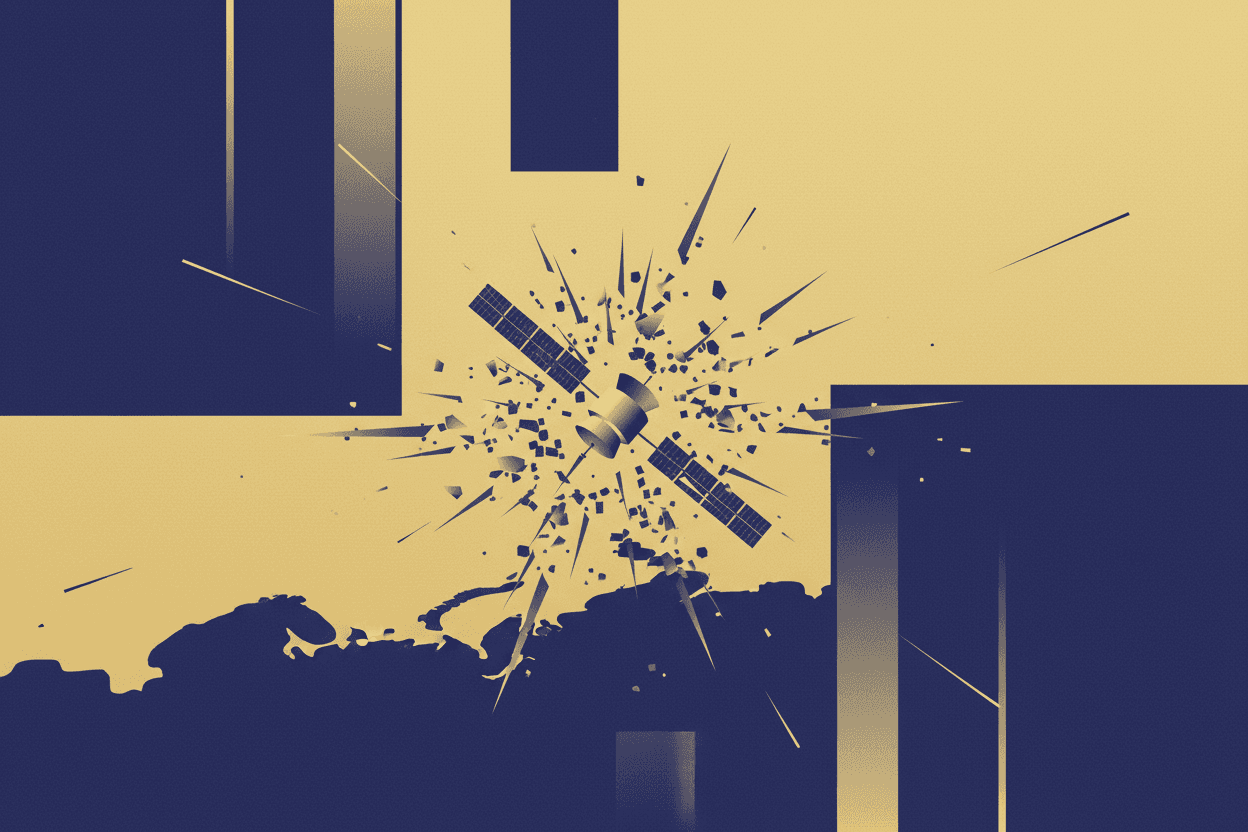
At 16:56 UTC on February 10, 2009, the commercial Iridium 33 slammed into the defunct Russian military satellite Cosmos 2251 at a closing speed of nearly 26,000 miles per hour. The impact instantly vaporized both spacecraft, scattering fragments across an 800-mile-wide orbital corridor. It remains the first and only time two intact satellites have accidentally collided in orbit.
The Iridium-Cosmos crash exposed a terrifying reality: there is no global air traffic control for space. Airlines have the FAA and international coordination bodies. Ships have maritime tracking systems. But satellites? They operate in a legal and informational void.
The U.S. military's Space Surveillance Network tracked both satellites and their increasingly precarious orbits. Analysts could see the trajectories converging. But the system was designed for missile warning, not collision prevention. The military had no formal obligation—or established channel—to notify commercial operators of impending disasters.
[!INSIGHT] Iridium's constellation was designed with redundancy: 66 active satellites plus spares. This redundancy saved the company's service, but masked the systemic failure. Losing one satellite was an inconvenience, not a catastrophe. But each debris piece now threatens every other satellite in low Earth orbit.
Iridium reportedly received no warning. Even if they had, the company later stated they would have dismissed the alert as a false alarm—such predictions were common, and most never materialized. The screening tools available in 2009 produced frequent warnings with low confidence. Operators learned to ignore them.
“*"We saw it coming, but we didn't have the protocols in place to act. It was a failure of imagination as much as a failure of systems.”
— Brian Weeden, Secure World Foundation
Why Didn't Anyone Act?
Several factors converged to create the perfect storm:
No Legal Mandate: No international treaty requires satellite operators to share orbital data or coordinate maneuvers.
Military Secrecy: The U.S. military possessed the most comprehensive tracking data but was reluctant to share precise information that might reveal surveillance capabilities.
False Alarm Fatigue: Close approach predictions were routine. Operators received hundreds of conjunction warnings; virtually all passed without incident.
Cost-Benefit Calculus: Maneuvering a satellite burns precious fuel and disrupts service. Without high-confidence data, operators chose inaction.
The Debris Cascade: Kessler Syndrome in Slow Motion
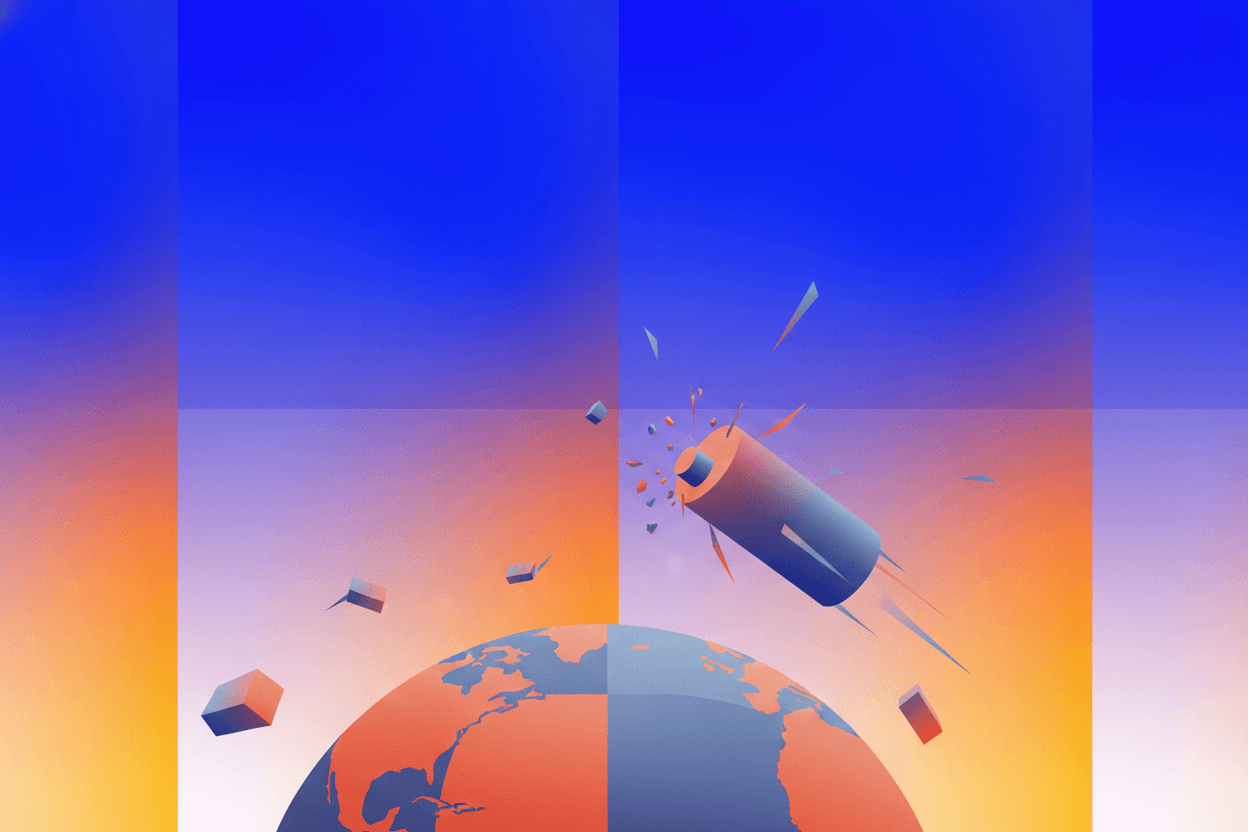
The collision didn't just destroy two satellites. It fundamentally altered the orbital environment. The impact generated over 2,300 trackable fragments—objects larger than a softball—and an estimated 100,000 particles too small to track but large enough to destroy functioning spacecraft.
[!NOTE] As of 2024, approximately 1,500 pieces of debris from the Iridium-Cosmos collision remain in orbit. They will continue circling Earth for decades, some for centuries, each a potential bullet traveling at hypersonic speeds.
Each fragment carries kinetic energy equivalent to a hand grenade. A paint fleck once chipped a windshield on the Space Shuttle. A fragment the size of a marble could disable a satellite. A piece the size of a tennis ball? Catastrophic.
NASA scientist Donald Kessler predicted this scenario in 1978. His theory, now called Kessler Syndrome, describes a cascade: collisions produce debris, debris causes more collisions, which produce more debris, until entire orbital regimes become unusable. The Iridium-Cosmos crash was Kessler Syndrome's first real-world proof of concept.
The Orbital Environment Today
Fifteen years after the collision, the problem has compounded dramatically:
Starlink and Mega-Constellations: SpaceX alone has launched over 6,000 satellites since 2019, increasing conjunction alerts by orders of magnitude.
Anti-Satellite Tests: Russia's 2021 ASAT test destroyed Cosmos 1408, adding 1,500 more debris fragments.
Near-Misses Weekly: The International Space Station performs debris avoidance maneuvers regularly. In 2022, it dodged debris from the Russian ASAT test.
[!INSIGHT] The U.S. Space Surveillance Network now tracks over 45,000 objects larger than 10 centimeters. The estimated population of objects between 1 and 10 centimeters exceeds 1 million. None of these can be maneuvered. All were created by human activity.
The Birth of Space Traffic Management
The Iridium-Cosmos collision became a wake-up call—but the response has been agonizingly slow. The United States established the Space Data Association in 2009, a voluntary information-sharing consortium. In 2022, the Space Force launched a pilot program providing more detailed conjunction warnings to commercial operators.
Yet fundamental problems persist:
No International Authority: The Federal Aviation Administration regulates U.S. launches but has no jurisdiction once satellites reach orbit.
Commercial Opacity: Companies like SpaceX share some data voluntarily, but no law requires transparency.
Crowded Orbits: The most valuable orbital bands—especially 500-600 km altitude—are becoming congested beyond anyone's ability to manage.
“*"We are operating 19th-century traffic rules in a 21st-century orbital environment. It's not a question of if another collision happens, but when.”
— Dr. Holger Krag, European Space Agency Space Debris Office
Implications: Who Owns the Sky?
The 2009 collision raised questions that remain unanswered. Who is liable when a piece of Russian debris destroys an American satellite? The 1972 Liability Convention assigns fault—but proving which fragment hit which satellite, and tracing that fragment's origin, can be impossible.
More urgently: who has the authority to order a satellite to move? Currently, no one. Operators make independent decisions based on incomplete data. In a world of mega-constellations carrying thousands of satellites, this decentralized approach is a recipe for disaster.
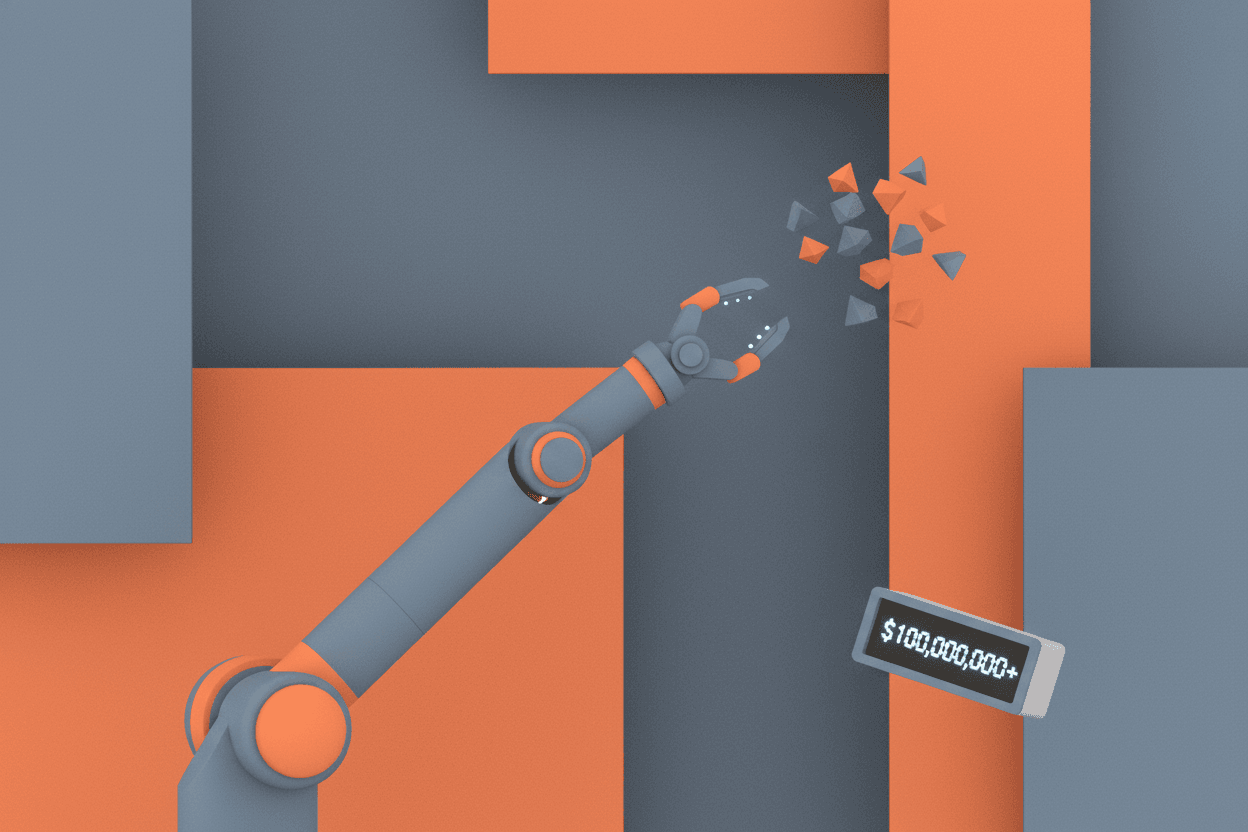
The economics are stark. A single communications satellite can cost $200-300 million to build and launch. The global space economy exceeds $500 billion annually. A cascading debris event could shut down entire orbital bands, crippling GPS, weather forecasting, telecommunications, and scientific research for decades.
Key Takeaway: The 2009 Iridium-Cosmos collision was entirely preventable—and entirely inevitable. It revealed a fatal gap in humanity's management of orbital space: we have no traffic control system, no enforcement mechanism, and no international coordination body with real authority. Since then, we've added thousands more satellites while the debris problem compounds. Without binding international agreements on space traffic management, data sharing, and debris mitigation, the next collision is not a possibility—it's a certainty. The only question is whether we'll act before the cascade becomes unstoppable.
Sources: NASA Orbital Debris Program Office; Secure World Foundation; U.S. Space Surveillance Network; European Space Agency Space Debris Office; Union of Concerned Scientists Satellite Database; Kessler, D.J. & Cour-Palais, B.G. (1978). "Collision Frequency of Artificial Satellites: The Creation of a Debris Belt." Journal of Geophysical Research.
This is a Premium Article
Hylē Media members get unlimited access to all premium content. Sign up free — no credit card required.