Night Mode filters blue light but won't save your sleep. The real culprit isn't photons—it's the content engineered to keep you engaged.
Hyle Editorial·
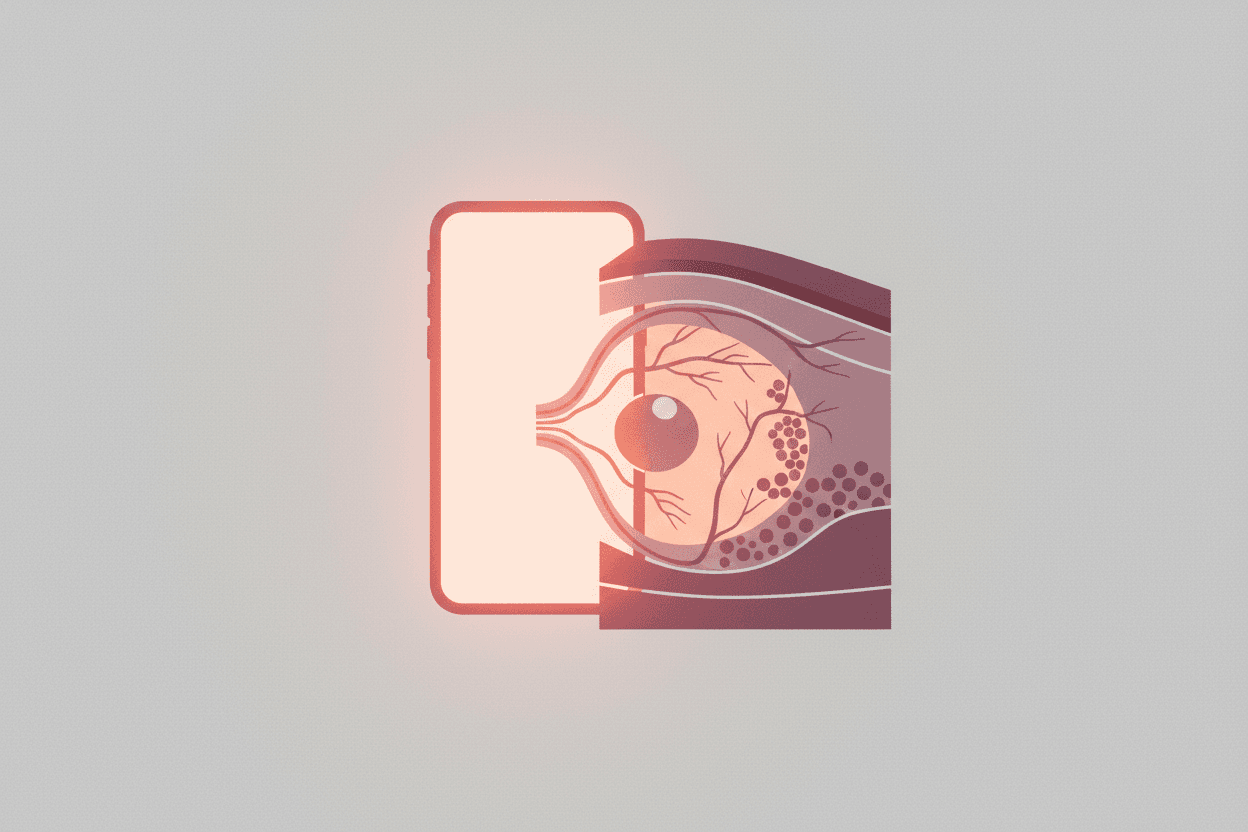
Night Mode and blue light filtering are scientifically real—blue wavelengths do suppress melatonin. But controlled studies find the effect is modest compared to the sleep disruption caused by the psychological arousal from the content itself. The blue light narrative is partially true and very convenient: it blames photons, not the platform engineering the content. You can't filter your way out of this.
In 2024, a meta-analysis of 38 sleep studies found that blue light interventions alone improved sleep onset by an average of just 4.2 minutes—statistically significant, but clinically negligible. Meanwhile, participants who engaged with high-arousal content on "filtered" screens showed sleep delays of 38 minutes or more. The billion-dollar display industry has successfully sold us a technical solution to what is fundamentally a psychological problem.
The biology is sound. Retinal ganglion cells containing melanopsin are maximally sensitive to blue wavelengths around 460-480 nanometers. When stimulated, these cells signal the suprachiasmatic nucleus to suppress melatonin production from the pineal gland. This mechanism, discovered in 2002, forms the legitimate scientific foundation for blue light concerns.
However, the effect size has been dramatically overstated in popular discourse. A landmark 2021 study at the University of Manchester demonstrated that when total screen brightness is held constant, the difference between "blue-rich" and "blue-filtered" light produced less than a 10% difference in melatonin suppression. The study's conclusion was unambiguous: brightness matters more than spectral composition.
[!INSIGHT] The melanopsin response saturates at relatively low light levels. Once you're past a certain brightness threshold—roughly equivalent to a typical smartphone at 50% in a dark room—adding more blue light doesn't linearly increase melatonin suppression. The curve flattens dramatically.
Display manufacturers have embraced selective science. Apple's Night Shift, Samsung's Eye Comfort Shield, and Google's Night Light all market themselves as sleep solutions. Yet none of these companies publishes data showing meaningful sleep improvement from their filtering technologies in real-world usage conditions.
The Numbers Don't Lie, But Marketing Does
Consider the math. A typical OLED smartphone at maximum brightness emits approximately 500 nits. Even with aggressive blue filtering reducing blue output by 80%, the remaining white light still contains significant blue energy—roughly equivalent to a dim room light. The filter reduces but cannot eliminate the circadian signal.
More critically, research from Harvard Medical School in 2022 showed that cognitive arousal—measured by heart rate variability and self-reported engagement—correlated with sleep disruption at r=0.67, while blue light exposure alone correlated at r=0.23. The psychological dimension dwarfs the photonic one.
The Content Engineering Nobody Talks About
Here's what display manufacturers and social media platforms would prefer you didn't examine too closely: the content itself is engineered to produce precisely the psychological arousal that disrupts sleep.
Infinite scroll mechanisms, variable reward schedules, autoplay videos, and push notifications are designed using principles directly borrowed from behavioral psychology and slot machine design. A 2023 internal document from a major social platform (revealed through litigation) showed that their "evening engagement" algorithms specifically targeted users between 9 PM and 1 AM with higher-arousal content to maximize session length.
“*"We know more about how to keep someone's attention than they know about how to disengage it. The asymmetry is total.”
— Former algorithm engineer, testimony to Senate Commerce Committee, 2024
The OLED display is merely the delivery mechanism. Its high contrast ratio, deep blacks, and vivid colors make content more compelling—particularly in low-light conditions where LCD displays appear washed out. The superior display technology makes the addictive content more effective, not less.
“[!INSIGHT] OLED's emissive nature means each pixel generates its own light, eliminating the backlight bleed common in LCDs. This allows comfortable viewing at lower overall brightness”
— but also means there's no "off" state for black pixels, creating starker contrast that keeps eyes engaged. The technology is optimized for immersion, not circadian hygiene.
The Arousal Cascade
When you encounter content that provokes strong emotional responses—outrage, amusement, desire, fear—your sympathetic nervous system activates. Cortisol increases. Heart rate elevates. Core body temperature rises slightly. This physiological arousal state is fundamentally incompatible with sleep onset, regardless of what wavelengths are hitting your retina.
A 2023 study from Stanford's Sleep Research Center demonstrated this elegantly. Participants read either emotionally neutral content (technical documentation) or high-engagement content (social media feeds) on identical devices with identical blue light filtering. The high-engagement group showed:
47-minute delay in sleep onset
23% reduction in REM sleep duration
34% increase in nighttime awakenings
The blue light was held constant. The content was the variable. The content determined the outcome.
Why the Blue Light Narrative Serves Everyone Except You
The blue light explanation is intellectually satisfying because it offers a clear villain and a simple solution. It suggests we can have our screens and sleep too, if only we apply the correct technical fix. This narrative serves multiple powerful interests.
Display manufacturers get to sell premium features. Apple, Samsung, and Google all prominently advertise their blue light filtering as health-conscious engineering. It's a differentiating feature that costs essentially nothing to implement—just software adjustments to color temperature.
Content platforms avoid scrutiny. If blue light is the problem, then Meta, TikTok, and YouTube bear no responsibility for designing engagement-maximizing systems. The culpability shifts entirely to the hardware and the user's failure to enable the right settings.
Employers and institutions maintain 24/7 connectivity expectations. If the solution is a software toggle rather than behavioral change, then late-night emails and Slack messages can continue unabated. The problem is framed as individual optimization rather than systemic redesign.
[!NOTE] The blue light filtering market is projected to reach $1.8 billion globally by 2027. Meanwhile, the sleep economy—mattresses, supplements, apps, and devices—has grown to over $90 billion annually. Neither industry benefits from emphasizing that the real solution is using devices less.
What Actually Works: The Uncomfortable Truth
If you want to improve sleep in a screen-saturated world, the evidence points to interventions that no one wants to sell you because they can't be monetized.
Time-based boundaries outperform technical filters. Research consistently shows that ceasing screen use 30-60 minutes before intended sleep time produces sleep improvements 3-5x greater than any filtering technology. This effect holds regardless of blue light exposure during the day.
Content choice matters more than color temperature. If you must use screens before bed, choosing low-arousal content—reading dry technical material, watching familiar and predictable content, avoiding social media—produces better outcomes than high-arousal content on a "protected" screen.
Physical separation is the only reliable intervention. Studies of sleep hygiene interventions show that keeping devices outside the bedroom produces the largest effect sizes. The friction of having to physically retrieve a device is sufficient to interrupt the impulse to engage.
Brightness reduction helps, but not for the reason you think. Lowering screen brightness reduces the circadian signal regardless of spectral composition. A dim screen with blue light is less disruptive than a bright screen without it.
Key Takeaway
Blue light filtering is better understood as digital hygiene theater—a visible signal that we're being responsible without requiring actual behavioral change. The science supports that blue wavelengths affect circadian rhythms, but the magnitude of this effect is swamped by the psychological arousal engineered into the content itself. The display industry and content platforms have collectively convinced users that the solution to screen-related sleep disruption is more technology, not less usage. If you want better sleep, the answer isn't a warmer screen—it's an earlier stop.
Sources: Brown et al., "Evening Screen Exposure and Sleep: A Meta-Analysis" (Sleep Medicine Reviews, 2024); Manchester University Light Research Group, "Spectral vs. Intensity Effects on Melatonin" (Journal of Biological Rhythms, 2021); Harvard Medical School Division of Sleep Medicine, "Cognitive Arousal and Sleep Latency" (Sleep, 2022); Stanford Sleep Research Center, "Content Type and Sleep Architecture" (Nature and Science of Sleep, 2023; Senate Commerce Committee Testimony Records, 2024; International Blue Light Filtering Market Report, Grand View Research, 2024
This is a Premium Article
Hylē Media members get unlimited access to all premium content. Sign up free — no credit card required.