The Chip War Nobody Is Calling a War
In 2022, the US banned advanced chip exports to China—economic warfare without bullets. With $150B retaliation and allies scrambling, who actually wins?

In October 2022, the US government banned the export of advanced semiconductor technology to China. No bombs. No soldiers. Economists called it the most significant act of economic warfare since the 1940s oil embargo that preceded Pearl Harbor. China called it an act of war. Both may be right.
The Commerce Department's Bureau of Industry and Security (BIS) didn't just restrict a few products—it systematically targeted every node of the advanced semiconductor supply chain. Nvidia's most powerful AI chips. ASML's lithography machines. Even the American citizens who work in China's chip factories, who now risk prosecution for sharing technical knowledge. The rules span 139 pages of dense regulatory text, but their intent is crystal clear: freeze China's technological advancement at the 14-nanometer generation while the rest of the world races toward 2nm.
The October 7, 2022 export controls represented a fundamental shift in US strategy. Previous restrictions had targeted specific Chinese companies—Huawei, SMIC, Hikvision. This was different. For the first time, the United States restricted technology based not on who the buyer was, but on what the technology could do.
The Three Pillars of Control
1. Advanced Computing Chips: The ban prohibits exports of chips exceeding certain performance thresholds for bidirectional transfer rates—effectively targeting the GPUs and AI accelerators essential for training large language models and military simulations. Nvidia's A100 and H100 chips, the workhorses of AI computing, vanished from Chinese markets overnight.
2. Semiconductor Manufacturing Equipment (SME): Any equipment capable of producing chips below 16nm (non-planar transistors) now requires a license. Since no Chinese company can currently mass-produce cutting-edge chips without Western equipment, this struck at the heart of China's self-sufficiency ambitions.
3. Foreign Direct Product Rule: Perhaps most aggressively, the US asserted extraterritorial jurisdiction over foreign-made chips that use American technology—which is essentially all of them. Even chips manufactured in Taiwan, South Korea, or Europe fall under these rules if they incorporate American designs, software, or equipment.
[!INSIGHT] The Foreign Direct Product Rule effectively weaponizes American technological dominance. Since US companies control approximately 85% of chip design software (EDA tools) and key semiconductor manufacturing technologies, nearly every advanced chip on Earth has American DNA—and thus falls under US export jurisdiction.
The Biden administration followed up with additional rounds of restrictions in October 2023 and 2024, each time tightening the noose. The 2023 update closed loopholes that had allowed Nvidia to sell slightly modified chips (the A800 and H800) to Chinese buyers. The message was unmistakable: there would be no grey zone, no workarounds, no escape.
The Coalition Strategy
Crucially, the United States understood that unilateral action would fail. If Dutch company ASML continued selling its extreme ultraviolet (EUV) lithography machines to China, American restrictions would be meaningless. If Japan's Tokyo Electron kept exporting etching equipment, China could still build advanced fabs.
Thus began an intense diplomatic campaign to build what analysts call "Chip NATO." By early 2023, both Japan and the Netherlands had agreed to parallel restrictions. ASML, the only company in the world capable of building the machines that make cutting-edge chips, was prohibited from shipping even its older deep ultraviolet (DUV) systems to China.
“"We reached out to our key allies and explained that this wasn't about economics”
China's Response: The Great Substitution Campaign
If US strategists expected China to capitulate, they miscalculated. Beijing responded with the largest state-directed industrial investment in modern history: approximately $150 billion in semiconductor development funding, spread across state-owned enterprises, private champions, and a constellation of new research institutes.
The "Big Fund" and Beyond
China's National Integrated Circuit Industry Investment Fund—colloquially known as the "Big Fund"—had already deployed two phases totaling $45 billion before the 2022 restrictions. In response to the US ban, Phase III launched in 2024 with an additional $47.5 billion, the largest single tranche yet.
But the real money flows through less visible channels:
- Provincial government funds: Major manufacturing regions like Jiangsu, Shanghai, and Shenzhen have established their own semiconductor investment vehicles
- State bank lending: China's major policy banks have directed hundreds of billions in low-interest loans to chip companies
- Talent acquisition: Enhanced programs to recruit overseas Chinese engineers and foreign experts, despite the US ban on American citizens working in China's chip sector
The SMIC Breakthrough
In 2023, Semiconductor Manufacturing International Corporation (SMIC)—China's largest foundry—achieved what many thought impossible without Western equipment. Using older DUV lithography machines already in its possession, SMIC produced a 7nm chip for Huawei's Mate 60 Pro smartphone.
[!INSIGHT] The 7nm breakthrough came at enormous cost. Without EUV lithography, SMIC had to use multi-patterning techniques that dramatically reduce yield and increase production costs. Industry estimates suggest SMIC's 7nm yields remain below 50%, compared to 90%+ for TSMC's equivalent process. This is sustainable for flagship phones, but not for the massive AI training clusters China needs.
The achievement was strategically significant but economically concerning. SMIC had demonstrated that China could achieve advanced nodes without Western equipment—but at costs that make large-scale AI chip production impractical.
The Huawei Resurrection
Huawei, once the world's largest smartphone maker, had been nearly destroyed by earlier US restrictions cutting off access to Google services and TSMC's manufacturing. The Mate 60 Pro's unexpected 2023 launch—with a domestically 5G chip—signaled that China's semiconductor industry had achieved a fragile resilience.
By 2024, Huawei had returned to profitability and was shipping laptops with domestically designed chips. The company announced plans to build an entirely domestic AI training cluster using chips designed by HiSilicon (its semiconductor arm) and manufactured by SMIC.
The American Response: CHIPS Act and Industrial Policy Reborn
The export controls were only half the strategy. The other half was rebuilding America's own semiconductor manufacturing base—a sector that had atrophied for decades as production migrated to East Asia.
The $52 Billion Bet
The CHIPS and Science Act, signed in August 2022, committed $52 billion to semiconductor manufacturing and research. The bulk—$39 billion—goes to manufacturing incentives, essentially subsidies for companies building fabs on US soil.
The results have been dramatic:
- TSMC is building two fabs in Arizona (with negotiations for more), representing $40 billion in investment
- Intel is expanding its Arizona and Ohio operations with $20+ billion in new facilities
- Samsung committed $17 billion to a new fab in Texas
- Micron announced a $100 billion manufacturing complex in upstate New York
[!NOTE] The CHIPS Act represents the most significant American industrial policy since the semiconductor industry's birth. However, construction delays, labor shortages, and cost overruns have plagued many projects. TSMC's Arizona fab, originally scheduled for 2024 production, has been delayed to 2025 or later. Intel's Ohio fab faces similar timeline challenges.
The Talent Problem
Money can build factories. It cannot instantly create the specialized workforce required to run them. The semiconductor industry faces a severe global talent shortage:
- The US semiconductor workforce is aging, with many senior engineers approaching retirement
- Immigration restrictions have made it difficult to recruit foreign talent
- Taiwan's university system produces proportionally more semiconductor engineers than American institutions
- Training a senior process engineer takes 10-15 years of hands-on experience
“"We can build the buildings. We can buy the equipment. But we cannot manufacture the people who know how to make these machines work. That knowledge takes a generation to develop.”
The Stakes: AI, Military Power, and the Next Century
Why are both nations pouring hundreds of billions into this conflict? Because the consensus among strategists, technologists, and intelligence officials is that advanced semiconductors will determine the balance of power for the next century.
AI as Force Multiplier
Modern artificial intelligence—particularly the large language models that have captured public attention—requires massive computational resources. Training GPT-4 reportedly required approximately 25,000 Nvidia A100 GPUs running for months. More advanced models will require orders of magnitude more compute.
The nation that leads in AI will lead in:
- Military applications: Autonomous weapons, logistics optimization, intelligence analysis, cyber warfare
- Economic productivity: Automated coding, research acceleration, manufacturing optimization
- Surveillance and control: The technologies that enable smart cities also enable population monitoring
Control over the most advanced AI chips means control over who can build these capabilities at scale.
The 2nm Frontier
As of 2024, only three companies can produce chips at the most advanced nodes: TSMC, Samsung, and Intel. China's most advanced mass production remains at 14nm, with experimental 7nm production that remains economically marginal.
The gap is widening. TSMC and Samsung are racing toward 2nm production by 2025-2026. Intel hopes to regain process leadership with its "18A" node (equivalent to roughly 1.8nm) by 2025. Each new node generation requires exponentially more sophisticated equipment, materials, and expertise.
[!INSIGHT] The economic and military implications compound exponentially at each new process node. A 2nm chip delivers roughly 25-30% better performance and 50% better power efficiency than 5nm. For AI training, this translates to millions of dollars in electricity savings and weeks of reduced training time. For military applications, it means autonomous systems that can process more data with less power—critical for drones, satellites, and soldier-carried electronics.
Taiwan: The Geopolitical Fault Line
All of this hinges on one island 100 miles off China's coast. Taiwan, through TSMC, manufactures approximately 90% of the world's most advanced chips. An Chinese invasion or blockade of Taiwan would instantly sever the global semiconductor supply chain.
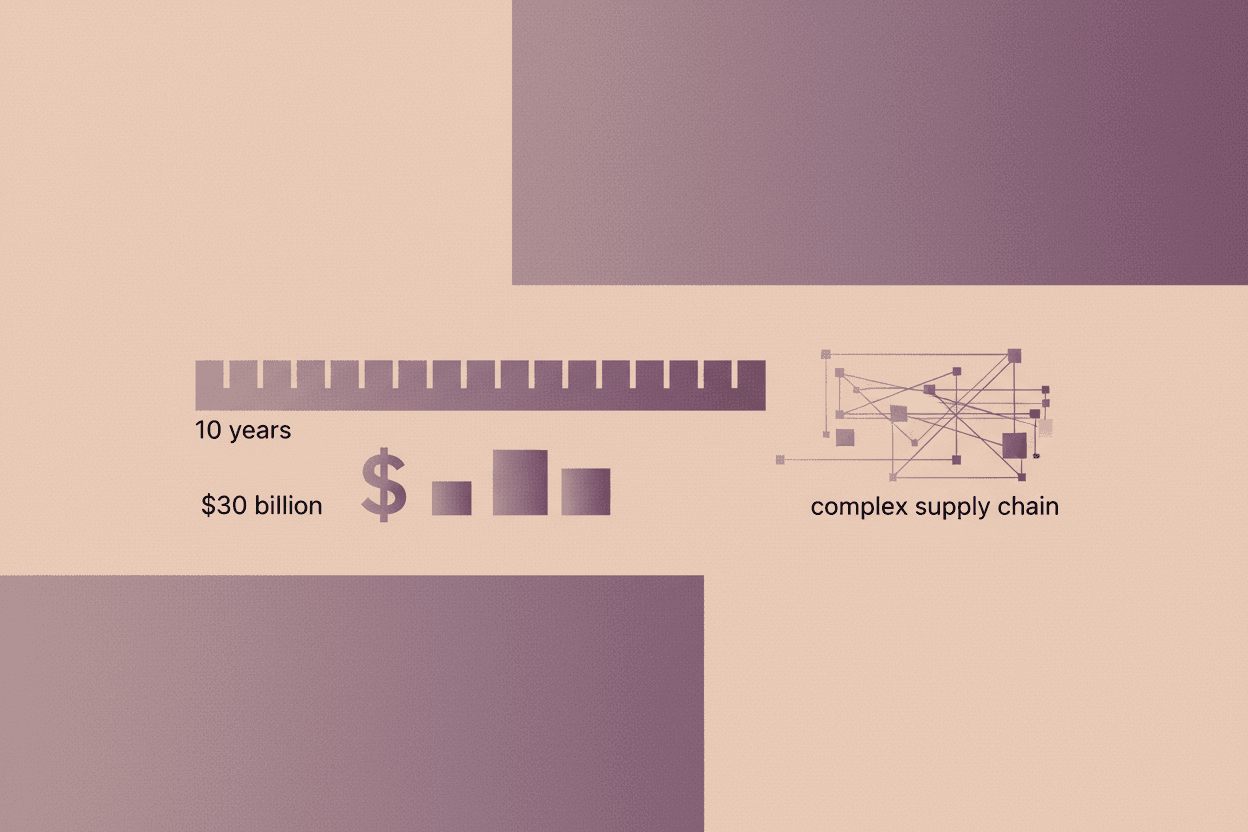
This creates a strategic paradox. The more the US restricts China's access to chips, the more incentive China has to seize Taiwan. Yet the more China threatens Taiwan, the more the US and its allies accelerate efforts to build capacity outside the island—a process that will take at least a decade.
Implications: A Fractured Technological World
The chip war is reshaping the global economy in ways that will persist for decades, regardless of who "wins."
The End of Efficient Globalization
For thirty years, semiconductors flowed freely across borders. Companies designed chips in one country, manufactured them in another, assembled devices in a third, and sold globally. This system maximized efficiency and minimized costs.
That era is ending. Every major power now prioritizes supply chain security over efficiency:
- The US is paying premium prices for domestic manufacturing
- China is accepting lower yields and higher costs for domestic substitution
- The European Union has launched its own Chips Act with €43 billion in funding
- Japan is subsidizing domestic production and recruiting TSMC to build fabs on its soil
The Rise of Technological Blocs
The world is dividing into technological spheres of influence. Countries will increasingly have to choose between American-dominated supply chains and Chinese alternatives:
- American bloc: US, Japan, South Korea, Taiwan, Netherlands, EU, Australia
- Chinese bloc: China, Russia, Iran, North Korea, and developing nations seeking alternatives to Western technology
This bifurcation will accelerate as both sides invest in incompatible standards and technologies.
Innovation Slowdown?
Some analysts warn that technological decoupling will slow overall innovation. When researchers cannot collaborate across borders, when companies cannot access the best components regardless of origin, when standards fragment into regional variants—the pace of progress may decelerate.
Others argue that competition drives innovation. The original Space Race produced dramatic technological advances. Perhaps the chip war will do the same.
Conclusion: The Long War
The chip war is not a temporary dispute that will resolve through negotiation. It is a structural conflict between the world's two most powerful nations, rooted in incompatible visions of the future. The United States seeks to preserve the technological superiority that has underpinned its global dominance since 1945. China seeks the technological autonomy it views as essential for national security and its rightful place as a global power.
Neither side can afford to lose. Neither side can afford to back down.
The weapons in this war are not missiles and tanks, but photolithography machines and GPU clusters. The battles are fought not on beaches but in corporate boardrooms, university laboratories, and bureaucratic agencies. The casualties are not soldiers but efficiencies—the economic costs of redundant supply chains, duplicated research, and fractured markets.
Sources: Bureau of Industry and Security Export Control Rules (October 2022, 2023, 2024); Congressional Research Service CHIPS Act Reports; Semiconductor Industry Association Data; China's National Integrated Circuit Industry Investment Fund Filings; Company Disclosures from Nvidia, TSMC, SMIC, Intel, and ASML; CSIS Reports on Semiconductor Geopolitics; Reuters, Financial Times, and Bloomberg Technology Reporting (2022-2024).
This is a Premium Article
Hylē Media members get unlimited access to all premium content. Sign up free — no credit card required.