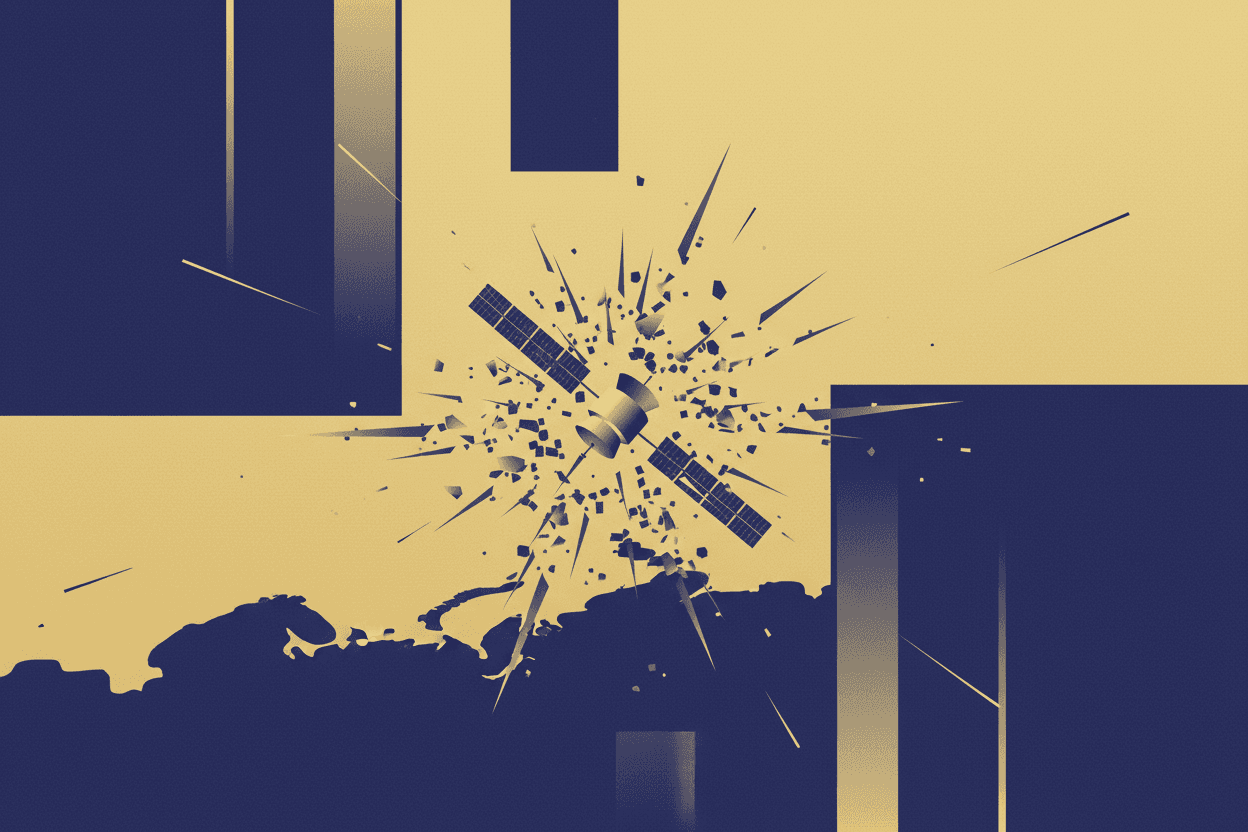
The Country That Blew Up Its Own Satellite and Created 1,500 Pieces of Debris
Explore how Russia's 2021 ASAT missile test shattered Cosmos 1408, triggered an ISS emergency, and exposed the escalating militarization of Earth's orbit.

In 2021, Russia shot down one of its own satellites — creating 1,500 pieces of debris that forced ISS astronauts to shelter in their escape capsules. It was a weapons test. It was also an act of vandalism against every spacefaring nation on Earth.
The missile, an interceptor known as Nudol, slammed into the defunct Soviet-era intelligence satellite Cosmos 1408 at over 17,000 miles per hour. Within milliseconds, a massive cloud of lethal shrapnel expanded across Low Earth Orbit (LEO), joining a chaotic swarm of over 36,000 trackable objects currently circling our planet. Traveling at extreme orbital velocities, even a tiny fleck of chipped paint possesses the kinetic energy of a detonating hand grenade.
Yet, Russia is far from the only nation to have intentionally obliterated its own orbital hardware. Why are the world's leading superpowers deliberately detonating explosives in an environment completely devoid of borders, where a single miscalculation could render space permanently inaccessible to humanity? The answer lies at the dangerous intersection of military posturing and a legal void that dates back to the Cold War.
The Architecture of Orbital Annihilation
When the PL-19 Nudol missile struck Cosmos 1408, it did not merely destroy a 2,000-kilogram relic of the Soviet intelligence apparatus. It fundamentally altered the risk calculus for every commercial and governmental entity operating in Low Earth Orbit. The resulting debris cloud physically intersected the orbital plane of the International Space Station (ISS), forcing the seven-member crew—which ironically included two Russian cosmonauts—to seal themselves inside their Soyuz and Crew Dragon spacecraft, bracing for a potential catastrophic depressurization.
[!INSIGHT] The Kinetic Reality of Orbital Debris In Low Earth Orbit, objects travel at roughly 7.8 kilometers per second (17,500 mph). At these hypervelocity speeds, a one-centimeter fragment of aluminum strikes with the explosive equivalent of a small bomb. A ten-centimeter piece will instantly vaporize a satellite, generating thousands of new fragments in a deadly cascading effect.
The Cosmos 1408 strike generated over 1,500 pieces of trackable debris—fragments larger than a softball, cataloged and monitored by ground-based radar networks. However, military radar cannot track the estimated hundreds of thousands of smaller fragments. Each of these sub-centimeter shards is now a permanent, untrackable bullet whizzing blindly through the shared commons of space, threatening everything from weather satellites to global internet constellations.
A Legacy of Intentional Debris
While international condemnation of the 2021 Russian test was swift and severe, the historical reality is that blowing up orbital infrastructure has become an established, albeit reckless, method for superpowers to flex their military muscles. The structural conflict between national security imperatives and the preservation of space as a global commons has deep historical roots across several major spacefaring powers.
- China's Fengyun-1C Test (2007): The modern era of destructive anti-satellite (ASAT) testing was ushered in by China. By destroying an aging weather satellite at an altitude of 865 kilometers, the test generated over 3,500 pieces of trackable debris. Because of the high altitude, much of this shrapnel will remain in orbit for decades, if not centuries, causing persistent navigational hazards.
- United States Operation Burnt Frost (2008): In a move widely interpreted as a direct response to China's demonstration, the U.S. Navy fired an SM-3 missile from an Aegis cruiser to destroy USA-193, a failing American spy satellite. The Pentagon claimed the strike was necessary to prevent a toxic hydrazine fuel tank from crashing into a populated area, but the geopolitical messaging was unmistakable.
- India's Mission Shakti (2019): Eager to join the elite club of undisputed space superpowers, India targeted its own Microsat-R satellite. While officials claimed the test was conducted at a low enough altitude (300 kilometers) to ensure the debris would burn up in the atmosphere within weeks, independent trackers monitored fragments lingering for years, some of which posed an elevated hazard to the ISS.
“"The destruction of a satellite in orbit is the equivalent of detonating a bomb in a crowded public square and walking away from the shrapnel.”
The Tragedy of the Orbital Commons
The core issue driving this continuous environmental degradation is a fundamental structural conflict: space is governed by outdated treaties that entirely failed to anticipate the tactical value of Low Earth Orbit. The 1967 Outer Space Treaty strictly prohibits the placement of nuclear weapons or weapons of mass destruction in orbit, but it remains dangerously silent on the use of conventional, ground-launched kinetic kill vehicles against a nation's own hardware.
[!NOTE] The Kessler Syndrome Proposed by NASA scientist Donald Kessler in 1978, this scenario describes a theoretical threshold where the density of objects in LEO becomes so high that a single collision triggers a runaway chain reaction. Each impact creates more debris, causing more impacts, until the orbit becomes completely impassable and entirely unusable for generations.
Whenever a nation conducts an ASAT test, they are effectively borrowing against the future of human spaceflight. They demonstrate their capability to blind an adversary's GPS, communication, or reconnaissance networks, but they do so by irreparably polluting the shared environment necessary to deploy those very systems. It is a terrifying paradox of deterrence: to prove you can protect your orbital assets, you must actively degrade the environment where they reside.
As the global economy becomes increasingly dependent on satellite constellations for everything from global financial transactions to autonomous vehicle navigation, the stakes of this geopolitical posturing have never been higher. The Russian strike on Cosmos 1408 was not an isolated incident; it was simply the latest escalation in a hidden arms race where the battlefield itself is the ultimate casualty.
A Precarious Orbit
The immediate aftermath of the Russian test saw a renewed diplomatic push to globally ban destructive, direct-ascent ASAT testing. Several nations, led by the United States, have since pledged to unilaterally halt such tests to preserve the orbital environment. Yet, as long as the capability exists and the strategic value of absolute space superiority remains, the temptation for hostile actors to demonstrate that power will persist.
Sources: Secure World Foundation Global Counterspace Capabilities Report, NASA Orbital Debris Program Office, United Nations Office for Outer Space Affairs (UNOOSA)..