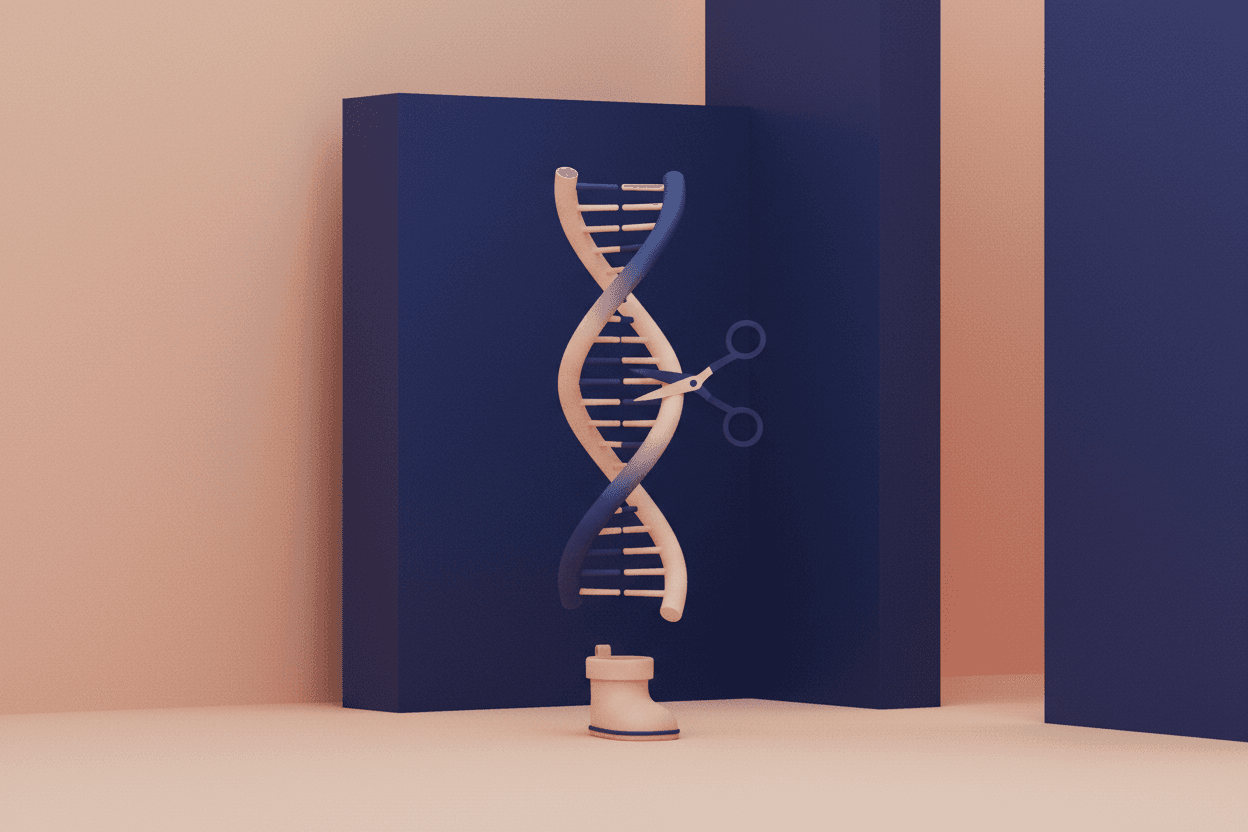
Enzymes That Teleport Hydrogen Atoms
Your liver breaks down alcohol using quantum tunneling. Discover how hydrogen atoms defy classical physics inside your body every second of every day.

Your liver enzymes work partly by teleporting hydrogen atoms. Not metaphorically — literally tunneling through energy barriers that classical physics says are impassable. Your hangover is a quantum event.
In 2023, researchers at the University of Manchester confirmed that alcohol dehydrogenase, the enzyme processing every drink you consume, facilitates hydrogen transfer through quantum mechanical tunneling with rates 10^17 times faster than classical chemistry predicts. The hydrogen nucleus doesn't climb over the energy barrier. It appears on the other side.
This raises a question that should haunt every biochemistry textbook: if enzymes have evolved to exploit quantum mechanics, what else about human biology have we been explaining wrong?
The Tunneling Paradox
Classical chemistry operates on a simple principle: chemical reactions require activation energy. Molecules need enough kinetic energy to climb over an energy barrier before they can transform. It's like rolling a ball up a hill — without sufficient speed, the ball rolls back down.
Quantum mechanics offers a loophole. Particles can tunnel through barriers they cannot climb over. The probability is vanishingly small for heavy atoms, but hydrogen — the lightest element — has a high enough tunneling probability to matter.
[!INSIGHT] A hydrogen nucleus (proton) has a mass small enough that its quantum wave function extends beyond classical boundaries, giving it a measurable probability of appearing on the other side of an energy barrier without ever traversing the space in between.
The mathematics of tunneling has been settled since the 1920s. But for decades, biochemists assumed biological systems were too "warm, wet, and messy" for delicate quantum effects to survive. Thermal noise would drown out quantum coherence. Enzymes were thought to work purely through classical transition states.
That assumption began crumbling in 1989.
Alcohol Dehydrogenase: The Quantum Drunk
Judith Klinman at UC Berkeley published the first definitive evidence that enzymes use quantum tunneling. Her team studied alcohol dehydrogenase (ADH), the liver enzyme that converts toxic ethanol into acetaldehyde — the compound responsible for hangover symptoms.
The experiment was elegant. Klinman replaced hydrogen atoms in the substrate with deuterium (hydrogen's heavier isotope) and tritium (even heavier). Classical chemistry predicts reaction rates should slow proportionally to mass — perhaps 2-3 times slower for deuterium.
The results shocked the field. Reaction rates dropped by factors of 50 to 100.
“"The magnitude of the isotope effect was incompatible with classical transition state theory. The hydrogen was tunneling.”
This wasn't a subtle quantum correction. The enzyme had evolved a structure that positioned the hydrogen donor and acceptor at precisely the right distance and orientation to maximize tunneling probability. The protein scaffold was a quantum engineering device.
Subsequent research has confirmed tunneling in dozens of enzymes. One of the most studied is triosephosphate isomerase (TIM).
TIM: Evolution's Quantum Machine
Triosephosphate isomerase is called a "perfect enzyme" because its catalytic rate is limited only by how fast substrate molecules can diffuse into its active site. Evolution has optimized TIM to the physical maximum.
Part of that optimization involves quantum tunneling.
TIM catalyzes a critical step in glycolysis — the metabolic pathway that extracts energy from glucose. The reaction involves transferring a hydrogen atom from one carbon to another. Classical chemistry says this transfer should require significant activation energy.
Instead, TIM's active site holds the substrate in a conformation that reduces the tunneling distance to roughly 0.6 nanometers. The enzyme dynamically compresses during catalysis, bringing donor and acceptor even closer.
“[!INSIGHT] X-ray crystallography studies reveal TIM's active site residues form hydrogen bonds that create a "tunneling-ready" geometry. The protein doesn't just hold substrate”
A 2019 study using kinetic isotope effects and computational modeling estimated that tunneling contributes to approximately 60-80% of the hydrogen transfer rate in TIM. The enzyme isn't using quantum mechanics as a minor supplement. Quantum tunneling is the primary mechanism.
The Shape of Things to Come
These discoveries force a reconceptualization of what enzymes actually are.
The classical view holds that enzymes lower activation energy by stabilizing transition states — essentially making the hill smaller. The quantum view suggests enzymes also shorten the distance through the hill, enabling tunneling.
This has practical implications.
Pharmaceutical companies designing enzyme inhibitors have traditionally focused on transition state analogs — molecules that mimic the geometry of the classical transition state. But if tunneling is the dominant mechanism, the transition state geometry may be less relevant than the tunneling pathway geometry.
[!NOTE] A 2022 review in Nature Catalysis estimated that quantum tunneling is likely involved in at least 30-40% of all known enzymatic hydrogen transfer reactions. The true number may be higher, as tunneling signatures can be subtle and require specialized isotope experiments to detect.
Some researchers now propose that enzyme evolution selects for "promoting vibrations" — protein motions that compress the tunneling distance at the exact moment of reaction. The entire protein scaffold may act as a quantum mechanical antenna, channeling thermal energy into precisely timed compressions.
Implications for Synthetic Biology
If nature builds quantum machines, can we?
Synthetic biologists working on de novo enzyme design have struggled to match natural catalytic efficiency. Designed enzymes often achieve only 0.001% of natural enzyme rates.
The tunneling hypothesis offers an explanation. Natural enzymes have been selected over billions of years not just for binding affinity, but for quantum mechanical optimization. The precise positioning required for efficient tunneling may be extremely difficult to design from scratch.
Understanding tunneling could unlock new approaches:
-
Rational design incorporating tunneling geometry: Computational tools could optimize designed enzymes for tunneling distance and promoting vibrations, not just binding energy.
-
Quantum-enhanced biocatalysts: Industrial enzymes could be engineered to exploit tunneling for reactions currently requiring expensive metal catalysts or extreme conditions.
-
Drug metabolism prediction: Understanding which enzymes use tunneling could improve predictions of how quickly patients metabolize pharmaceuticals, enabling personalized dosing.
“"We've been trying to reverse-engineer enzymes while missing half the blueprint. It's like trying to understand a computer while ignoring electricity.”
The Wet, Warm, and Quantum Problem
The success of tunneling in enzymes revisits a deeper question: why do quantum effects survive in biological systems?
Decoherence — the loss of quantum coherence through environmental interaction — should theoretically destroy delicate quantum superpositions within femtoseconds at biological temperatures. The warm, wet cellular environment seems fundamentally hostile to quantum mechanics.
Yet enzymes work.
Two explanations have emerged. First, tunneling is relatively robust to decoherence because it doesn't require sustained quantum coherence — only a momentary probability distribution that extends through the barrier. Second, enzymes may have evolved to protect quantum effects, creating local environments that minimize decoherence.
This second possibility has profound implications. If biology has found ways to maintain quantum effects in warm, wet conditions, those mechanisms could inform quantum computing research, where decoherence remains the primary obstacle.
What Your Liver Knows That Physics Textbooks Don't
The human body processes approximately one standard drink per hour through alcohol dehydrogenase. Each ethanol molecule requires two hydrogen transfers. Assuming 10 grams of ethanol per drink and Avogadro's number of molecules, your liver performs roughly 10^23 quantum tunneling events during a typical evening of drinking.
These aren't rare quantum curiosities. They're the metabolic workhorses keeping you alive.
Sources: Klinman, J.P. (1989). "Quantum Mechanical Effects in Enzyme Catalysis." Biochemistry; Kohen, A. & Klinman, J.P. (1998). "Enzyme Catalysis: Beyond Classical paradigms." Accounts of Chemical Research; Hammes-Schiffer, S. (2019). "Quantum Mechanical Effects in Enzyme Catalysis." Chemical Reviews; Nature Catalysis (2022). "Quantum Tunneling in Biological Catalysis: A Comprehensive Review."
This is a Premium Article
Hylē Media members get unlimited access to all premium content. Sign up free — no credit card required.