The Gut-Brain Axis: How Your Microbiome Controls Your Mood
90% of serotonin is made in your gut, not your brain. Discover how your microbiome silently governs your mental health—and why probiotics may rewrite psychiatry.
Hyle Editorial·
Ninety percent of your serotonin is manufactured in your gut, not your brain. This single statistic demolishes the century-old assumption that mental health is purely a cerebral affair. More alarming still: large-scale epidemiological studies reveal that patients prescribed broad-spectrum antibiotics are 40% more likely to develop depression within 12 months of treatment. The implication is staggering—bacteria living in your intestines may be puppeteering your emotional life.
But here's the question that keeps neuroscientists awake at night: how exactly do microscopic organisms in your colon communicate with the three pounds of neural tissue between your ears? And if we can decode this conversation, could treating mental illness become as simple as rearranging your internal ecosystem?
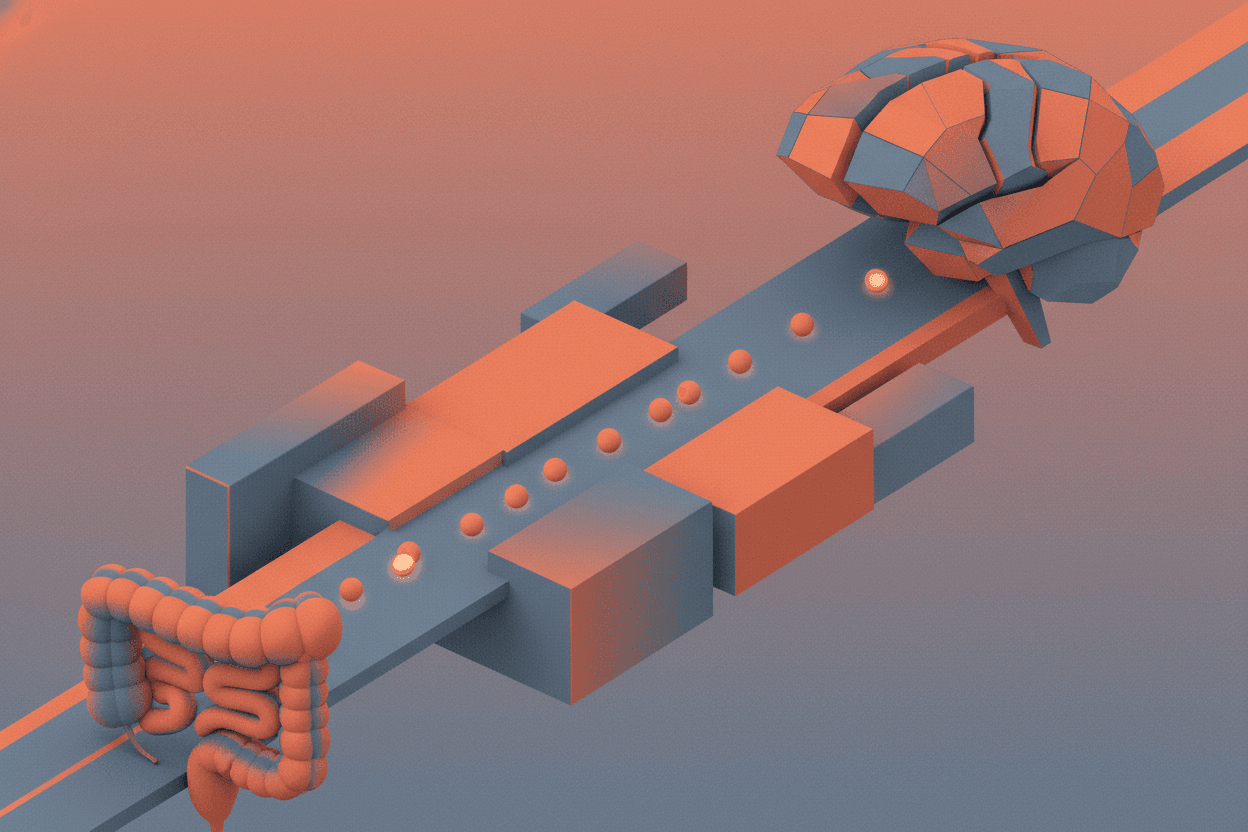
The connection between gut and brain isn't metaphorical—it's anatomical. The vagus nerve, a bundle of roughly 100,000 fibers running from your brainstem to your colon, serves as a bidirectional communication cable. For decades, physiologists assumed traffic flowed predominantly brainward, allowing the mind to regulate digestion. They had it backwards.
[!INSIGHT] Approximately 80% of vagal fibers are afferent—meaning they carry information FROM the gut TO the brain, not the other way around. Your intestines are talking; your brain is mostly listening.
Gut bacteria produce neurotransmitters directly. Lactobacillus and Bifidobacterium species manufacture GABA, the brain's primary inhibitory neurotransmitter. Escherichia and Saccharomyces produce norepinephrine. Candida, Streptococcus, and Enterococcus generate serotonin. These molecules don't cross the blood-brain barrier themselves—but they stimulate enterochromaffin cells in your intestinal lining, which then signal the vagus nerve to notify the brain.
A landmark 2011 experiment demonstrated this elegantly: researchers fed mice a broth containing Lactobacillus rhamnosus for 28 days. The mice showed reduced anxiety behaviors and lower corticosterone levels under stress. Crucially, when the vagus nerve was surgically severed, the probiotic effect vanished entirely. The psychological benefits required an intact phone line from gut to brain.
“"The gut microbiota can be viewed as a key regulator of the brain-gut axis, influencing not only gut function but also behavior and emotion.”
— Dr. John Cryan, neuroscientist, University College Cork
The Antibiotic-Depression Connection
If beneficial bacteria support mental health, destroying them should produce the opposite effect. Population-level data confirms this hypothesis with unsettling precision.
A 2015 study analyzing health records from 1.8 million Danish residents found that antibiotic exposure was associated with a statistically significant increase in depression risk. The effect was dose-dependent: patients who received 2-5 antibiotic prescriptions showed a 23% increased risk, while those receiving more than 5 prescriptions faced a 53% elevated risk. A separate British study of 202,574 patients yielded comparable results, with single antibiotic courses increasing depression probability by 24%.
The mechanism isn't mysterious. Broad-spectrum antibiotics—particularly clindamycin, ciprofloxacin, and cephalosporins—deplete gut bacterial diversity by 30-50% in some studies. When keystone species disappear, the production of short-chain fatty acids like butyrate plummets. Butyrate normally crosses the blood-brain barrier and promotes the expression of brain-derived neurotrophic factor (BDNF), essential for neuroplasticity and mood regulation. Remove butyrate, and the brain's resilience falters.
[!NOTE] Not all antibiotics show equal psychiatric risk. Penicillins demonstrate weaker associations than fluoroquinolones or clindamycin, suggesting that specific bacterial taxa—rather than overall diversity—may mediate the mental health effects.
The clinical implications are profound. Psychiatric assessments rarely inquire about recent antibiotic use. Patients prescribed antibiotics receive no mental health monitoring. Yet the data suggests that a five-day course of ciprofloxacin may carry comparable depression risk to major life stressors like job loss or divorce—at least for susceptible individuals.
Probiotics Enter the Psychiatric Arena
If antibiotics can induce depression, can probiotics treat it? The emerging clinical data offers cautious optimism.
A 2017 meta-analysis pooled results from 10 randomized controlled trials encompassing 689 participants. Probiotic supplementation significantly reduced depression scores compared to placebo, with effects most pronounced in clinically depressed populations. A 2019 systematic review of 21 trials reached similar conclusions, noting that multi-strain formulations outperformed single-species products.
The most compelling evidence comes from a 2020 trial published in JAMA Psychiatry. Researchers administered a specific probiotic combination (Lactobacillus helveticus and Bifidobacterium longum) to 44 patients with major depressive disorder for 8 weeks. The treatment group showed significantly greater improvement on the Hamilton Depression Rating Scale than placebo recipients—a mean reduction of 5.7 points versus 3.0 points.
However, the field remains plagued by inconsistency. A 2021 trial using identical strains found no benefit. A 2022 crossover study showed effects only during the active treatment phase, with symptoms returning after discontinuation. The heterogeneity suggests that probiotics aren't magic bullets; their efficacy likely depends on baseline microbiome composition, diet, and genetic factors.
Implications: Rethinking Mental Healthcare
The gut-brain axis forces a fundamental reconceptualization of psychiatric medicine. Current treatments—SSRIs, antipsychotics, anxiolytics—target the brain directly, manipulating neurotransmitter levels at their presumed source. But if serotonin's primary production site is the intestinal epithelium, perhaps we've been intervening at the wrong anatomical level.
This doesn't invalidate existing treatments. SSRIs work, albeit imperfectly. But augmenting standard psychiatry with microbiome-targeted interventions could improve outcomes substantially. Consider the implications for treatment-resistant depression, which affects approximately 30% of depressed patients. If a subset of these individuals harbor dysbiotic gut ecosystems, fecal microbiota transplantation or personalized probiotic regimens might succeed where conventional pharmaceuticals fail.
“"We are witnessing the birth of a new discipline”
— psychobiotics—the use of probiotics to treat mental illness. It represents a paradigm shift from brain-centric to whole-body psychiatry."
The economic stakes are immense. Depression costs the global economy approximately $1 trillion annually in lost productivity. A 10% improvement in treatment efficacy through microbiome interventions could translate to $100 billion in recovered output—not to mention immeasurable reductions in human suffering.
[!INSIGHT] The gut-brain axis explains several clinical puzzles: why irritable bowel syndrome and depression co-occur in 60-80% of patients, why stress triggers gastrointestinal symptoms, and why dietary changes sometimes outperform pharmaceuticals for mood disorders.
Conclusion
The microbiome represents the most consequential psychiatric discovery of the 21st century—and most clinicians haven't integrated it into practice. Your gut bacteria manufacture neurotransmitters, modulate vagal signaling, produce neuroactive metabolites, and shape immune responses that affect brain function. When antibiotics devastate this ecosystem, depression rates rise measurably in population data.
Key Takeaway: Mental health is not merely brain health. The organisms colonizing your intestines exert profound influence over your emotional state through the vagus nerve and circulating metabolites. Protecting and cultivating a healthy microbiome—through judicious antibiotic use, fermented foods, and targeted probiotics—may prove as important for psychological well-being as any pharmaceutical intervention.
The next decade will likely see the emergence of "psychobiotics" as a mainstream psychiatric treatment class. For now, the evidence supports a pragmatic approach: minimize unnecessary antibiotic exposure, consume fiber and fermented foods regularly, and consider probiotic supplementation during periods of psychological stress or after antibiotic courses. Your gut bacteria were here before you were born—and they'll be managing your mood long after you've finished reading this article.
Sources: Cryan, J.F. & Dinan, T.G. (2012). Mind-altering microorganisms: the impact of the gut microbiota on brain and behaviour. Nature Reviews Neuroscience. Lurie, I. et al. (2015). Antidepressant use and risk of Clostridium difficile infection. Journal of Clinical Psychiatry. Wallace, C.J.K. & Milev, R. (2017). The effects of probiotics on depressive symptoms in humans. Annals of General Psychiatry. Rudzki, L. et al. (2019). Immune system and microbiome in mood disorders. Pharmacological Reports. Chahwan, K. et al. (2022). Gut microbiome and depression. Frontiers in Neuroendocrinology.
This is a Premium Article
Hylē Media members get unlimited access to all premium content. Sign up free — no credit card required.