Mass isn't innate—it's resistance from wading through an invisible field. The Higgs discovery revolutionized physics, but deep mysteries remain unsolved.
Hyle Editorial·
Mass is not a property particles are born with. It's a resistance they develop by wading through a field that fills all of space. The universe is basically molasses.
In 2012, physicists at CERN's Large Hadron Collider announced the discovery of the Higgs boson—a particle that had been hunted for nearly 50 years. The news made headlines worldwide, but few outside physics departments grasped what had actually been found. The Higgs boson isn't just another particle; it's the smoking gun proving that empty space isn't empty at all. It's filled with an invisible field that gives particles their mass by resisting their motion.
Before 1964, the Standard Model of particle physics faced a fatal mathematical problem. The equations worked beautifully for massless particles like photons, but they collapsed whenever physicists tried to give particles mass. The mathematics produced infinities—nonsensical results that suggested the theory was fundamentally broken.
[!INSIGHT] The symmetry at the heart of quantum field theory forbids particles from having intrinsic mass. Adding mass terms by hand violates gauge invariance—the mathematical principle that makes the Standard Model predictive.
Three independent research teams proposed the same radical solution in 1964. Peter Higgs, François Englert and Robert Brout, and Gerald Guralnik, Carl Hagen, and Tom Kibble all suggested that particles don't carry mass as an inherent property. Instead, they acquire it through interaction with a field that permeates all of space.
The mechanism works through spontaneous symmetry breaking. The laws of physics remain symmetric—the underlying equations don't distinguish between different particles—but the vacuum state does. The Higgs field has a non-zero value everywhere, even in empty space, breaking the symmetry and allowing particles to behave as if they have mass.
The Analogy That Actually Works
Most popular explanations use Margaret Thatcher at a cocktail party (she attracts admirers who cluster around her, gaining effective "mass"). But a more precise analogy imagines the universe as a tank of viscous fluid:
Massless particles (photons): Like perfectly streamlined fish that slip through the fluid without resistance—they travel at the speed of light
Massive particles (electrons, quarks): Like swimmers pushing through molasses—their resistance to acceleration is what we measure as mass
The Higgs field: The molasses itself—an invisible medium filling all space
“*"The Higgs mechanism is the only way we know to give particles mass without destroying the mathematical consistency of the theory. Nature appears to have chosen this solution.”
— Steven Weinberg, Nobel Laureate
How the Higgs Mechanism Actually Works
The mathematical machinery is elegant but subtle. Here's what happens at the quantum level:
The Mexican Hat Potential
The Higgs field has a unique potential energy shape—often called the "Mexican hat" potential. In mathematical terms:
$$V(\phi) = \mu^2|\phi|^2 + \lambda|\phi|^4$$
When $\mu^2 < 0$, the minimum energy state isn't at zero—the field "rolls down" to a non-zero value. This is the Higgs vacuum expectation value, approximately 246 GeV.
Particle-Field Coupling
Different particles couple to the Higgs field with different strengths:
Particle
Higgs Coupling Strength
Resulting Mass
Electron
Weak (0.000003)
0.511 MeV
Top Quark
Strong (~1.0)
173 GeV
Photon
Zero
Massless
W Boson
Medium
80.4 GeV
The coupling strength directly determines mass: $m = y \times v / \sqrt{2}$, where $y$ is the Yukawa coupling and $v$ is the Higgs vacuum expectation value.
“[!INSIGHT] The Higgs boson mass (125 GeV) tells us the shape of the potential energy landscape. At this value, the universe sits in a "metastable" state”
— potentially stable for billions of years, but possibly destined for a catastrophic phase transition.
The Discovery at CERN
Finding the Higgs boson required colliding protons at energies of 13 TeV and examining the debris for the specific decay patterns predicted by theory. The discovery announced on July 4, 2012, showed a new particle with mass around 125 GeV decaying into photons, W bosons, and Z bosons exactly as predicted.
The statistical significance reached 5 sigma—meaning less than a 1 in 3.5 million chance of being a random fluctuation. Peter Higgs and François Englert received the 2013 Nobel Prize in Physics.
The Hierarchy Problem: Why the Higgs Is Still Mysterious
Despite the triumph of discovery, the Higgs mechanism reveals an even deeper puzzle. The calculated mass of the Higgs boson should be enormous—around $10^{19}$ GeV—because of quantum corrections from virtual particles constantly appearing and disappearing in the vacuum.
Yet the measured value is only 125 GeV.
This isn't a small discrepancy—it's a factor of $10^{17}$, one of the worst predictions in the history of physics. For the Higgs mass to be this small, quantum corrections from different particles must cancel to one part in $10^{17}$.
[!NOTE] This fine-tuning problem has driven theoretical physics for decades. Proposed solutions include supersymmetry (new particles that automatically cancel the corrections), extra dimensions (which dilute the quantum corrections), or the anthropic principle (we observe a low mass because any other value would prevent life from existing).
What the LHC Hasn't Found
The Large Hadron Collider has now analyzed data from over 300 trillion collisions. Beyond the Higgs, it has found:
No supersymmetric particles
No extra dimensions
No dark matter candidates
Nothing unexpected
This "nightmare scenario"—finding only what the Standard Model predicts—suggests our theories are incomplete but we don't yet know how.
Implications: Mass, Reality, and What Remains Hidden
The Higgs mechanism reveals something profound about the nature of reality. The properties we consider fundamental—mass, inertia, the feeling of substance—are emergent phenomena arising from interaction with an invisible field.
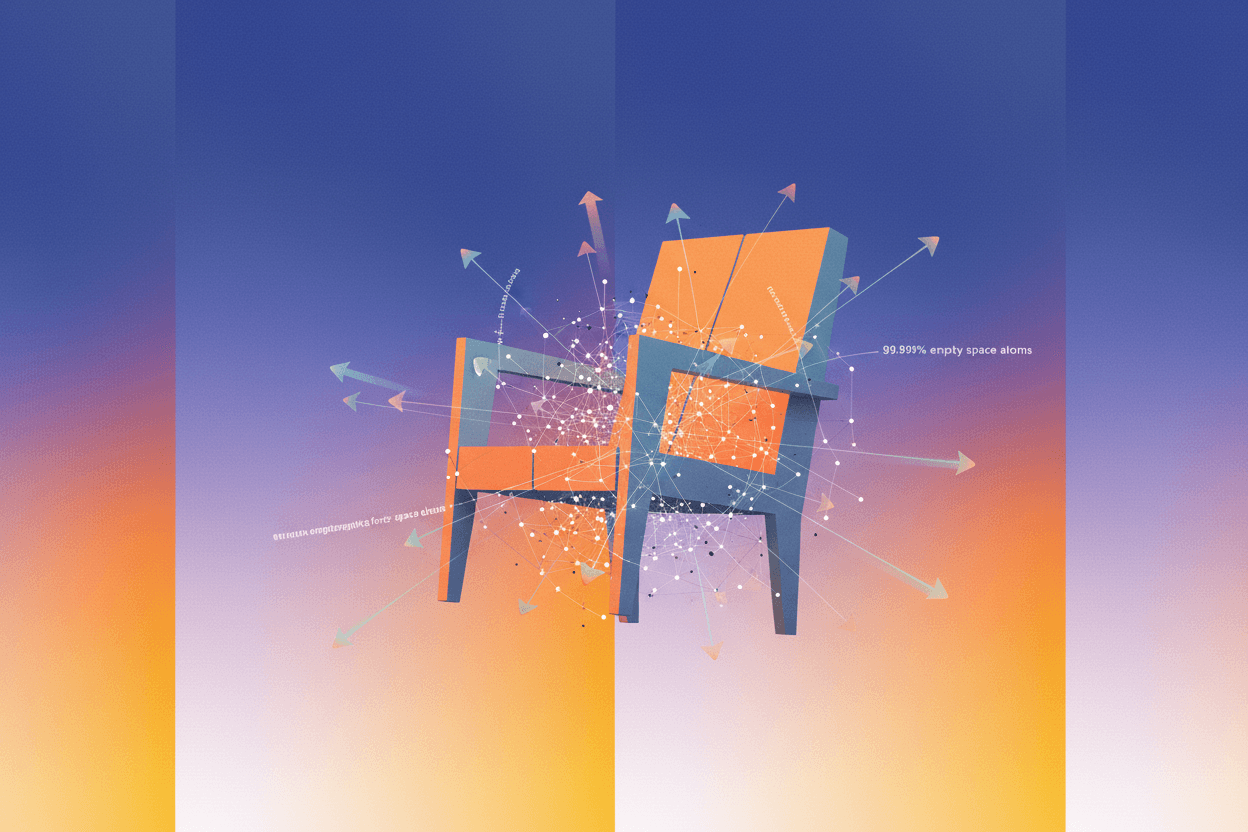
The chair you're sitting on feels solid not because atoms are solid (they're mostly empty space) but because its electrons interact with the Higgs field, giving them inertia. The Earth orbits the Sun because the gravitational interaction between masses—all ultimately traceable to Higgs coupling—follows spacetime curvature.
The Matter-Antimatter Asymmetry
The Higgs field may also hold clues to why the universe exists at all. During the early universe's rapid expansion (inflation), the Higgs field could have created the matter-antimatter imbalance that allows stars, planets, and life to exist. Understanding this connection remains an active research frontier.
Conclusion
The discovery of the Higgs boson completed the Standard Model of particle physics—the most successful scientific theory ever created. Every predicted particle has been found, every measured property matches predictions to extraordinary precision.
Yet the triumph is incomplete. The hierarchy problem, the absence of new physics at the LHC, and the deep mystery of why the Higgs field has exactly the strength it does all point to physics beyond our current understanding.
Key Takeaway: Mass is not an intrinsic property of matter but an acquired characteristic—a resistance that emerges when particles interact with the Higgs field. The 2012 discovery confirmed this mechanism, but the fine-tuning required for it to work suggests we're still missing something fundamental about how the universe constructs reality.
Sources: ATLAS Collaboration. (2012). Observation of a new particle in the search for the Standard Model Higgs boson. Physics Letters B, 716(1), 1-29. | CMS Collaboration. (2012). Observation of a new boson at a mass of 125 GeV with the CMS experiment at the LHC. Physics Letters B, 716(1), 30-61. | Higgs, P. W. (1964). Broken symmetries and the masses of gauge bosons. Physical Review Letters, 13(16), 508. | ATLAS Collaboration. (2023). Combined measurements of Higgs boson production and decay using up to 139 fb⁻¹ of proton-proton collision data at √s = 13 TeV. CERN-EP-2023-215.
This is a Premium Article
Hylē Media members get unlimited access to all premium content. Sign up free — no credit card required.