The Starlink Problem: When Progress Creates the Disaster
SpaceX's Starlink has connected 3 million people to high-speed internet while doubling active satellites in orbit. Is this progress or orbital catastrophe?
Hyle Editorial·
SpaceX's Starlink has connected 3 million people in remote areas to high-speed internet. It has also doubled the number of active satellites in orbit in just 4 years. The technology that solves digital inequality may be creating orbital inequality—and potentially, an impassable barrier around Earth.
In March 2024, Starlink satellites came within 20 meters of colliding with another spacecraft. Such near-misses now happen weekly. By 2027, Elon Musk's company plans to expand from 6,000 satellites to 42,000. Amazon, OneWeb, and China's state-backed programs are rushing to stake their own orbital claims. The result? Low Earth Orbit is becoming a Gold Rush town with no sheriff—and everyone is running out of space.
The numbers are staggering. Before Starlink's first launch in 2019, approximately 2,000 active satellites orbited Earth. By early 2024, that number exceeded 9,000—with Starlink alone accounting for over 6,000. The company launches approximately 200 new satellites every month, each one adding to an unprecedented concentration of hardware in an already-crowded orbital shell between 340 and 614 kilometers altitude.
But SpaceX is no longer alone. OneWeb, backed by the UK government, has deployed over 600 satellites. Amazon's Project Kuiper has secured FCC approval for 3,236 satellites, with the first units launching in late 2023. China has announced plans for its own 13,000-satellite constellation called Guowang. The European Union is exploring a 170-satellite network for secure communications.
[!INSIGHT] The International Telecommunication Union (ITU) has received filings for over 400,000 satellites from various operators. Even if only 10% of these are deployed, orbital traffic will increase twentyfold within a decade.
This isn't simply congestion—it's a fundamental transformation of humanity's relationship with space. For the first time in history, the region between Earth and the rest of the cosmos is being enclosed, partitioned, and claimed by competing interests.
The Kessler Syndrome Revisited
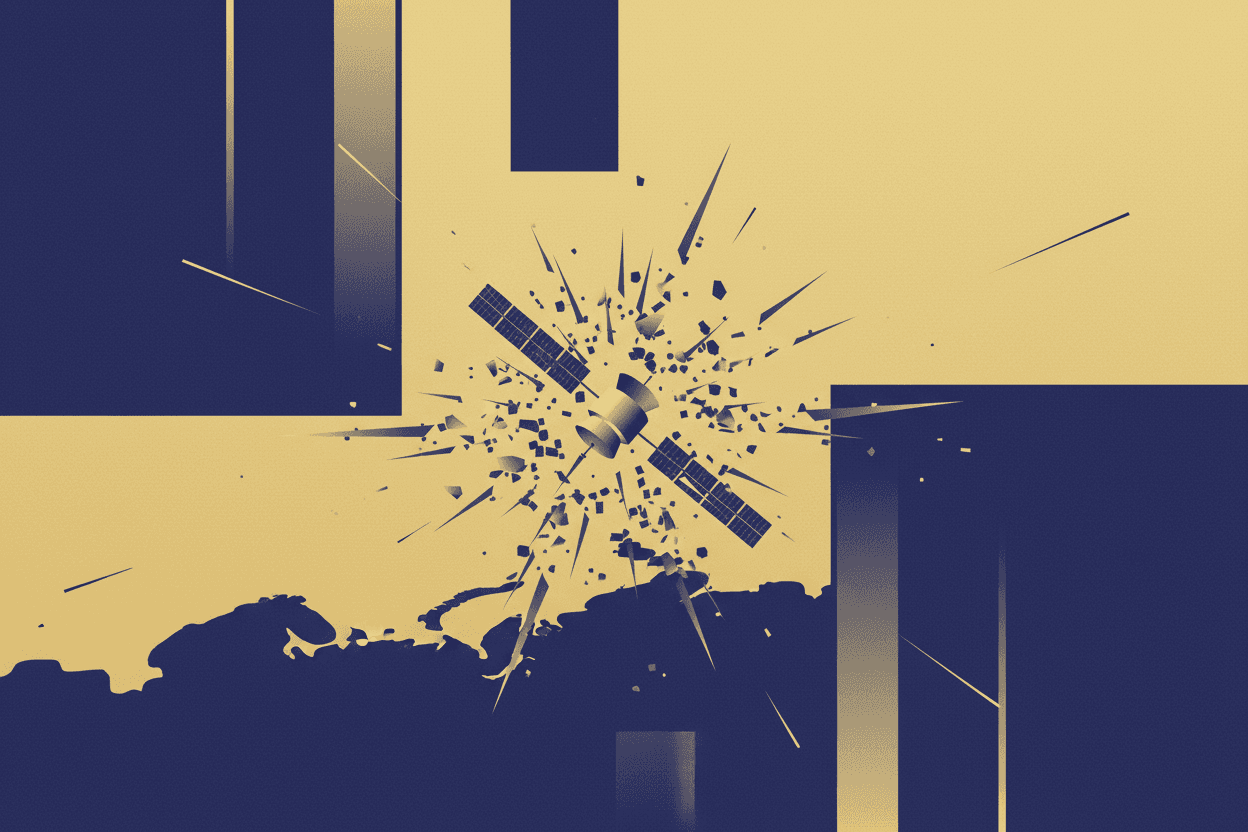
In 1978, NASA scientist Donald Kessler proposed a nightmare scenario: enough debris in orbit could trigger cascading collisions, each creating more fragments that would cause more collisions, eventually rendering space inaccessible for decades. The "Kessler Syndrome" remained theoretical for decades. It may not stay that way.
In September 2024, a defunct Russian satellite broke apart, creating over 700 tracked debris fragments. Earlier that year, a Chinese rocket stage exploded, littering a heavily-used orbital band. Each piece of debris travels at approximately 28,000 kilometers per hour—fast enough that a one-centimeter paint fleck carries the kinetic energy of a hand grenade.
“*"We're seeing the early stages of an environmental crisis in space. The difference is that unlike pollution on Earth, this one could trap us on the planet.”
— Dr. Moriba Jah, University of Texas at Austin, astrodynamicist
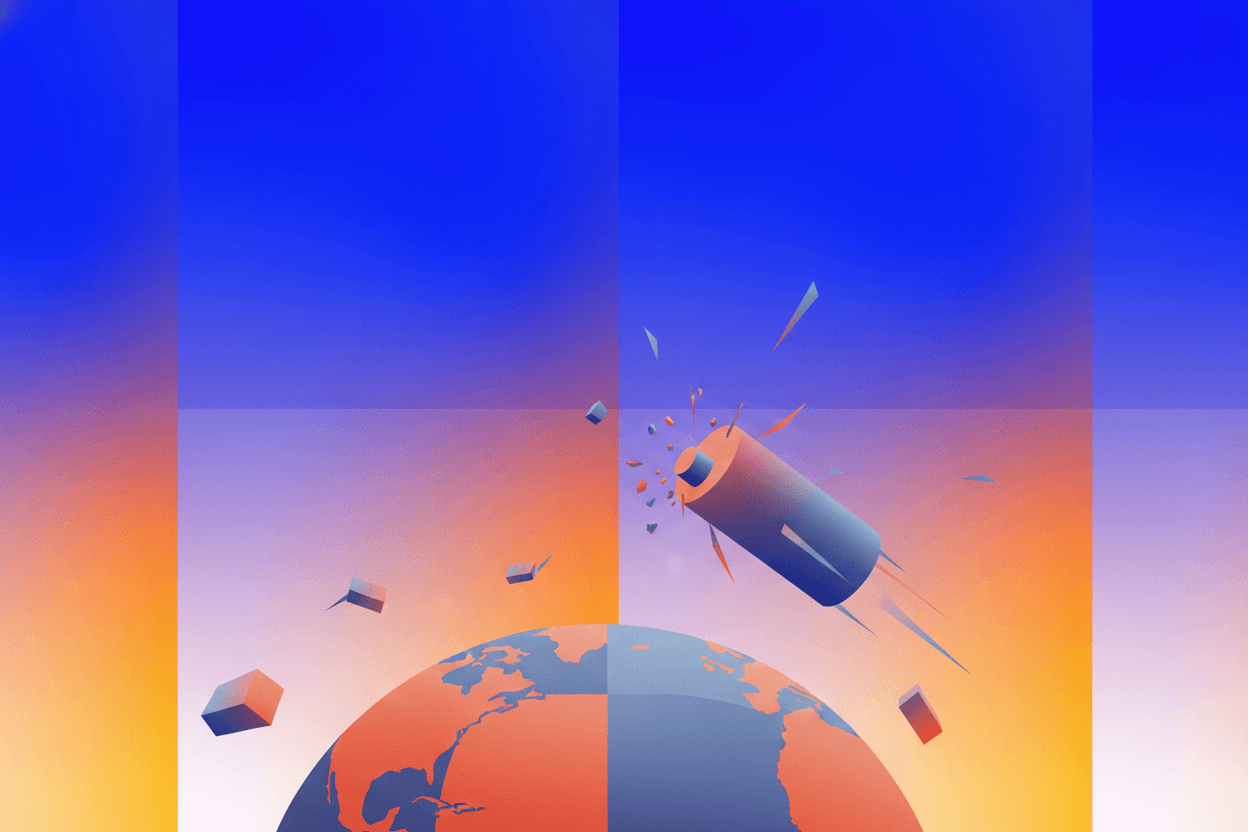
The mega-constellations amplify this risk exponentially. With 42,000 Starlink satellites alone, statistical models suggest multiple collisions per year become inevitable. And each collision doesn't just destroy two satellites—it creates thousands of fragments that threaten every other object in similar orbits.
The Tragedy of the Orbital Commons
Space, like the high seas or the atmosphere, functions as a global commons. No single nation or corporation owns it. Yet the current regulatory framework—rooted in the 1967 Outer Space Treaty—was designed for an era when only superpowers could reach orbit. It never anticipated a world where a single company might launch more satellites in a month than all nations combined launched in the first four decades of the Space Age.
The ITU manages radio frequency allocations, preventing satellites from jamming each other's signals. But orbital slots operate on a first-come, first-served basis. SpaceX's early move has effectively claimed the most valuable real estate in Low Earth Orbit—the sweet spot where latency is low, coverage is broad, and launch costs are manageable.
[!NOTE] Under current international law, there is no mechanism to limit how many satellites a single entity can launch, nor any requirement to coordinate mega-constellation deployments across national boundaries. The first filer wins—regardless of broader consequences.
Latecomers face a stark choice: accept less optimal orbital shells, or risk dangerous proximity to SpaceX's expanding constellation. This isn't just commercial competition; it's the enclosure of a shared resource that all humanity depends upon for weather monitoring, climate science, disaster response, and national security.
The Astronomy Crisis
Ground-based astronomy faces an existential threat. A single Starlink satellite can ruin a telescope's long-exposure image with a bright streak across the frame. With thousands of satellites continuously crossing the sky, astronomers report that some observations have become nearly impossible.
The Vera C. Rubin Observatory, a $700 million facility designed to map the entire visible sky every few nights, may lose up to 40% of its twilight observations to satellite interference. These hours are critical for tracking near-Earth asteroids that could threaten our planet—a cosmic irony: the technology promising to connect humanity may blind us to existential threats from space.
Radio astronomers fare no better. Starlink satellites transmit in frequencies adjacent to protected radio astronomy bands. Even with improved shielding, the sheer quantity of transmitters creates background noise that can overwhelm faint signals from distant galaxies.
“*"We're building a fence around Earth that blocks our view of the universe. Future generations may never see a truly dark sky.”
— Dr. Samantha Lawler, University of Regina
The Connectivity Paradox
Here lies the central dilemma: Starlink is not villainous technology. For 3 million users in rural Alaska, war-torn Ukraine, and remote Pacific islands, it provides internet access that was previously impossible. Schools, hospitals, and emergency services depend on it. The revenue from Starlink funds SpaceX's Mars ambitions—humanity's most serious effort to become a multi-planetary species.
The same company that crowds orbit with satellites is also the only entity actively working to reduce orbital debris. SpaceX's Starship vehicle, if successful, could economically deorbit defunct hardware. Starlink satellites are designed to deorbit within five years of mission end—a significant improvement over legacy satellites that remain for decades.
Yet good intentions cannot overcome physics. The orbital environment has finite capacity. Every satellite launched consumes a portion of that capacity, and every collision—however rare—permanently degrades it. The question is not whether Starlink provides value, but whether any single actor should be permitted to fundamentally alter a global commons.
The Governance Gap
Space law has not kept pace with space commerce. The 1967 Outer Space Treaty prohibits national appropriation of celestial bodies but says nothing about orbital shells. The 1972 Liability Convention makes launching states responsible for damage—but only after damage occurs. There is no framework for managing collective risk, no mechanism for resolving disputes between satellite operators, and no enforcement body with real authority.
The United Nations Office for Outer Space Affairs has proposed voluntary guidelines for debris mitigation. Compliance is patchy. The ITU struggles to process the deluge of satellite filings. By the time international consensus emerges, the orbital environment may already be degraded beyond easy repair.
Key Takeaway
The Starlink dilemma represents a broader pattern: technological capabilities expanding faster than governance structures can adapt. Without international coordination on orbital traffic management, debris mitigation standards, and equitable access to orbital resources, humanity risks repeating the same tragedy of the commons that has degraded fisheries, forests, and climate—except this time, the resource being destroyed is our bridge to the cosmos itself.
Sources: Union of Concerned Scientists Satellite Database (2024), ESA Space Debris Office Annual Report, ITU Filings Database, NASA Orbital Debris Program Office Quarterly Updates, Scientific American interviews with Dr. Moriba Jah (2023-2024), Vera C. Rubin Observatory Environmental Impact Statement, SpaceX Starlink documentation and FCC filings.
This is a Premium Article
Hylē Media members get unlimited access to all premium content. Sign up free — no credit card required.