The Prison That Watches Itself
Your open-plan office uses the same psychological architecture as a 1791 prison design. Discover how buildings manipulate behavior without you noticing.
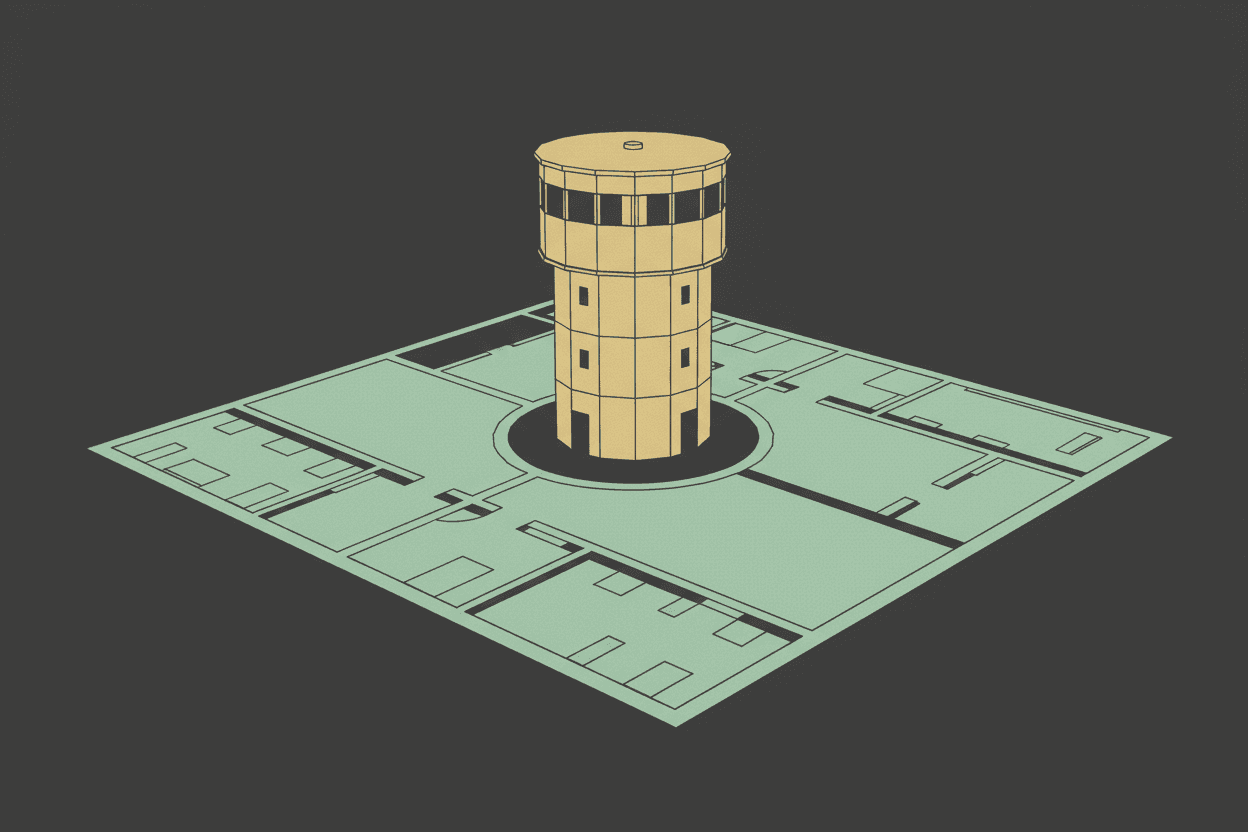
Jeremy Bentham designed a prison in 1791 where inmates could never know if they were being watched. Guards didn't need to watch — the threat was enough. Your open-plan office is the same building. Same psychology. Different prison.
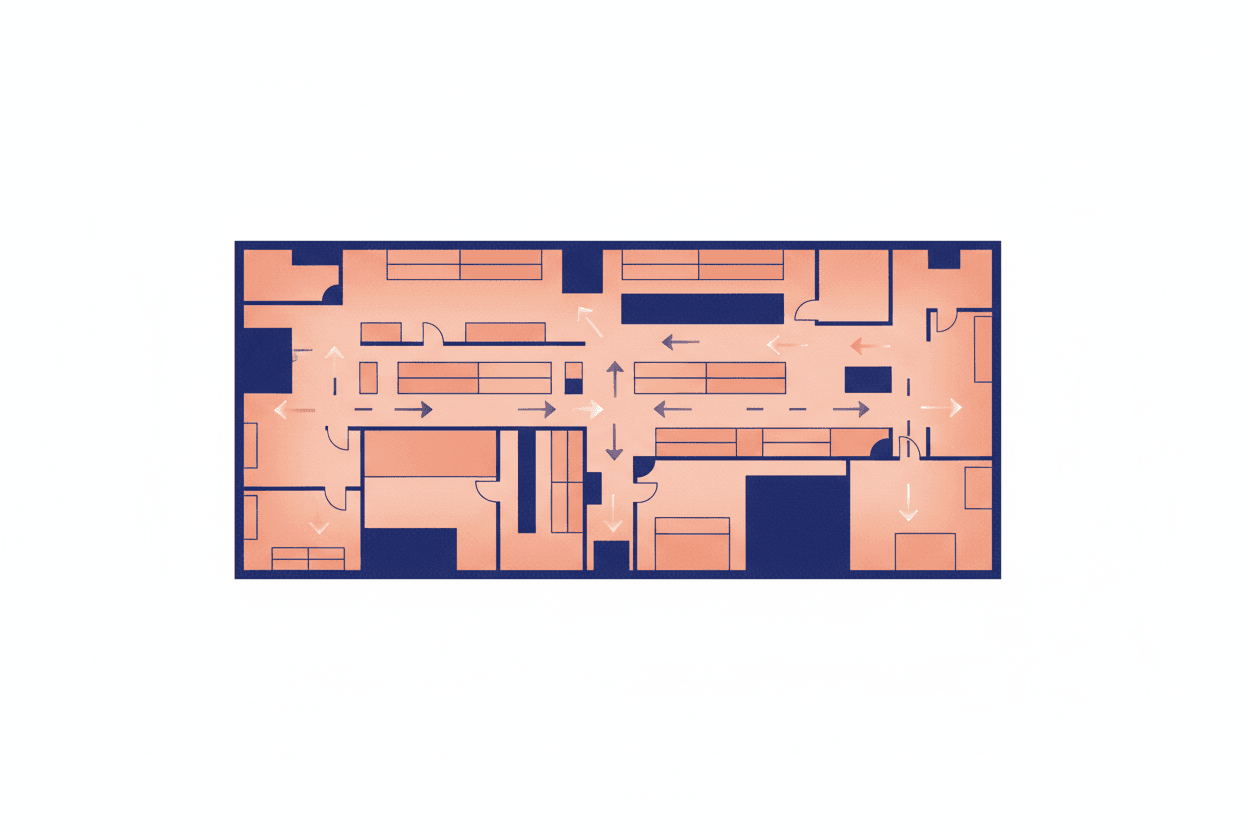
In 2023, researchers at the University of California found that employees in transparent, open workspaces took 23% fewer breaks and reported 31% higher stress levels than those in traditional offices with doors. The glass walls weren't there to help them collaborate. They were there to make them feel seen.
The question isn't whether your workplace is watching you. It's whether the building itself has made you complicit in your own surveillance — and why you never noticed it happening.
The Panopticon: A Perfect Machine
Bentham called his invention the Panopticon — from the Greek for "all-seeing." The design was elegant in its cruelty: a circular ring of cells, each with windows on both sides, surrounding a central watchtower. Backlighting made inmates visible at all times, while blinds on the tower ensured they could never know if a guard was present.
[!INSIGHT] The Panopticon's power wasn't surveillance — it was asymmetric visibility. The observed could always be seen; the observer could never be confirmed. This asymmetry produced self-discipline without requiring actual discipline.
The prisoner, unable to determine whether they were being watched at any given moment, would eventually assume they were always being watched. They would regulate their own behavior. The guard tower could stand empty, and the prison would still function.
Bentham was delighted. He wrote to everyone who would listen — including the French National Assembly — claiming his design would reduce the cost of incarceration while increasing its moral effectiveness. He called it "a mill for grinding rogues honest."
“"Morals reformed”
The British government rejected his proposals. But the idea never died. It simply evolved.
Foucault's Discovery: Discipline Without Guards
In 1975, French philosopher Michel Foucault published Discipline and Punish, a genealogy of the modern prison. His central argument: the Panopticon wasn't just a building — it was a diagram for modern power.
Foucault observed that the 19th century had replaced public torture with institutional discipline. The shift wasn't humanitarian; it was operational. The old model required violence. The new model required only visibility.
[!INSIGHT] Foucault's key insight was that Panopticism had escaped the prison. Schools, hospitals, factories, and barracks all adopted the same logic: make people visible, and they will discipline themselves.
The architecture of control spread through institutions like a virus. Open wards in hospitals. Desks arranged in rows facing the teacher. Factory floors with sightlines from the foreman's office. Each space designed to make the observed feel potentially watched at all times.
Foucault called this "disciplinary society" — a social order where power operates not through force but through the internalization of the gaze. You don't need guards when people police themselves.
But here's what Foucault couldn't have predicted: the same logic would eventually be used to design corporate headquarters for the world's wealthiest companies — and employees would compete to work there.
The Open-Plan Office: Panopticism for Profit
In 2019, WeWork operated over 400 locations across 27 countries. Their design language was consistent: glass walls, open floor plans, minimal private space. They called it "community." Critics called it surveillance.
A 2018 study by Harvard Business School found that open-plan offices actually decreased face-to-face interaction by 73%. Employees, aware of their visibility, retreated into headphones and digital communication. The architecture promised collaboration but produced self-isolation.
“[!NOTE] The open-plan office originated in the 1950s with German design group Quickborner. Their "Bürolandschaft" (office landscape) was meant to democratize the workplace. By the 1990s, it had become a cost-saving measure”
Amazon's fulfillment centers take the logic further. Warehouse floor layouts are designed for maximum visibility, with algorithms tracking worker movement in real-time. A 2021 report found that Amazon warehouse workers took bathroom breaks at rates suggesting constant awareness of being monitored — some workers urinated in bottles to avoid productivity penalties.
Google's campuses, by contrast, use transparency architecturally. Glass walls in meeting rooms, open atriums, and few closed doors. The message is trust and openness. The effect is visibility and self-regulation. Employees work harder when they feel observed by peers, even without formal surveillance.
The building doesn't need cameras. It only needs glass.
The Prison Without Walls
The Panopticon's true horror wasn't the watching — it was the possibility of watching. Bentham understood that uncertainty produces compliance more effectively than certainty. A prisoner who knows they're unwatched for one hour will break rules that hour. A prisoner who might be watched at any moment never breaks rules at all.
This is the logic embedded in modern architecture:
- Glass walls in offices create peer visibility without explicit surveillance
- Open floor plans eliminate private space where unobserved behavior could occur
- Hot-desking removes territorial ownership, keeping workers mobile and visible
- Activity-based working ensures no single workspace becomes a private refuge
“"The Panopticon is a machine for creating and sustaining a power relation independent of the person who exercises it; in short, that the inmates should be caught up in a power situation of which they are themselves the bearers.”
WeWork's glass walls, Amazon's warehouse sightlines, and Google's open campuses all function on Bentham's principle: make visibility constant, and self-discipline follows.
The prison doesn't need guards. It only needs architecture.
Implications: Living in the Light
If Foucault was right that Panopticism escaped the prison, we should ask: where hasn't it escaped to?
Social media platforms operate on the same logic. The possibility of being seen by followers, employers, or algorithms produces constant self-regulation. We curate our lives for invisible audiences. The tower has no guards — only the statistical probability of a gaze.
Smart homes with voice assistants and security cameras extend the logic into domestic space. The possibility that devices are listening or watching produces behavioral modification. We speak differently when Alexa is in the room. We behave differently when the doorbell has a camera.
[!NOTE] A 2022 Pew Research study found that 63% of Americans believe it's impossible to go through daily life without having their data collected by companies or the government. The awareness of being observed has become ambient.
The implications are stark: if power now operates through architecture rather than authority, resistance must also be architectural. Privacy isn't a policy problem — it's a design problem.
Bentham's prison failed because governments weren't ready for it. The corporate version succeeded because employees consented to it. We signed up for glass walls and open plans. We called it innovation.
Sources: Foucault, M. (1975). Discipline and Punish: The Birth of the Prison. Bentham, J. (1787). Panopticon; or, The Inspection House. Bernstein, E. & Turban, S. (2018). The Impact of the Open Office on Human Interaction. Harvard Business School. Kantarjian, H. (2021). Amazon Warehouse Workers and Bathroom Break Access. The Guardian. Pew Research Center (2022). Americans and Data Privacy.
This is a Premium Article
Hylē Media members get unlimited access to all premium content. Sign up free — no credit card required.