Robert Moses built bridges too low for buses. His concrete barriers reveal how architecture became a weapon of exclusion—and why poor neighborhoods still bear the scars.
Hyle Editorial·
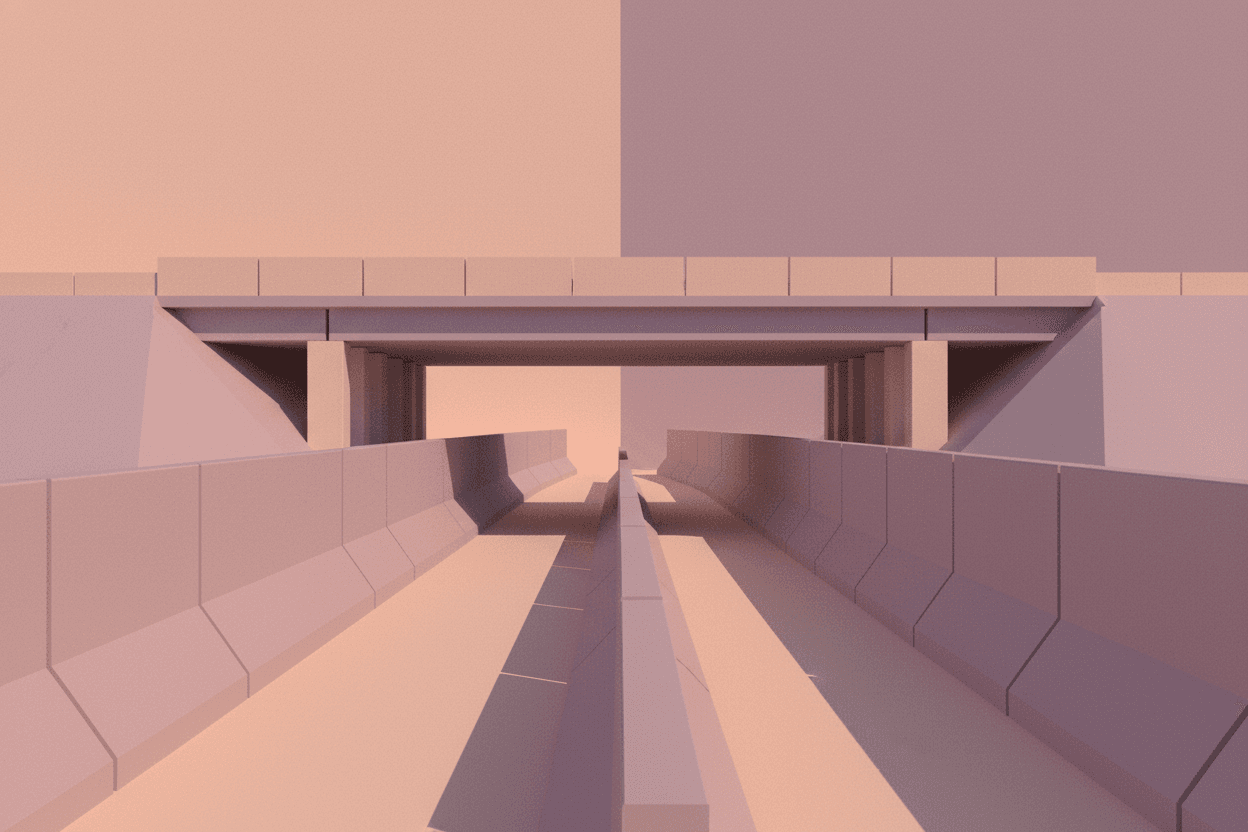
In the 1930s, a New York city planner built bridges with 9-foot clearances — just low enough to block buses, just high enough for cars. It wasn't an engineering constraint. It was a racial policy expressed in concrete. Robert Moses, the unelected "master builder" who shaped modern New York, designed over 200 bridges and overpasses leading to Long Island's prized beaches. Each one was calculated: 9 feet of vertical space meant that public transit buses—carrying predominantly Black and working-class residents from Manhattan, Brooklyn, and Queens—could not pass. Private automobiles, owned almost exclusively by white middle-class families, glided through unimpeded.
This wasn't discovered until decades later, when urban scholar Robert Caro documented it in his 1974 Pulitzer-winning investigation The Power Broker. Moses had left a paper trail. Internal memos revealed that the bridge heights were explicitly discussed as a way to keep "the wrong element" from reaching Jones Beach. The infrastructure was not neutral. It was a filter.
[!INSIGHT] Architecture is never just about aesthetics or function. Every design decision—ceiling height, staircase width, transit access—encodes assumptions about who belongs and who doesn't.
The Architecture of Hostility
Moses didn't stop at bridges. His public housing projects—tower blocks rising from isolated superblocks—were designed with deliberate hostility toward the people who would live there. The sidewalls of many Stuyvesant Town and Williamsburg buildings were left blank, windowless, facing the street like fortress walls. Ground-level retail was banned. The goal was separation: residents would sleep in their towers, commute to work, and return. No street life. No mixed commerce. No "undesirable" gathering.
Jane Jacobs, the activist-scholar who opposed Moses, documented how this design philosophy destroyed the "eyes on the street" that made neighborhoods safe. In her 1961 classic The Death and Life of Great American Cities, she showed that mixed-use districts—where shopkeepers, residents, and pedestrians created constant informal surveillance—had lower crime rates than the tower-in-a-park models Moses championed.
“"Cities have the capability of providing something for everybody, only because, and only when, they are created by everybody.”
— Jane Jacobs
The contrast is visible from space. Wealthy neighborhoods have small blocks, multiple street connections, ground-floor retail, and pedestrian-scaled buildings. Poor neighborhoods—especially those shaped by mid-century urban renewal—feature large superblocks, dead-end streets, aggressive setbacks, and defensive architecture. The pattern repeats in Chicago's Robert Taylor Homes, St. Louis's Pruitt-Igoe, and London's Brutalist estates. In 1972, Pruitt-Igoe was demolished just 18 years after opening. Its failure was not social alone. The architecture had made community impossible.
The Pattern Recognition of Poverty
When you enter a neighborhood, you diagnose its economic status in seconds. What are you actually seeing? It's not just litter or deferred maintenance. It's the spatial logic.
1. Fragmented Street Networks
Poor neighborhoods designed during the urban renewal era often feature cul-de-sacs, looping roads, and single points of entry. This reduces connectivity and increases travel time to jobs, healthcare, and services. A 2018 study by the Federal Reserve Bank of Philadelphia found that street connectivity was a stronger predictor of intergenerational poverty than school quality.
2. Hostile Landscaping
Anti-homeless spikes, bench dividers, and sloped surfaces are now ubiquitous in commercial districts. But in subsidized housing, hostility takes subtler forms: exposed plazas with no shade, benches designed to be uncomfortable after 15 minutes, lighting that creates harsh shadows rather than even illumination.
3. The Visibility of Surveillance
In wealthy areas, security is invisible: doormen, private cameras, gated driveways. In poor areas, surveillance is performative: police cameras with flashing blue lights, metal detectors at school entrances, uniformed guards in housing lobbies. The architecture announces that residents are suspects first, citizens second.
“[!NOTE] Research by architect Oscar Newman in the 1970s coined the term "defensible space." But his findings”
— that residents are safer when they feel ownership over their environment—were often twisted to justify further fortification rather than community empowerment.
Moses' Ghost: Policy Frozen in Form
Robert Moses was forced from power in 1968, but his philosophy endures. Every time a city installs retractable bollards to prevent vehicle access, every time a park bench is designed with armrests to prevent sleeping, every time a new housing project is built without ground-floor retail—Moses wins.
The 2020 protests following George Floyd's murder brought new attention to hostile architecture. In Philadelphia, activists dismantled anti-skateboarding knobs on a public fountain. In San Francisco, the city removed 40 boulders placed under an overpass to deter homeless encampments. The boulders had cost $14,000. Their removal cost another $8,000. The architecture of exclusion has a price tag.
“"You can draw any kind of picture you like, and it's not going to be a city until you have a mixture of uses, a mixture of ages, a mixture of incomes.”
— Jane Jacobs
The Biden administration's 2021 Infrastructure Investment and Jobs Act allocated $1.2 trillion to roads, bridges, and transit. Urban planners are watching closely. Will new projects repeat the mistakes of the past—building highways through Black neighborhoods, designing stations inaccessible to wheelchairs, prioritizing car speed over pedestrian safety? Or will infrastructure finally become neutral ground?
The Unfinished Bridge
Architecture is policy made visible. When you see a poor neighborhood that looks poor—tower blocks separated by empty plazas, streets that go nowhere, retail concentrated in strip malls accessible only by car—you are seeing decisions, not destiny. Those bridges on Long Island still stand. Buses still can't pass. The concrete remembers what the culture pretends to forget.
Key Takeaway: Poor neighborhoods don't look poor by accident. They are the built environment of exclusion—designed, documented, and deliberate. Undoing this requires not just investment, but a fundamental rethinking of who architecture serves and who it screens out.
Sources: Robert Caro, The Power Broker (1974); Jane Jacobs, The Death and Life of Great American Cities (1961); Federal Reserve Bank of Philadelphia, "Street Connectivity and Economic Mobility" (2018); Oscar Newman, Defensible Space (1972); The Guardian, "Hostile Architecture: How Cities Are Designed to Exclude" (2020)
This is a Premium Article
Hylē Media members get unlimited access to all premium content. Sign up free — no credit card required.