Why Museums Are Always White Inside
The white gallery wall was never neutral. Discover how a 1929 political decision at MoMA shaped global museum aesthetics and what art erased along the way.
The Political Invention of Neutrality
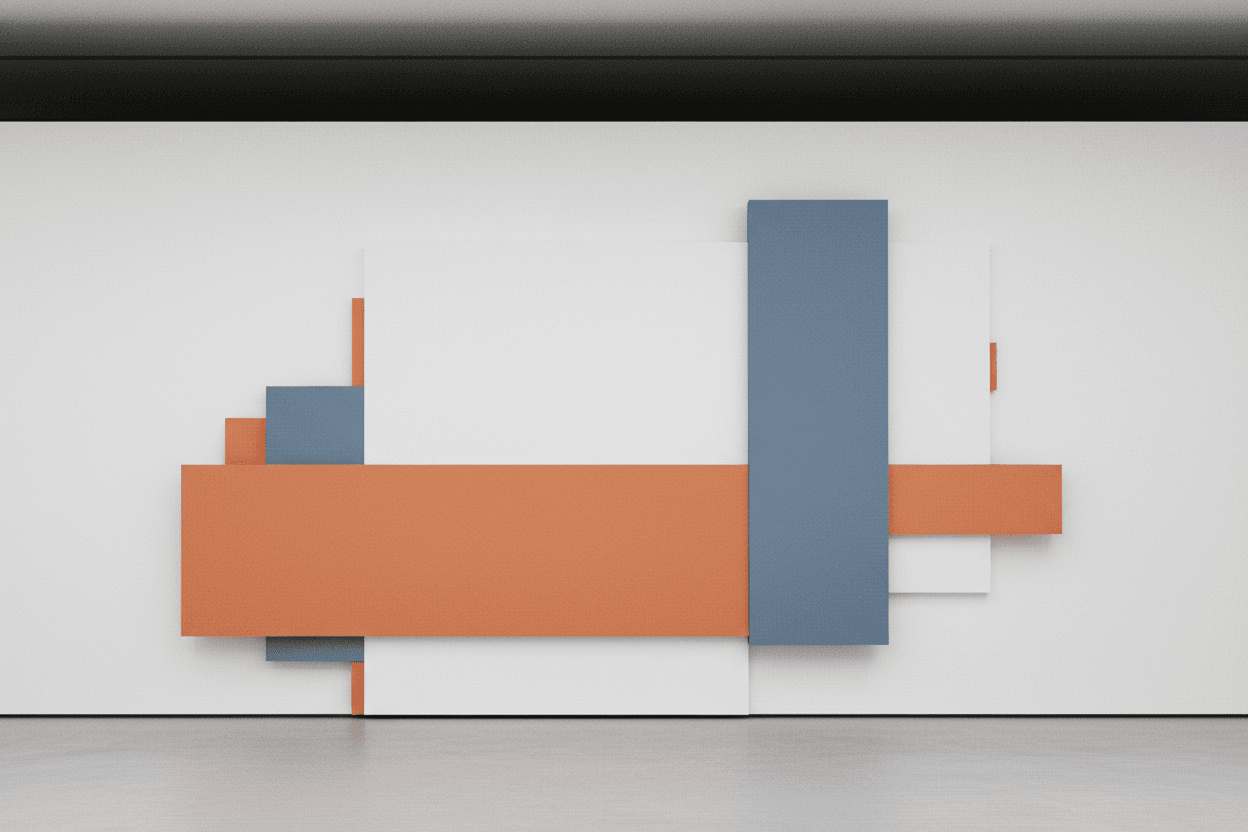
Museum walls are white because of a political decision made in 1929. It was never about neutrality. When Alfred H. Barr Jr. founded the Museum of Modern Art in New York, he made a radical aesthetic choice that would reshape how the entire world encounters art: the white cube. But this seemingly innocent backdrop was actually designed to serve a specific cultural agenda, one that privileged certain artworks while systematically devaluing others. Today, over 90% of contemporary galleries worldwide still replicate this visual language, yet few visitors question why we've agreed to experience creativity inside spaces that resemble clinical laboratories.
The MoMA Revolution: 1929 and the Birth of the White Cube
Before 1929, museums were eclectic architectural spaces filled with richly colored walls, decorative moldings, and densely hung paintings. The Metropolitan Museum of Art displayed works against deep reds, greens, and burgundies. The Louvre covered its salon walls floor-to-ceiling with no visual breathing room. Art was understood as part of a larger decorative tradition, continuous with architecture, craft, and daily life.
Alfred Barr changed everything. As MoMA's founding director, he conceived of a new kind of museum, one that would treat modern art as a serious intellectual enterprise requiring scientific rigor in its presentation. The white wall became his signature intervention, borrowed from the Bauhaus and Russian Constructivist exhibitions that emphasized clean lines and industrial materials.
[!INSIGHT] Barr's white cube wasn't merely aesthetic, it was ideological. By stripping away decorative context, he positioned modern art as universal, timeless, and independent of cultural particularity. This supposed universality, however, implicitly centered Western modernist values while marginalizing everything else.
The timing was significant. In 1929, the same year as the stock market crash, MoMA opened its doors. The white gallery offered a vision of purity and rationality amid social chaos. It suggested that art could transcend the messy world of politics and economics, existing in a rarefied realm of pure visual experience.
Brian O'Doherty and the Critique of the White Cube
In 1976, art critic Brian O'Doherty published a series of influential essays titled "Inside the White Cube," systematically analyzing how gallery architecture shapes perception. His central argument: the white cube is never neutral. It constructs a specific kind of viewer and a specific kind of art.
O'Doherty identified several key features of the white cube ideology:
-
Ahlistorical Present: The white gallery eliminates cues that might locate art in time. No windows, no shadows, no weather. Art exists in an eternal "now."
-
Scientific Authority: Clinical white suggests laboratory conditions, implying that aesthetic judgment is objective rather than subjective.
-
Commodity Readiness: By removing all competing visual stimuli, the white cube presents each artwork as a discrete, valuable object ready for acquisition.
“*"The white cube is a device for establishing control over artworks, for supervising their behavior. It is a ghetto space, a reservation.”
The white cube, O'Doherty argued, doesn't just display art; it actively produces meaning. It tells us that art should be viewed in isolation, divorced from context, function, and social life. This understanding privileges certain traditions, particularly Western modernism, while making other cultural practices invisible or illegible.
What Gets Erased: Non-Western Art and Contextual Meaning
The white cube's claim to neutrality has profound consequences for what art gets shown and how audiences understand it. Consider traditional Japanese scrolls, designed to be viewed in tatami rooms with specific lighting conditions. Or African sculptures created for ritual contexts, where movement, touch, and sound were integral to meaning. The white cube strips these works of their original conditions, presenting them as static visual objects.
A 2022 study by the Williams College Museum of Art found that 78% of non-Western objects in major American museums are displayed without any contextual information about their original use, ritual significance, or cultural meaning. They float in white space, aestheticized but fundamentally misunderstood.
[!NOTE] The rise of ethnographic museums in the 19th century actually preceded the white cube, but often displayed non-Western art in simulated "authentic" environments. The modern white cube represents a different problem: the pretense that context is unnecessary.
Contemporary artists have actively challenged the white cube. Fred Wilson's 1992 exhibition "Mining the Museum" at the Maryland Historical Society rearranged colonial artifacts to reveal hidden histories. Mai-Thu Perret's installations recreate domestic environments to question why certain spaces are considered appropriate for art. These interventions expose what the white cube normally conceals.
Rethinking Museum Space: Beyond the White Wall
In recent years, museums have begun questioning the white cube orthodoxy. The Tate Modern's Turbine Hall embraces industrial architecture rather than concealing it. The Barnes Foundation controversially recreated its original Merion installation rather than adopting standard museum display. The Zeitz MOCAA in Cape Town converted a grain silo, letting the building's history shape visitor experience.
Some institutions are experimenting with colored walls. The Baltimore Museum of Art's 2022 exhibition "How Do We Know the World?" used deep blues, warm ochres, and textured surfaces specifically designed by artists rather than defaulting to white. Visitor surveys indicated that 67% of respondents felt more emotionally connected to artworks in colored environments.
[!INSIGHT] The white cube persists partly because it's practical. Curators can reconfigure spaces quickly, and donors expect a certain institutional aesthetic. Change requires not just recognizing the white cube as a choice, but committing resources to alternatives.
Digital spaces present new questions. Virtual galleries often replicate white cube aesthetics by default, extending its ideology into the metaverse. But they also offer opportunities to create impossible architectures, impossible lighting, impossible contexts, if creators are willing to abandon familiar conventions.
The Illusion of Neutrality
The white gallery wall is not a neutral background; it is a 94-year-old curatorial philosophy disguised as common sense. It carries assumptions about what art is, how it should be viewed, and whose perspectives matter. Recognizing this doesn't mean every museum must immediately paint its walls purple. But it does mean understanding that exhibition design is always an interpretive act, a form of storytelling.
When you walk into a white gallery, you're not entering a space of pure visual experience. You're stepping into an argument about art that Alfred Barr made in 1929, an argument that has shaped global visual culture for nearly a century. The question is whether this argument still serves contemporary audiences, or whether it's time for a new conversation.
Sources: O'Doherty, B. (1976). Inside the White Cube. Artforum; Staniszewski, M.A. (1998). The Power of Display; Williams College Museum of Art (2022). Contextual Display in American Museums; Baltimore Museum of Art (2022). Visitor Experience Survey; Barr, A.H. Jr. (1936). Cubism and Abstract Art, MoMA.