You Share 60% of Your DNA With a Banana
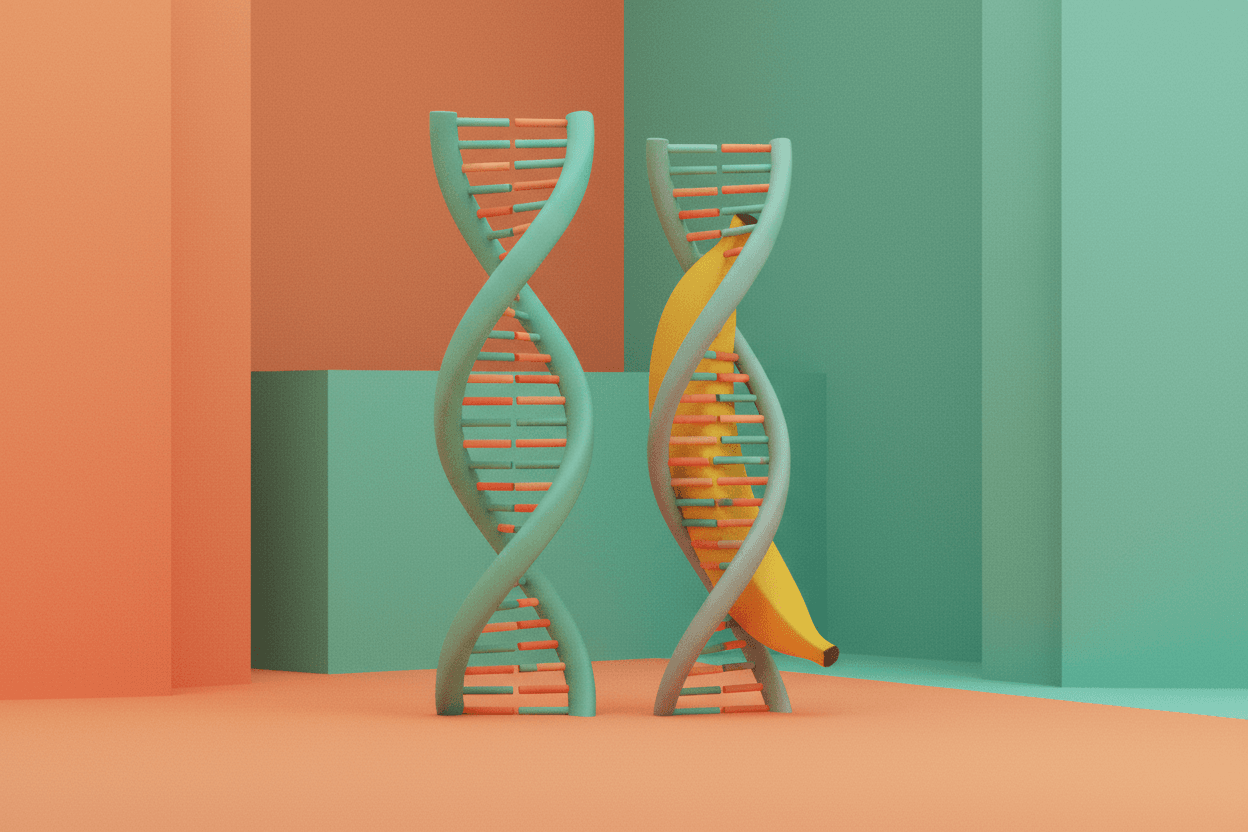
You're 60% banana at the molecular level. This shocking genetic overlap reveals how evolution conserves essential code across all life on Earth.
The Banana in Your Genome
You're 60% banana. Not metaphorically. Literally, at the molecular level. Here's what that says about all life on Earth.
When scientists at the National Human Genome Research Institute completed their comparative analysis in 2024, they confirmed what had seemed absurd: more than half of your genetic code matches that of Musa acuminata, the common banana. Even more unsettling? You share 44% of your DNA with a honeybee, 61% with a fruit fly, and 84% with your household dog. The genetic overlap doesn't stop at animals—75% of your genes have identifiable counterparts in yeast, a single-celled fungus.
But here's the question that should keep you awake: if we're genetically similar to everything, what exactly makes us human?
The Mystery of Conserved Genes
The shared genetic material isn't random debris from an ancient common ancestor. These are conserved genes—sequences so essential to life that natural selection has preserved them across billions of years of evolution. Change them even slightly, and the organism dies.
Consider the Hox genes. These master regulator genes control body segmentation and limb development. A fruit fly with a mutated Hox gene grows legs where its antennae should be. A human with a mutated Hox gene develops polydactyly—extra fingers or toes. The same genetic toolkit, deployed differently, builds a fly or a philosopher.
[!INSIGHT] The 60% figure refers to homologous genes—genes that share a common ancestral origin and perform similar core functions—not identical DNA sequences. The actual nucleotide-by-nucleotide match is lower, but the functional conservation is profound.
The conservation extends to the most fundamental cellular machinery:
- Ribosomal RNA genes: Nearly identical across all life, responsible for protein synthesis
- ATP synthase: The enzyme that generates cellular energy, conserved from bacteria to humans
- DNA polymerase: The replication machinery that copies genetic material
These aren't convenience genes. They're the operating system kernel of biology. Evolution doesn't rewrite the kernel—it builds increasingly complex applications on top.
The Banana-Human Overlap: What's Actually Shared
When we say you share 60% of your DNA with a banana, we're not talking about the genes that build a brain or create yellow pigment. The overlap occurs in three critical categories:
1. Basic Cellular Metabolism
Glycolysis—the breakdown of glucose for energy—requires the same enzyme cascade in your liver cells and in banana fruit tissue. The GAPDH gene that catalyzes a key step in this pathway is virtually interchangeable between species. Transfer the human version into a banana cell, and it functions perfectly.
2. DNA Replication and Repair
Every time a banana cell divides, it uses machinery nearly identical to yours. The helicases that unwind the double helix, the topoisomerases that prevent tangling, the ligases that seal breaks—these proteins show 70-90% amino acid sequence similarity between plants and mammals.
3. Protein Synthesis
The ribosome—the molecular machine that translates mRNA into proteins—is one of the most ancient and conserved structures in biology. The 16S ribosomal RNA component has regions that are >95% identical across all known life forms.
“"The ribosome is a molecular fossil. When we study its structure, we're looking at a machine built three billion years ago, still running in every cell of your body today.”
This conservation has practical implications. When scientists test new pharmaceuticals, they often start with yeast or fruit fly models because the core cellular processes are similar enough to generate relevant data.
Why Evolution Conserves Code
Natural selection operates on a simple principle: if it works, don't break it. When a gene performs an essential function, any mutation that disrupts that function is lethal. The organism dies before reproducing. The gene remains unchanged across geological time.
This creates a selective constraint that varies by gene function:
| Gene Category | Constraint Level | Example |
|---|---|---|
| Core metabolism | Extremely high | ATP synthase |
| Developmental regulators | High | Hox genes |
| Immune system genes | Moderate | MHC complex |
| Sensory receptors | Low | Olfactory genes |
[!NOTE] The 60% banana-human overlap represents the highly constrained portion of the genome. The remaining 40% includes rapidly evolving genes that define species-specific traits—immune responses, reproductive mechanisms, and neurological functions that distinguish a primate from a fruit.
The implications cascade through medicine. When a genetic disease affects a conserved pathway, researchers can study it in model organisms with confidence. The cystic fibrosis transmembrane regulator (CFTR) gene, when mutated, causes the same basic defect in human lungs and in genetically modified fish gills.
The Deep Unity of Life
The percentage comparisons—60% with bananas, 84% with dogs, 99.9% with other humans—tell a story that Darwin could only infer. All life shares a common ancestor that lived approximately 3.5 to 4 billion years ago. That ancestor already possessed the genetic toolkit for:
- Storing information in nucleic acids
- Extracting energy from chemical bonds
- Building proteins from amino acid templates
- Reproducing with variation
Everything since has been elaboration, not invention.
The banana-human genetic overlap isn't a curiosity. It's evidence of the deepest truth in biology: diversity is real, but unity is more fundamental. The same code runs in every cell, modified by context, expressing itself as a tree or a thought.
Sources: National Human Genome Research Institute (2024), Nature Genetics comparative genomics studies, Nobel Prize lectures (Ada Yonath, 2009), Proceedings of the National Academy of Sciences on conserved gene evolution.