The Shortest Path Between Two Points Is Now Through the Arctic
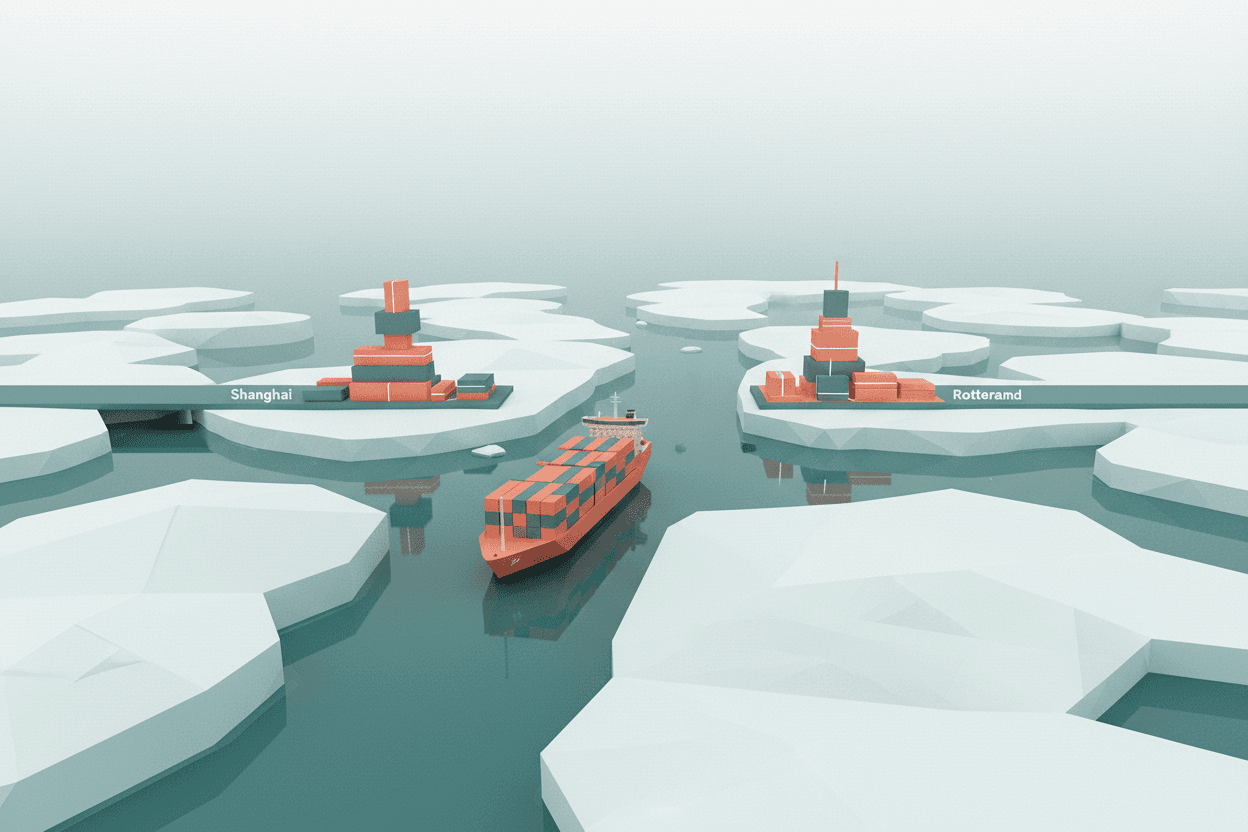
The fastest route from Shanghai to Rotterdam no longer goes through the Suez Canal. It goes through what used to be solid ice.
The New Geography of Global Trade
The fastest route from Shanghai to Rotterdam no longer goes through the Suez Canal. It goes through what used to be solid ice. In 2024, Arctic shipping traffic along the Northern Sea Route reached a historic milestone: over 80 million tons of cargo traversed waters that were impassable just two decades ago. The distance savings are staggering—ships traveling via Russia's northern coast cut 4,000 nautical miles compared to the Suez route, representing a 40% reduction in journey length.
Yet this emerging shortcut represents far more than a navigation convenience. It signals a fundamental reshaping of global trade routes, geopolitical power dynamics, and resource extraction economics. The Arctic, once a frozen barrier, has become a contested corridor where Russia, China, and Western powers are racing to establish dominance. The question isn't whether Arctic shipping will transform global logistics—it's who will control the terms of that transformation.
The Numbers Behind the Arctic Shortcut
The arithmetic of Arctic shipping presents an undeniable case for its economic potential. A containership traveling from Shanghai to Rotterdam via the Suez Canal covers approximately 10,500 nautical miles over 30-35 days. The same journey through the Northern Sea Route (NSR), hugging Russia's northern coastline, spans only 6,500 nautical miles—a reduction that translates to 10-15 days of sailing time saved.
[!INSIGHT] For shipping companies operating vessels that consume 200-300 tons of fuel per day, each day eliminated from a voyage represents savings of $60,000-$100,000 in fuel costs alone.
The 2024 shipping season, which now extends from July through December, recorded over 80 million tons of cargo along the NSR—a figure that has grown from virtually zero in 2010. While this still represents a fraction of the 1 billion tons annually passing through Suez, the trajectory is unmistakable. Russian state nuclear company Rosatom, which manages the route, projects 150 million tons by 2030.
The Suez Vulnerability Factor
The economic case for Arctic routing gained urgent credibility in March 2021, when the Ever Given ran aground in the Suez Canal, blocking one of the world's most critical waterways for six days. The incident stranded an estimated $9.6 billion in trade per day and exposed the fragility of chokepoint-dependent logistics.
“*"The Suez blockage was a wake-up call. Companies that had never considered Arctic alternatives suddenly began modeling scenarios where their primary routes were unavailable.”
Since 2021, major shipping lines including Maersk and COSCO have conducted experimental Arctic voyages, testing the commercial viability of polar routes. While regular container service remains limited, specialized vessels carrying liquefied natural gas (LNG), iron ore, and petroleum products have established reliable operations.
The Infrastructure Race
Russia has invested heavily in Arctic infrastructure, viewing the NSR as both an economic asset and a geopolitical lever. The country has commissioned 13 new icebreaker vessels since 2020, including the Arktika-class nuclear-powered icebreakers capable of breaking through ice up to 3 meters thick. By 2035, Russia plans to operate at least 10 nuclear icebreakers—a fleet that surpasses the combined capabilities of all other Arctic nations.
[!INSIGHT] Russia currently controls approximately 53% of Arctic coastline and has established 15 primary ports along the NSR, compared to just 2 major deepwater ports in the entire North American Arctic.
The flagship of this infrastructure push is the Sabetta port on the Yamal Peninsula, which serves as the export hub for the Yamal LNG project. The facility processed over 20 million tons of LNG in 2024, with ice-class tankers making year-round deliveries to Asian markets. China has emerged as the primary customer, with state-owned CNPC holding a 20% stake in the project.
China's Polar Silk Road
China's Arctic Policy, released in 2018, explicitly frames the region as a component of its Belt and Road Initiative. The document coined the term "Polar Silk Road" and outlined China's intention to participate in Arctic infrastructure development, scientific research, and resource extraction.
By 2024, Chinese investment in Arctic projects exceeded $90 billion, spanning LNG facilities in Siberia, port development in Kirkenes (Norway), and rare earth mining in Greenland. Chinese shipping giant COSCO has completed over 30 experimental Arctic voyages since 2013, accumulating critical operational data.
[!NOTE] Under the United Nations Convention on the Law of the Sea (UNCLOS), Arctic waters beyond 200 nautical miles from shore are considered international. However, Russia claims portions of the NSR as internal waters, requiring transit permits and icebreaker escorts—a position contested by the United States and European Union.
The Geopolitical Chessboard
The Arctic's transformation from frozen barrier to navigable corridor has rekindled dormant geopolitical tensions. Russia's 2022 invasion of Ukraine accelerated this dynamic, as Western sanctions complicated Arctic cooperation mechanisms that had functioned since the Cold War.
The Arctic Council, the primary forum for regional governance, suspended operations for seven months following the invasion. When activities resumed, Russia was excluded from working group meetings—effectively paralyzing the organization's consensus-based decision-making.
“*"We are witnessing the militarization of the Arctic at a pace not seen since the 1980s. The difference is that climate change has made this region strategically valuable in ways it never was before.”
Russia has reopened over 50 Cold War-era military installations in the Arctic since 2015, including air defense systems, radar stations, and submarine bases. NATO has responded with increased presence, including Norway's 2024 agreement to host additional U.S. Marines and Finland's integration of Arctic defense planning following its NATO accession.
The Environmental Paradox
The Arctic shipping boom embodies a bitter irony: the industry is enabled by climate change while simultaneously accelerating it. Arctic waters are warming four times faster than the global average, with summer sea ice extent declining by approximately 13% per decade since satellite monitoring began in 1979.
Shipping contributes to this cycle through black carbon emissions—particulate matter that settles on ice and accelerates melting by absorbing solar radiation. A 2023 study in Nature Communications estimated that increased Arctic shipping could add 0.2°C to regional warming by 2050, creating feedback loops that further extend the navigation season.
[!INSIGHT] Heavy fuel oil (HFO), the dominant fuel for large vessels, is particularly damaging in Arctic environments. A single spill could persist for decades due to slow biodegradation rates in cold water. The International Maritime Organization banned HFO in Arctic waters starting in 2024, but exemptions for certain vessel types extend the phase-out to 2029.
Indigenous communities across the Arctic have raised concerns about shipping's impact on marine mammals, which serve as both cultural resources and food security. The Inuit Circumpolar Council has documented disruptions to whale migration patterns and increased difficulty in hunting activities near shipping lanes.
Implications: The New Geography of Commerce
The emergence of Arctic shipping routes represents more than an incremental improvement in logistics—it signals a fundamental restructuring of global trade geography that has remained largely unchanged since the opening of the Suez Canal in 1869.
For Russia, the NSR offers an alternative to Western-dominated trade corridors and a source of leverage as Europe seeks to reduce energy dependence. Russian officials have discussed preferential transit fees for "friendly nations" and restrictions on vessels from sanctioning countries—raising the prospect of a bifurcated global shipping system.
For China, Arctic access reduces vulnerability to U.S. naval dominance in the Strait of Malacca and the Indian Ocean—through which approximately 80% of Chinese oil imports currently pass. The "Malacca Dilemma" that has preoccupied Chinese strategic planners for two decades may find its solution in melting polar ice.
For Western nations, the Arctic presents a strategic dilemma: engagement risks legitimizing Russian claims and contributing to environmental damage, while exclusion cedes influence to competitors in a region projected to host 10% of global shipping by 2050.
Sources: Rosatom Northern Sea Route Directorate (2024), Arctic Council Shipping Reports, Nature Communications (2023), U.S. Coast Guard Arctic Strategy, The Arctic Institute, Wilson Center Polar Institute, IMO Polar Code Documentation,UNCTAD Maritime Statistics