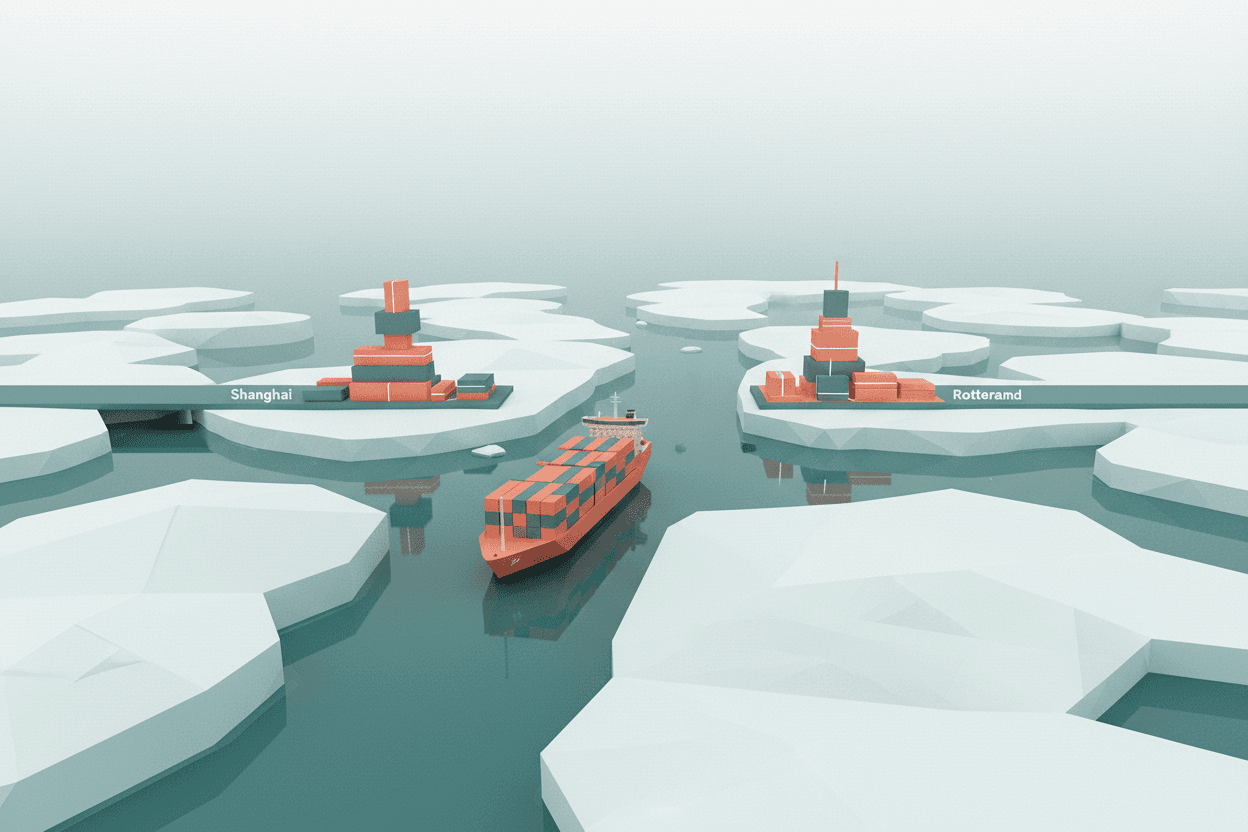
1,400 km from the Arctic, China declared itself a 'Near-Arctic State.' Its icebreaker fleet and Polar Silk Road are reshaping Arctic geopolitics.
Hyle Editorial·
China is 1,400 km from the Arctic Circle. It has declared itself a 'Near-Arctic State' and is building the world's most aggressive polar fleet. Nobody stopped them.
In January 2018, Beijing published its first Arctic Policy white paper, coining the term "Polar Silk Road" and asserting that non-Arctic states have rights to participate in Arctic affairs. By 2024, China operates three heavy icebreakers with three more under construction, while its state-owned enterprises have invested over $90 billion in Arctic infrastructure projects across Iceland, Greenland, and Russia. The question isn't whether China belongs in the Arctic—the question is what happens when the ice melts and the Polar Silk Road becomes the fastest shipping lane between Asia and Europe.
The term "Near-Arctic State" appears nowhere in international law. The eight Arctic Council member states—Canada, Denmark, Finland, Iceland, Norway, Russia, Sweden, and the United States—have geographic claims based on territory within the Arctic Circle. China has none.
Yet in its 2018 white paper, Beijing argued that climate change transforms the Arctic from a remote frontier into a global commons. The logic is audacious: as Arctic ice melts, Arctic affairs become everyone's business. China cited its scientific research programs, its growing icebreaker fleet, and its economic investments as evidence of legitimate Arctic stakeholder status.
[!INSIGHT] China's Arctic strategy mirrors its approach to the South China Sea: create facts on the ground (or in this case, in the ice) until presence becomes accepted as legitimacy.
The Arctic Council admitted China as an observer state in 2013, alongside Japan, South Korea, Singapore, India, and Italy. But Beijing has distinguished itself through the scale of its commitment. The Polar Research Institute of China now operates year-round stations in the Arctic, and Chinese scientists publish more Arctic climate research than any non-Arctic nation.
The Icebreaker Arms Race
Numbers tell the story. The United States operates two heavy icebreakers, both aging. Russia operates over 40. China launched its first indigenous heavy icebreaker, the Xuelong 2, in 2019 and has announced plans for a fleet of six by 2030.
Nation
Heavy Icebreakers (2024)
Planned by 2030
Russia
41+
50+
China
3
6+
United States
2
3
Canada
2
2
“"Whoever controls the Arctic icebreakers controls the Arctic. It's that simple.”
— Malte Humpert, Arctic Institute founder
Chinese icebreakers are officially designated for scientific research, but their dual-use capability is undeniable. The Xuelong class can break 1.5-meter ice continuously, enabling year-round Arctic navigation. Military analysts note that the same hull designs and crew training apply to naval operations in polar regions.
Infrastructure Footholds: Iceland and Greenland
The Icelandic Port Play
In 2018, a Chinese state-owned conglomerate attempted to purchase a decommissioned NATO naval base in Iceland. The deal collapsed after Icelandic public opposition and U.S. diplomatic pressure. But the pattern was clear: Chinese investment targeted strategic infrastructure with potential dual-use applications.
Chinese companies have successfully invested in Icelandic geothermal energy projects and tourism infrastructure. These investments create economic dependencies and stakeholder relationships that translate into political influence within Iceland's parliament. When Reykjavik considers Arctic policy positions, Chinese investment now weighs in the balance.
Greenland: Mining Rights and Airport Contracts
Greenland represents China's most aggressive Arctic infrastructure play. The Greenland government, seeking independence from Denmark through economic self-sufficiency, initially welcomed Chinese investment in rare earth mining projects.
The Kvanefjeld multi-element deposit contains one of the world's largest rare earth reserves—critical for electric vehicles, wind turbines, and military technology. A Chinese consortium attempted to acquire the project in 2016, but political pressure from Denmark and the United States eventually blocked the sale in 2021.
[!NOTE] Greenland's population of 56,000 controls a territory larger than Mexico with strategic position between North America and Europe. Chinese influence there would reshape NATO's northern flank.
Chinese firms have also pursued airport construction contracts in Greenland, offering financing terms no Western competitor could match. When the United States reopened its consulate in Nuuk in 2020 after 67 years, American diplomats acknowledged the move was explicitly designed to counter Chinese influence.
The Russian Factor: Partnership with Friction
China's most significant Arctic foothold comes through partnership with Russia. The Yamal LNG project, a $27 billion liquefied natural gas facility in Siberia's Arctic, received 20% financing from China's Silk Road Fund. Chinese state-owned CNPC owns a 20% stake.
This partnership gives China legitimate Arctic energy access and operational experience in polar logistics. Chinese vessels now regularly transit the Northern Sea Route, a shipping lane Russia controls along its Arctic coast. In 2024, Chinese cargo volume through the route increased 40% year-over-year.
But the partnership carries strategic costs. Russia's invasion of Ukraine in 2022 complicated Chinese Arctic ambitions. Western sanctions on Russia created opportunities for Chinese companies but also associated Beijing with Moscow's international isolation. Arctic Council cooperation has effectively frozen, leaving China without its primary forum for Arctic legitimacy-building.
[!INSIGHT] The China-Russia Arctic partnership is transactional, not trusting. Russia fears Chinese demographic and economic penetration of its Far East; China resents Russian fees and restrictions on Northern Sea Route transit.
The Polar Silk Road's Future
Climate change is China's Arctic opportunity. As summer sea ice disappears, the Arctic Ocean becomes navigable for longer periods each year. By 2050, the Northern Sea Route could be ice-free for six months annually—a shipping lane that cuts 40% off the distance between Shanghai and Rotterdam.
Chinese planners have calculated the stakes precisely. An ice-free Arctic means:
Energy security: Shortcut for Middle East oil imports vulnerable to Malacca Strait chokepoints
Trade dominance: Faster, cheaper container shipping between Asia and Europe
Resource access: Arctic seabed minerals, fish stocks, and potential oil and gas reserves
Strategic position: Naval presence between North America and Russia's northern approaches
The eight Arctic nations have not coordinated a response. Russia welcomes Chinese investment but fears Chinese influence. The United States warns about Chinese intentions but lacks icebreaker capacity to maintain presence. Nordic Arctic states balance economic opportunities against security concerns.
“"China is playing a long game in the Arctic. They're not asking for permission”
— they're creating presence, and presence over time becomes precedent."
Implications: Governance Without Rules
The Arctic legal framework assumes that only the eight Arctic coastal states have substantive claims to Arctic waters and resources. The United Nations Convention on the Law of the Sea (UNCLOS) provides territorial and economic zone boundaries based on continental shelves and coastlines.
China's approach exploits gaps in this framework. UNCLOS guarantees freedom of navigation through exclusive economic zones. If Chinese vessels—including icebreakers and research ships—regularly transit Arctic waters, China gains operational familiarity and potentially asserts customary rights.
The Arctic Council's consensus-based decision-making means China cannot be expelled as an observer, and its participation in working groups shapes Arctic governance from within. Chinese scientists chair committees on Arctic monitoring and assessment.
[!NOTE] Unlike Antarctica, which has a treaty system prohibiting military activity and mineral exploitation, the Arctic has no comprehensive governance treaty. The region is governed by a patchwork of bilateral agreements and UNCLOS provisions.
Western response remains fragmented. NATO has increased Arctic exercises but member states disagree on whether China represents a military threat. The U.S. Coast Guard's icebreaker program is years behind schedule. Investment screening mechanisms in Canada and Europe have blocked some Chinese Arctic acquisitions but not addressed the systematic nature of Beijing's strategy.
Key Takeaway: China has weaponized ambiguity in Arctic governance, using scientific presence, infrastructure investment, and dual-use icebreaker capabilities to establish itself as an Arctic stakeholder without Arctic territory. The self-declared "Near-Arctic State" status has no legal basis—but as ice melts and Chinese presence grows, international law may follow facts on the ground rather than precede them.
Sources: China's Arctic Policy White Paper (2018); U.S. Coast Guard Arctic Strategy; Arctic Institute research publications; SIPRI Arctic security reports; Greenland Ministry of Foreign Affairs statements; NATO Arctic assessments (2022-2024)
This is a Premium Article
Hylē Media members get unlimited access to all premium content. Sign up free — no credit card required.