The $35 Trillion Buried Under the Ice
Climate change is unlocking $35 trillion in Arctic resources. The irony? We caused the melting by burning the very resources we're now rushing to extract.
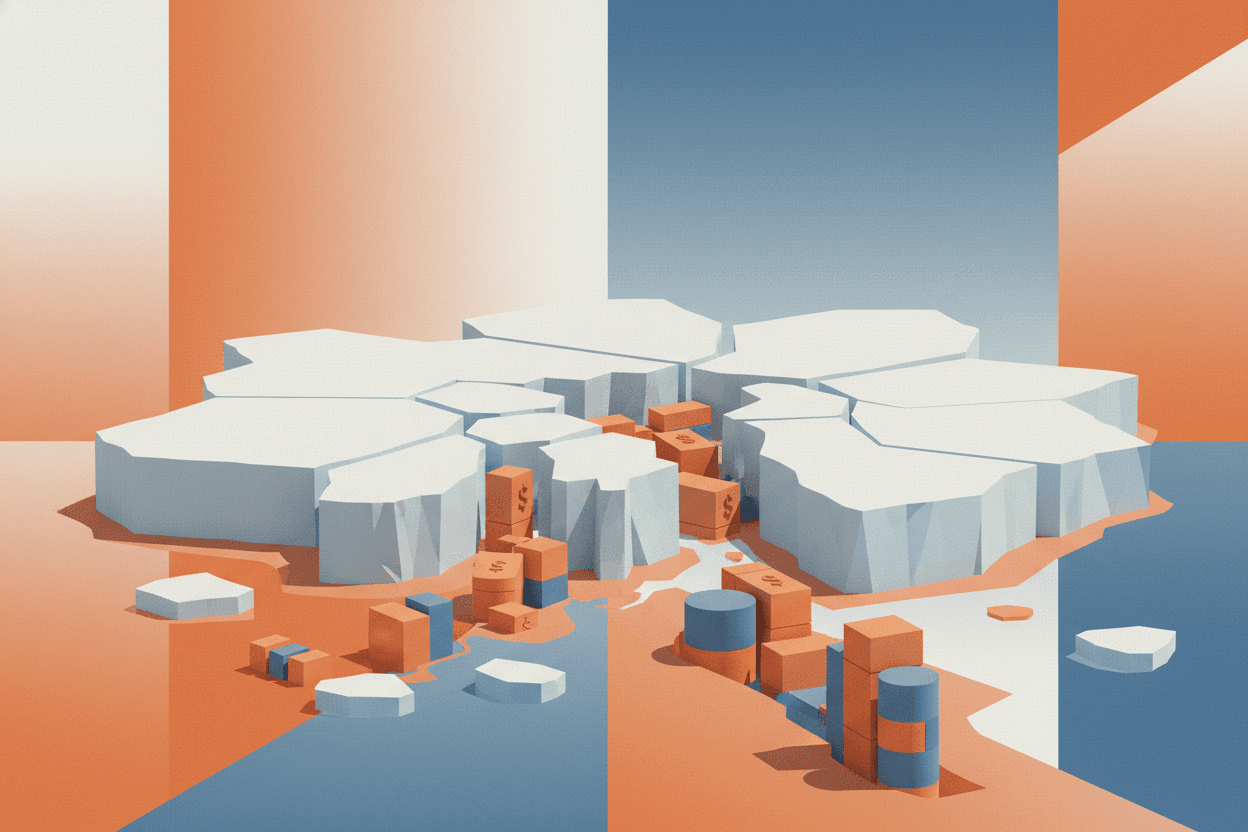
The Arctic holds 13% of the world's undiscovered oil. The only reason we can reach it is because we burned the oil that was already above ground.
In 2008, the United States Geological Survey released a staggering assessment: the Arctic Circle contains approximately 90 billion barrels of undiscovered oil, 1,669 trillion cubic feet of natural gas, and 44 billion barrels of natural gas liquids. At current market prices, these resources represent an estimated $35 trillion in value—roughly the GDP of the United States and China combined.
But here's the catch that keeps climate scientists awake at night: these treasure vaults are opening precisely because the Arctic is warming four times faster than the global average. The Arctic Ocean's summer sea ice has shrunk by roughly 13% per decade since satellite records began in 1979. What was once impenetrable is now, for months each year, navigable water.
The Geological Lottery
Why the Arctic Is So Resource-Rich
The Arctic's mineral wealth is not a geological accident. During the Mesozoic Era, approximately 250 to 66 million years ago, the region was a vast tropical inland sea teeming with marine life. As these organisms died and accumulated on the seafloor, they formed the organic-rich sediments that would eventually become the petroleum reservoirs we covet today.
The USGS conducted its Circum-Arctic Resource Appraisal by analyzing geological data from sedimentary basins across the region. Their findings revealed that approximately 84% of the undiscovered oil and gas lies offshore, beneath the continental shelves where territorial claims remain hotly contested.
[!INSIGHT] The geological formation that makes the Arctic oil-rich is the same process that created the Middle East's vast reserves—both were once warm, shallow seas perfect for accumulating organic matter over millions of years.
Rare Earths and Critical Minerals
Beyond hydrocarbons, the Arctic holds substantial deposits of rare earth elements, uranium, iron ore, nickel, and diamonds. Greenland alone contains the Kvanefjeld deposit, one of the world's largest rare earth reserves, critical for manufacturing everything from smartphones to wind turbines.
Russia's Kola Peninsula hosts the world's largest apatite-nepheline ores, essential for fertilizer production. Sweden's Kiruna mine produces 75% of the European Union's iron ore. These deposits have been exploited for decades, but melting permafrost and retreating ice are making previously inaccessible sites viable.
The New Great Game
Territorial Claims and Geopolitical Tension
The race for Arctic resources has triggered what analysts call a new Cold War—quite literally. Five nations border the Arctic Ocean: Russia, Canada, the United States, Norway, and Denmark (via Greenland). Each has submitted claims to extend their continental shelf boundaries under the United Nations Convention on the Law of the Sea (UNCLOS).
Russia has been the most aggressive. In 2007, Russian explorers planted a titanium flag on the seabed at the North Pole, symbolically claiming the territory. More substantively, Russia has submitted a claim to 1.2 million square kilometers of additional Arctic seabed, an area larger than France, Germany, and Italy combined.
“"The Arctic is Russia's Mecca. The resources there will define the 21st century.”
The Northern Sea Route
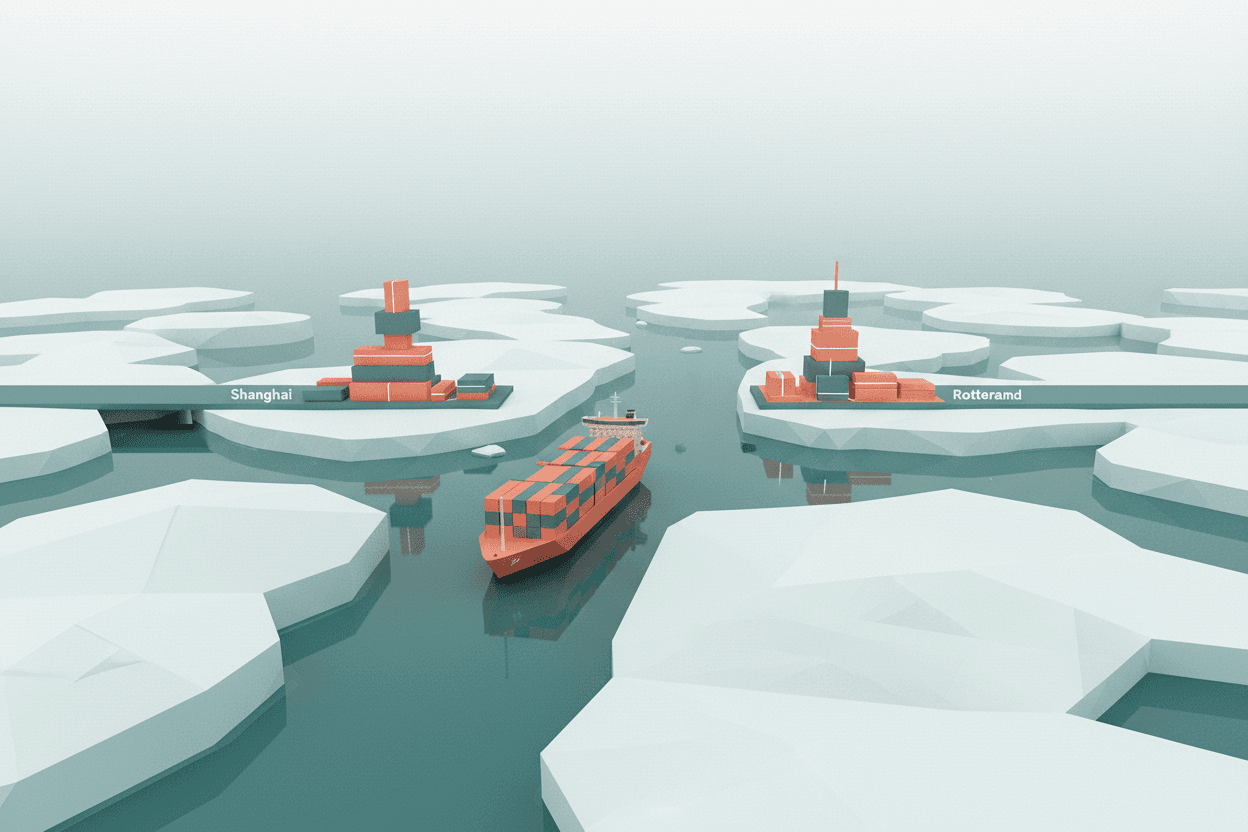
The melting ice has transformed the Northern Sea Route along Russia's northern coast from a theoretical passage to a viable shipping lane. In 2020, over 33 million tons of cargo traversed this route, a figure projected to reach 130 million tons by 2035. This route cuts 40% off the sailing distance between Europe and Asia compared to the traditional Suez Canal passage.
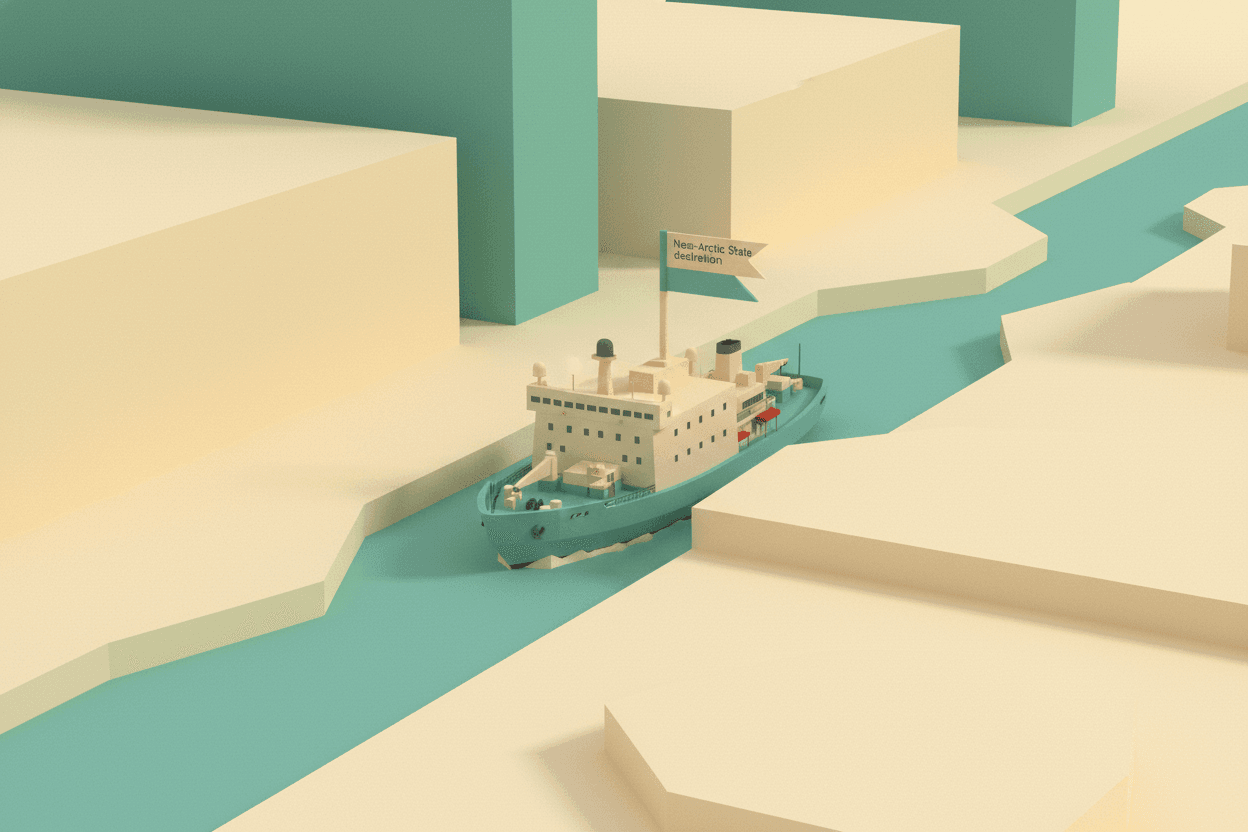
China has declared itself a "Near-Arctic State" and launched the Polar Silk Road initiative, investing heavily in Russian Arctic liquefied natural gas (LNG) projects. The Yamal LNG facility, operational since 2017, produces 16.5 million tons annually, with Chinese state-owned companies holding a 29.9% stake.
The Extraction Paradox
Carbon Feedback Loops
The cruel irony of Arctic resource extraction lies in its self-reinforcing nature. Burning fossil fuels releases greenhouse gases that warm the planet. Warming melts Arctic ice. Melting ice exposes new areas for fossil fuel extraction. Extracting and burning these fuels releases more greenhouse gases.
A 2019 study published in Science Advances calculated that Arctic permafrost contains approximately 1,460 to 1,600 billion tons of organic carbon—roughly twice the amount currently in Earth's atmosphere. As permafrost thaws, this carbon can be released as methane, a greenhouse gas 80 times more potent than carbon dioxide over a 20-year period.
[!NOTE] The term "feedback loop" describes a system where outputs cycle back as inputs, amplifying the original effect. In the Arctic, warming causes melting, which releases more greenhouse gases, which causes more warming.
Infrastructure on Sinking Ground
The extraction infrastructure itself faces existential threats from the warming it enables. Approximately 45% of Russian Arctic infrastructure is built on permafrost that is now degrading. The Norilsk nickel plant disaster of 2020, where a fuel tank collapsed and spilled 21,000 tons of diesel into Arctic rivers, was attributed to permafrost thaw destabilizing the foundation.
In Alaska, the Trans-Alaska Pipeline System, designed in the 1970s, now requires hundreds of millions of dollars in retrofitting as the ground beneath it shifts. About 60% of the pipeline is built on permafrost that was expected to remain stable indefinitely.
Indigenous Communities at the Crossroads
The Arctic is home to approximately four million people, including over 400,000 Indigenous peoples from dozens of distinct cultures: the Inuit of Canada and Greenland, the Sámi of Scandinavia, the Nenets and Khanty of Russia, and many others.
These communities face an impossible calculus. Resource development brings jobs, infrastructure, and economic opportunity to regions that have historically been marginalized. A 2021 survey by the Arctic Economic Council found that 68% of Arctic Indigenous communities supported some form of responsible resource development.
Yet the same development threatens traditional hunting grounds, disrupts migration patterns of animals these communities depend upon, and accelerates the cultural erosion that began with colonization. The Gwich'in people of Alaska and Canada have opposed oil drilling in the Arctic National Wildlife Refuge for decades, citing the threat to the Porcupine caribou herd that sustains their culture.
The Technology Frontier
Extracting in Extreme Conditions
Arctic extraction requires technological innovation that pushes engineering boundaries. Ice-class vessels with reinforced hulls can navigate through pack ice. Extended-reach drilling allows platforms to access reservoirs up to 12 kilometers horizontally from the drilling site, minimizing surface disturbance.
Norway's Snohvit LNG project, the first in the Barents Sea, uses subsea production facilities connected to shore by a 143-kilometer pipeline, eliminating the need for surface platforms in ice-prone waters. Russia's Prirazlomnoye field, the world's first offshore Arctic oil project, uses an ice-resistant stationary platform designed to withstand pressures from ice floes up to two meters thick.
These projects cost 30-50% more than equivalent operations in temperate climates, creating economic vulnerabilities. When oil prices crashed in 2020, several Arctic projects were suspended indefinitely. Shell abandoned its $7 billion Arctic drilling program in 2015 after finding insufficient quantities to justify continued operations.
Implications for Global Climate Targets
The International Energy Agency's 2021 Net Zero report stated unequivocally that achieving global climate targets requires no new oil, gas, or coal development beyond what was already committed. The Arctic's $35 trillion in resources, in this scenario, become stranded assets—wealth that exists physically but can never be economically extracted.
Yet the geopolitical and economic incentives for extraction remain powerful. Russia's Arctic LNG projects are central to the country's energy strategy through 2050. Norway's sovereign wealth fund, built on North Sea oil, increasingly looks north for future revenue.
The tension between climate commitments and resource wealth creates a collective action problem. If one nation refrains from extraction for climate reasons, another may claim those resources. The Arctic lacks the unified governance structure that might coordinate such decisions.
The Governance Gap
The Arctic Council, established in 1996, provides a forum for cooperation on environmental protection and sustainable development. However, its mandate explicitly excludes military security and resource sovereignty—precisely the issues driving the current competition.
In March 2022, following Russia's invasion of Ukraine, the seven other Arctic Council members paused participation in the body, leaving the primary forum for Arctic cooperation in limbo. This suspension has complicated efforts to establish joint standards for environmental protection and emergency response.
Sources: U.S. Geological Survey Circum-Arctic Resource Appraisal (2008); International Energy Agency Net Zero by 2050 Report (2021); Arctic Council Assessment Reports; H. R. H. et al., "Permafrost and Climate Change: Carbon Cycle Feedbacks," Science Advances (2019); The Arctic Economic Council Indigenous Development Survey (2021); Putin, V., Remarks at the International Arctic Forum (2017).
This is a Premium Article
Hylē Media members get unlimited access to all premium content. Sign up free — no credit card required.