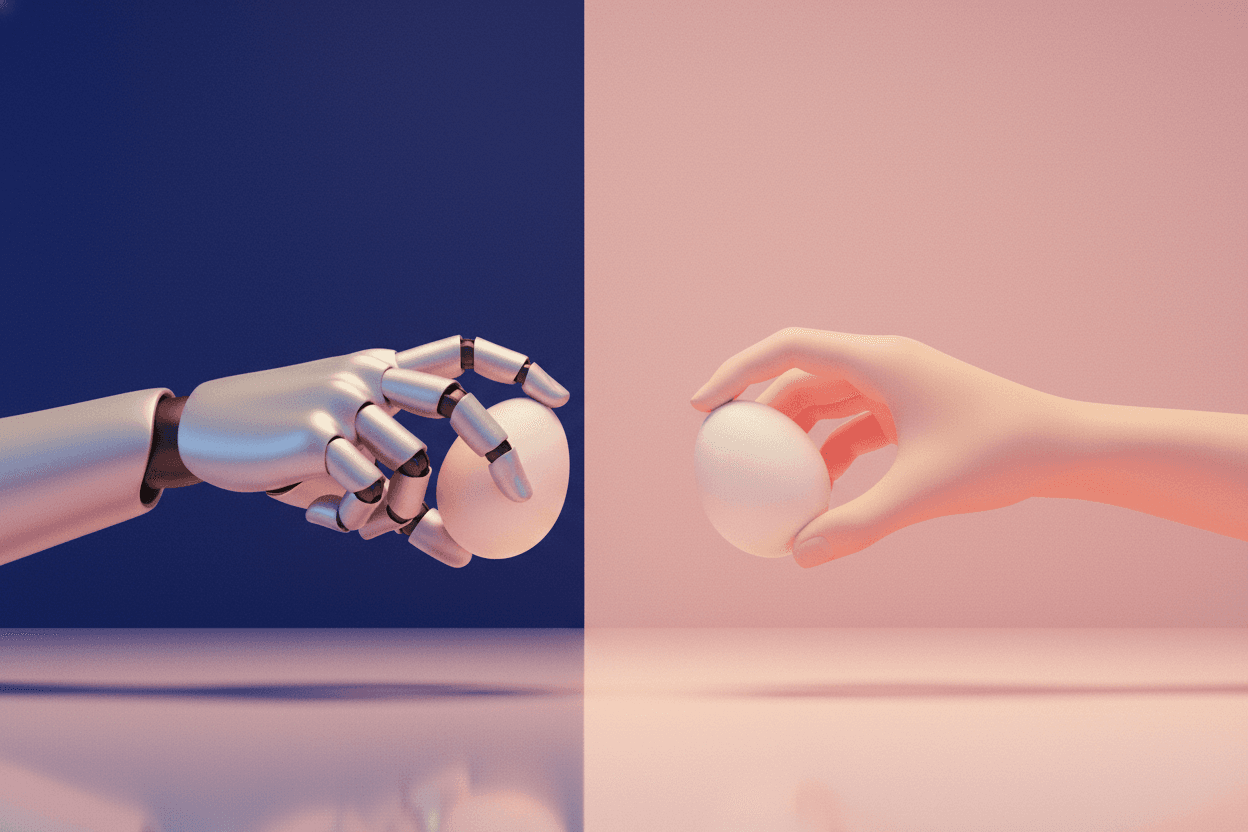
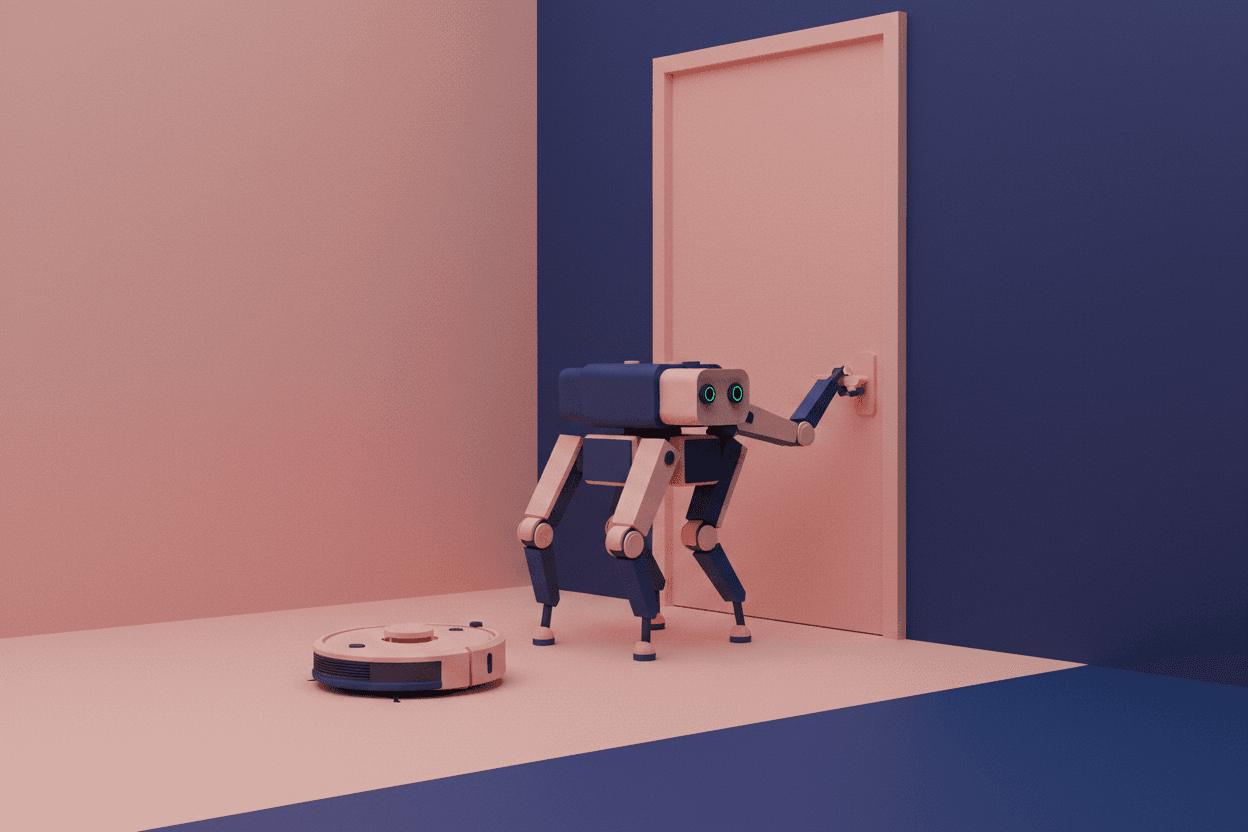
Tesla's Optimus promises a humanoid robot for $20,000. But the real bottleneck isn't AI or legs—it's building a hand that can fold laundry without destruction.
Hyle Editorial·
Tesla is selling a $20,000 humanoid robot. The hardest engineering challenge isn't the legs, the vision, or the AI. It's making the robot fold a T-shirt without destroying it. In 2024, Tesla, Figure AI, and Agility Robotics collectively raised over $6 billion to build humanoid robots that promise to revolutionize home and factory work. Yet watch any demo carefully, and you'll notice something telling: the hands move slowly, deliberately, almost hesitantly—when they move at all.
[!INSIGHT] The human hand contains 27 degrees of freedom and over 17,000 tactile receptors. The most advanced robotic hands today manage roughly 20 degrees of freedom with tactile sensitivity roughly equivalent to wearing thick gardening gloves.
The modern humanoid robot boom—driven by advances in large language models and vision systems—has solved the brain problem. Robots can now understand what you want them to do. What they still cannot do reliably is physically interact with the world the way a three-year-old child does effortlessly.
The Engineering Miracle You're Ignoring Right Now
Your hands are the most sophisticated mechanical devices you will ever own. Each hand contains 27 bones, 29 joints, and at least 123 named ligaments, all controlled by 34 muscles—17 in the palm and 18 in the forearm. This biological machinery allows you to crack an egg one moment and swing a sledgehammer the next, without any manual recalibration.
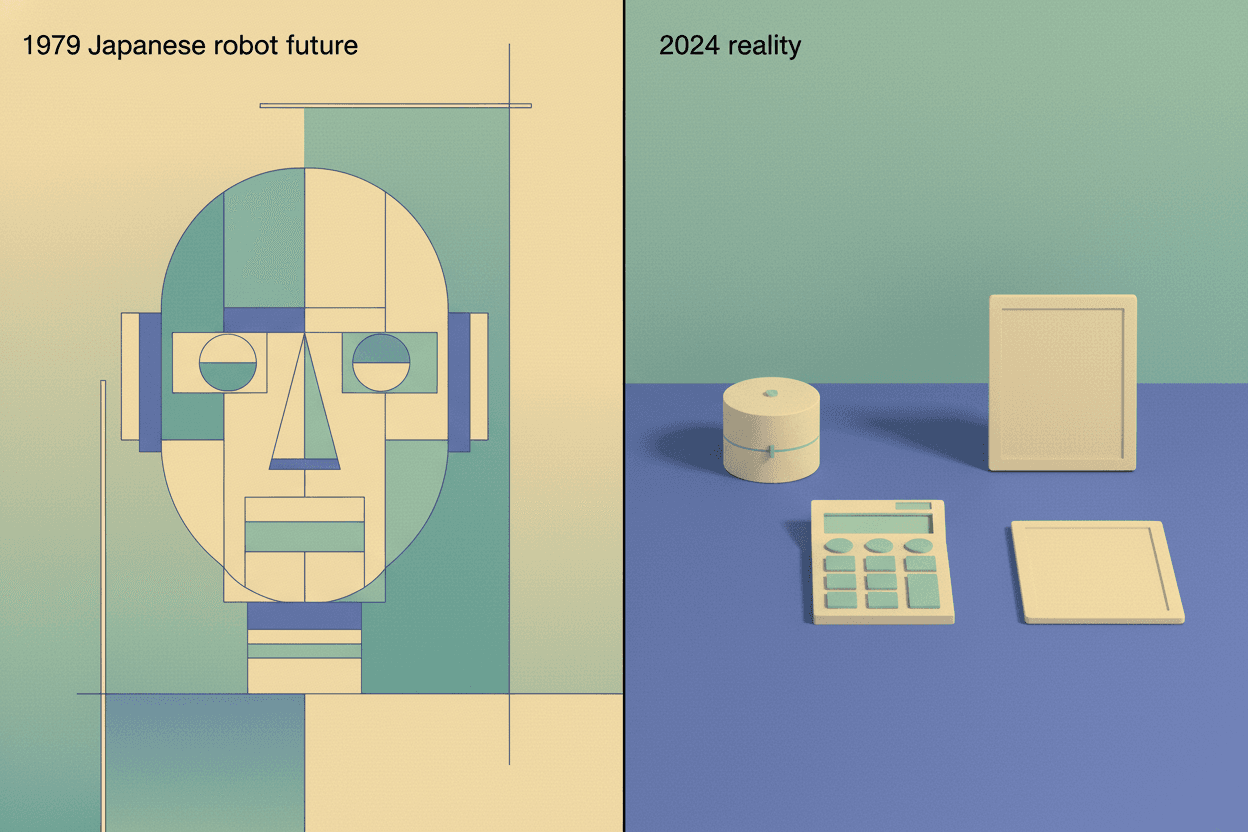
The field of dexterous manipulation—robotics speak for "using hands skillfully"—has made remarkably slow progress since the first robotic hands emerged in the 1960s. The Stanford Hand (1983) had three fingers and demonstrated that robotic grasping was possible. Four decades later, the Shadow Dexterous Hand sells for over $100,000 and still struggles with tasks any toddler completes before breakfast.
“"The hand is the instrument of the intelligence.”
— Maria Montessori
Consider what happens when you fold a T-shirt. You identify the fabric's edges through touch, adjust your grip pressure based on the material's slipperiness, coordinate both hands in asymmetric but complementary motions, and continuously correct for wrinkles and misalignments. Your brain processes this information subconsciously, but the computational requirements are staggering. Researchers at Columbia University estimated in 2023 that fully replicating human dexterous manipulation would require tactile sensors with 10,000 times the resolution of current technology.
Why Tesla's Optimus Struggles With Laundry
Tesla's Optimus robot represents the current state-of-the-art in humanoid robotics. The 2024 prototype stands 5'11", weighs 160 pounds, and features hands with 11 degrees of freedom per hand—impressive on paper, but roughly 40% of human capability.
The economics reveal the real constraint. Tesla targets $20,000 per unit, which sounds remarkable until you examine the hand budget. A fully articulated hand with human-level sensitivity currently costs between $50,000 and $150,000 to manufacture. To hit the $20,000 price point for the entire robot, Tesla's hand budget is likely under $2,000.
[!INSIGHT] The cost curve for robotic hands has declined only 3% annually since 2010, compared to 15% annual declines in computing power and 12% in battery technology. Physical manipulation hardware is not following Moore's Law.
This economic reality forces brutal trade-offs. Cheaper actuators mean less precise finger control. Simplified sensor arrays mean the robot essentially operates blind at the moment of contact. The result? Optimus can wave at crowds impressively, but folding a T-shirt still requires either extensive pre-programming or human teleoperation—a fact demos rarely disclose.
Figure AI, which raised $675 million from Microsoft, NVIDIA, and Jeff Bezos in early 2024, faces identical constraints. Their Figure 01 robot demonstrated making coffee in a viral video, but the task took over 90 seconds and required a Keurig machine specifically modified for robotic interaction. The robot wasn't manipulating a standard coffee maker; it was operating in an environment designed around its limitations.
The Simulation Gap
Why not simply train robots in simulation, the way ChatGPT learned language from billions of text examples? The answer reveals another fundamental asymmetry between digital and physical AI.
Language models train on text that exists in infinite supply. Robotic manipulation requires training on physical interactions, and physics simulators—no matter how sophisticated—cannot accurately model the chaotic behavior of fabric, the slight give of a ripe tomato, or the thousands of micro-adjustments your fingers make when threading a needle.
“"Sim-to-real transfer remains the central challenge in robotics. What works perfectly in simulation fails catastrophically in the real world about 60% of the time for dexterous tasks.”
— Dr. Chelsea Finn, Stanford AI Lab
NVIDIA's Isaac Sim and Google's simulation environments have made progress, but the gap remains substantial. A 2024 study from MIT found that robotic hands trained primarily in simulation showed a 73% success rate on tasks they had practiced virtually—but that success rate collapsed to 31% when researchers introduced minor variations like a slightly damp towel or a T-shirt made from unfamiliar fabric.
The Tactile Revolution
The most promising advances aren't coming from better mechanical design but from better sensing. Researchers at Carnegie Mellon's Robotics Institute demonstrated in late 2024 that adding high-resolution tactile sensors to a standard robotic hand improved manipulation success rates by 340% on delicate tasks.
These sensors work by mimicking the human fingertip's ability to detect microscopic surface changes. When your finger slides across fabric, you sense not just pressure but vibration, shear forces, and thermal changes. Current research focuses on "tactile skins" made from flexible electronics that can provide similar feedback.
[!NOTE] The Japanese government's Moonshot Research and Development program has allocated $320 million through 2030 specifically for tactile sensing research, recognizing it as a critical bottleneck for elderly care robotics.
Startup company SynTouch has developed sensors that replicate all three types of human touch sensation: static pressure, dynamic touch, and thermal sensation. Their sensors cost $800 per fingertip—a price that would put $12,800 of parts into a single hand, still incompatible with Tesla's mass-market ambitions.
Implications: The 2030 Home Robot Reality
The technical and economic constraints around dexterous manipulation have profound implications for when—and whether—humanoid robots will genuinely transform home life.
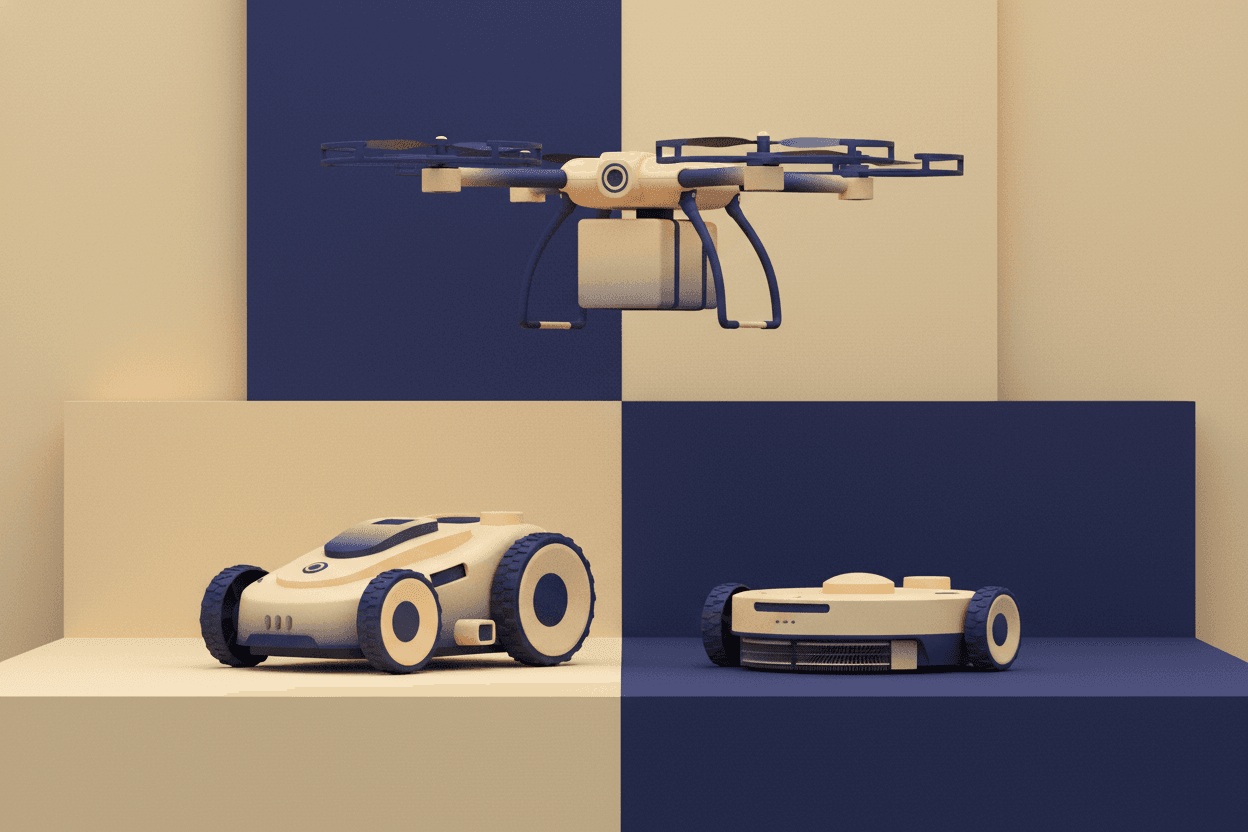
By 2030, expect humanoid robots in controlled environments: warehouses with standardized bins, factories with predictable layouts, and hospitals with procedures designed around robotic capabilities. These spaces can be engineered to minimize manipulation challenges, just as the Keurig was engineered for Figure 01.
The $20,000 home robot that folds laundry, loads dishwashers, and picks up toys remains fundamentally a 2035+ proposition. The hands simply aren't ready, and no amount of AI advancement can compensate for physical hardware limitations.
This reality check matters for investors, policymakers, and consumers. The humanoid robot revolution is real, but its timeline has been dramatically overstated by companies with strong incentives to promise near-term breakthroughs.
Conclusion
The humanoid robot race has misidentified the bottleneck. While billions flow into AI capabilities and demonstration videos, the humble hand—the most evolutionarily refined tool humans possess—remains the stubborn barrier between promise and reality.
Key Takeaway: The $20,000 humanoid robot is coming, but it will arrive in factories first. The domestic robot revolution requires solving the hand problem, which means advancing tactile sensing technology far beyond current capabilities while reducing costs by 90%. Until then, your T-shirts are safe from robotic assistance.
Sources: Stanford Robotics Institute research publications (2024), MIT Computer Science and Artificial Intelligence Laboratory manipulation studies, Columbia University Robotics Group tactile sensing estimates, NVIDIA Isaac Sim documentation, Figure AI and Tesla Optimus technical specifications, Shadow Robot Company pricing data, Carnegie Mellon Robotics Institute 2024 tactile sensing demonstration results, Japanese Ministry of Economy, Trade and Industry Moonshot program documentation.
This is a Premium Article
Hylē Media members get unlimited access to all premium content. Sign up free — no credit card required.