Why Your Roomba Is Smarter Than a Boston Dynamics Robot
Boston Dynamics' Atlas does backflips but can't open doors. Roomba has cleaned 40 million homes. The counterintuitive truth about specialized vs. general AI.
The Backflip Paradox
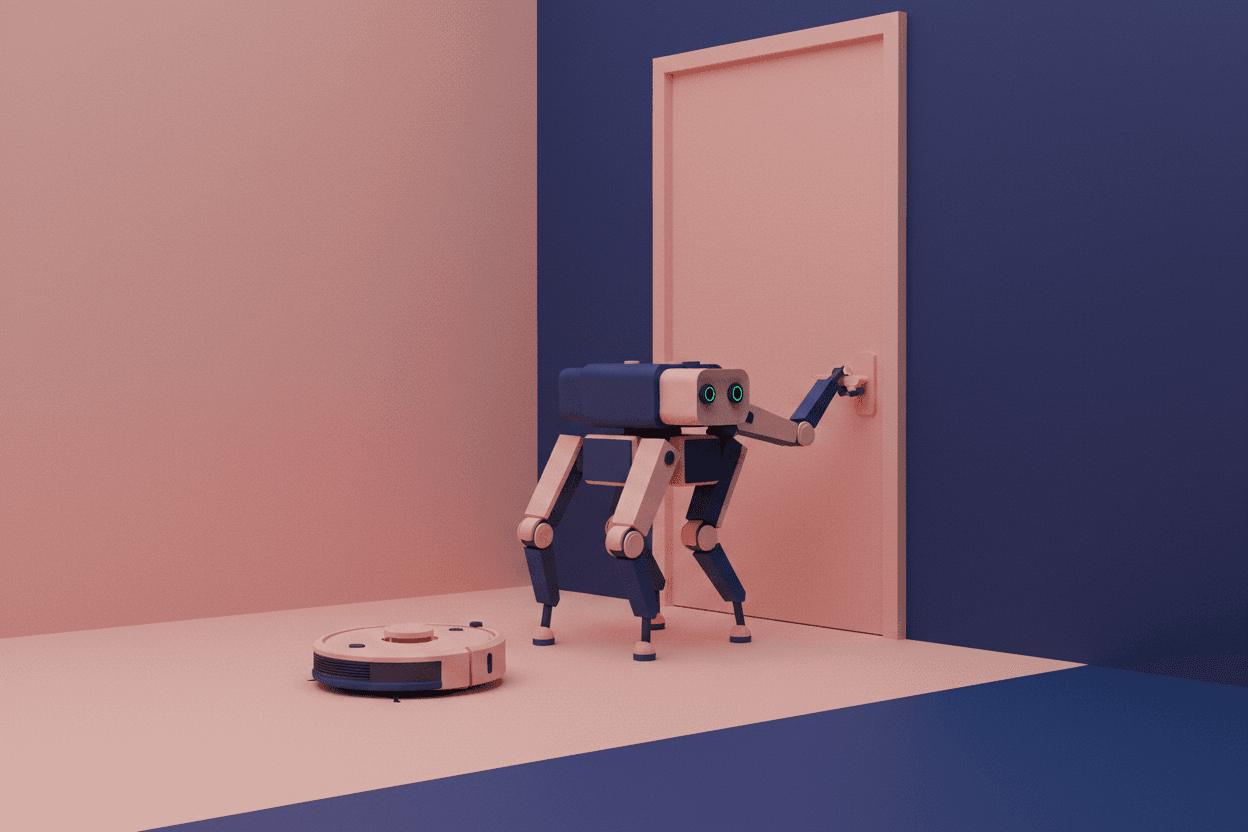
Boston Dynamics robots can do backflips. They cannot reliably open a door. Your Roomba has cleaned more floors than every humanoid robot ever built — combined. In 2024, while Atlas videos garnish millions of YouTube views, iRobot has sold over 40 million Roombas since 2002, generating $3.3 billion in lifetime revenue. The humanoid robots? Fewer than 10,000 units deployed globally, mostly in research labs.
Here's what's uncomfortable: the robot that costs $800 and bump-turns its way through your living room has solved something the $150,000 humanoid still cannot. And it's not a hardware problem.
The Specialization Trap
What Roomba Understood That Everyone Else Missed
In 2002, iRobot made a decision that seemed almost embarrassing: they built a robot that could do exactly one thing. It couldn't climb stairs. It couldn't pick up objects. It couldn't map a room with precision. It bounced off walls like a confused beetle.
But it shipped.
[!INSIGHT] The Roomba didn't win because it was smarter. It won because it defined success narrowly enough to achieve it. The J7940 Roomba models used less than 256 bytes of navigation memory in early versions — less than this sentence.
Boston Dynamics, founded in 1992, took the opposite approach. Marc Raibert's vision was biomimetic: build machines that move like animals, then figure out what they're for. The result? Robots that can run, jump, and dance — but cannot reliably complete a single commercial task at scale.
The General-Purpose Curse
Atlas, Boston Dynamics' flagship humanoid, represents the pinnacle of dynamic robotics. It weighs 196 pounds, stands 5 feet tall, and can perform parkour. Yet in the 2024 DARPA challenge simulations, Atlas-type robots failed to complete simple manipulation tasks — turning valves, opening doors, drilling holes — at rates exceeding 60%.
“"We've spent thirty years building robots that can move. We still haven't figured out what they should do once they get there.”
The problem isn't capability. It's context. A Roomba encounters maybe 50 distinct scenarios in its operational lifetime: corners, furniture legs, thresholds, pet waste. Atlas encounters infinity. Every door handle is different. Every stairwell is different. Every human interaction is different.
The Economic Reality Check
Follow the Money
Let's talk numbers, because they're devastating:
| Metric | Roomba (iRobot) | Atlas (Boston Dynamics) |
|---|---|---|
| Units Deployed | 40+ million | <500 (research only) |
| Price Point | $200-$1,000 | $150,000+ |
| Commercial Revenue | $1.2B annually | Undisclosed (negligible) |
| Primary Use Case | Floor cleaning | Demonstration videos |
[!NOTE] Boston Dynamics was acquired by Hyundai in 2021 for $1.1 billion, but the company has never disclosed a profitable quarter from robot sales. Revenue comes primarily from R&D contracts and, more recently, warehouse automation via Stretch — a specialized (not general-purpose) robot.
The venture capital thesis for humanoid robots goes like this: build a general-purpose platform, then software will unlock infinite use cases. It's the smartphone model applied to hardware. But here's the flaw — smartphones succeeded because software has zero marginal cost. Robots don't. Every new use case requires physical iteration.
Why Roomba's Simplicity Was Genius
Roomba's first-generation navigation system used a remarkably stupid algorithm: spiral outward, bounce off obstacles, repeat. It missed 15% of floor space. It got stuck on electrical cords. It couldn't find its dock half the time.
Customers loved it.
Why? Because the failure mode was acceptable. When Roomba gets stuck, you pick it up. When Atlas falls, it makes international news. The threshold for "good enough" in specialized robotics is vastly lower than in general-purpose systems.
[!INSIGHT] Roomba's competitive moat isn't technology — it's expectation calibration. They promised to reduce your cleaning burden, not eliminate it. Boston Dynamics promised the future, and now must deliver it.
The Moravec's Paradox Revisited
In 1988, Hans Moravec observed that high-level reasoning requires relatively little computation, but low-level sensorimotor skills require enormous computational resources. Chess? Easy. Walking across a cluttered room? Almost impossibly hard.
This paradox explains everything:
- Roomba operates in Moravec's "easy" zone — it doesn't need to understand the room. It just needs to cover area.
- Atlas operates in the "hard" zone — it must perceive, plan, and execute in real-time across infinite scenarios.
- The market rewards the easy zone — because that's where products actually ship.
The uncomfortable truth is that we've had the technology for useful robots since the 1990s. What we haven't had is the discipline to constrain the problem space.
Implications: What This Means for the Future of Robotics
The Lesson Nobody Wants to Hear
Every robotics startup pitch deck now includes some version of "we're building the general-purpose platform that will replace human labor." It's a compelling narrative. It's also almost certainly wrong.
The companies winning in robotics — iRobot, Kiva Systems (acquired by Amazon for $775M), Locus Robotics ($1B+ valuation) — all share one trait: they picked one job and did it adequately. Not perfectly. Adequately.
[!NOTE] Figure AI, which raised $675 million in 2024 to build general-purpose humanoids, has deployed fewer than 100 units. Locus Robotics, focused solely on warehouse picking, has deployed 10,000+ robots and counts Amazon, FedEx, and DHL as customers.
Where Humanoids Might Actually Win
This isn't to say humanoids are doomed. But their path to viability runs through specialization, not generality:
- Warehouse stacking: Limited environment, repetitive tasks
- Hospital logistics: Indoor navigation, predefined routes
- Hazardous inspection: Replace humans in dangerous settings
The common thread? These are Roomba-shaped problems — constrained, boring, monetizable — applied to a humanoid form factor.
Conclusion
Boston Dynamics makes the future look cool. iRobot made the future pay rent. In robotics, as in most things, boring wins.
The lesson for builders? Constraint is a feature. The sooner you accept that your robot will be stupid — but usefully stupid — the sooner you'll ship something that matters.
Sources: iRobot Annual Reports 2002-2023, Boston Dynamics technical demonstrations, DARPA Robotics Challenge results, MIT Robotics Lab interviews, Hyundai acquisition filings, Venture capital database analysis (PitchBook 2024)