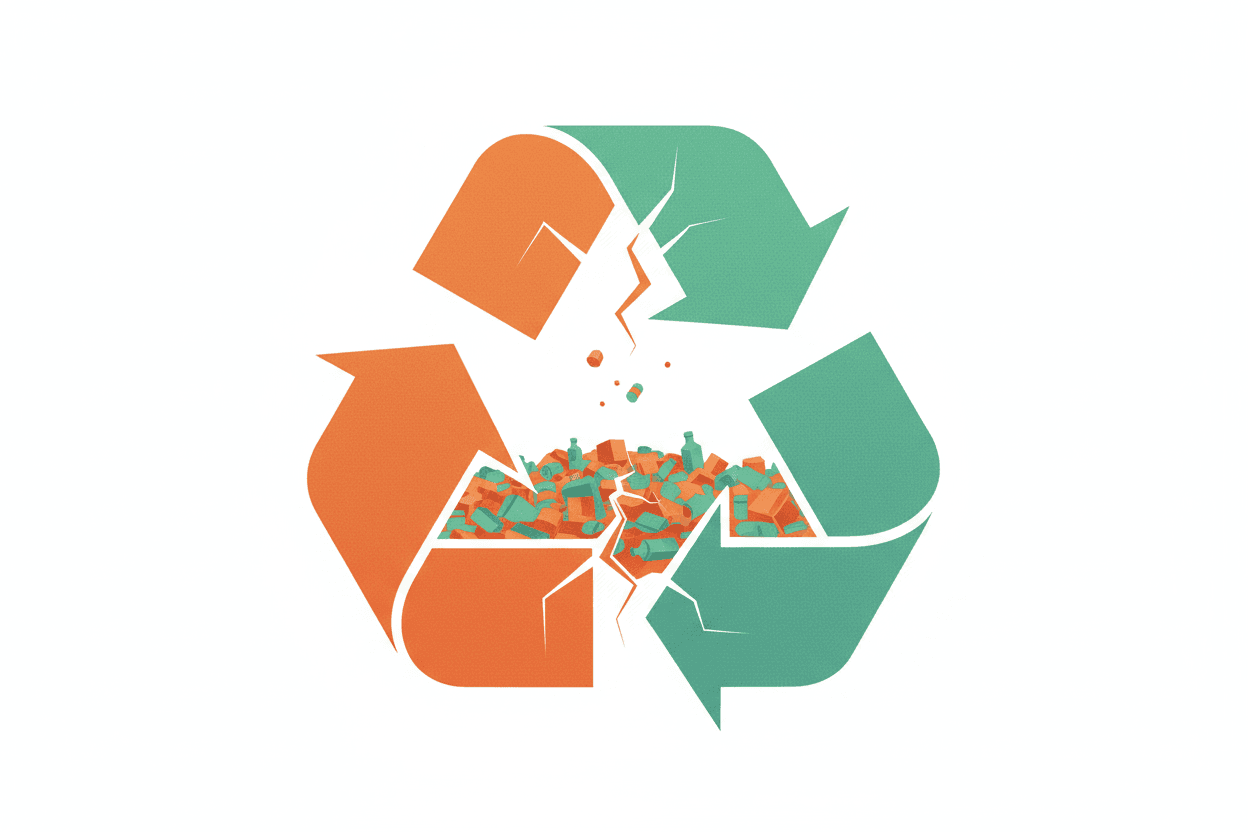
Internal documents reveal the plastic industry knew recycling would fail. They spent millions promoting it anyway — and 91% of plastic remains unrecycled today.
Hyle Editorial·
The plastic industry knew recycling wouldn't work at scale. They promoted it anyway — because it kept us buying. In 2024, global plastic production exceeded 400 million metric tons annually, yet only 9% of all plastic ever produced has been recycled. The rest? It sits in landfills, burns in incinerators, or chokes ecosystems worldwide.
Internal documents from the 1970s and 1980s, uncovered by NPR and PBS Frontline investigations, reveal that industry executives understood the technical and economic impossibility of large-scale plastic recycling. A 1986 analysis by the Vinyl Institute concluded that recycling polyvinyl chloride (PVC) was "not viable" due to contamination issues and collection costs. Yet in 1989, the industry launched a $50 million public relations campaign promoting recycling as the solution to plastic waste.
Plastic recycling faces fundamental chemical barriers that glass and aluminum do not. Unlike metals, which can be recycled indefinitely without degradation, polymers undergo thermal and mechanical stress during reprocessing. Each recycling cycle shortens polymer chains, degrading material properties.
The recycling rate equation reveals the challenge:
Where $Q_{degradation}$ represents the quality loss factor — typically 0.7-0.9 per cycle for most plastics.
The Plastics Recycling Foundation, established in 1985 by companies including Exxon, Dow, and Coca-Cola, internally acknowledged that achieving even 15% recycling rates would require "billions in infrastructure investment" with "no clear path to profitability."
[!INSIGHT] The industry's own research showed that mixed plastic waste streams cannot produce food-grade recycled material. Cross-contamination between polymer types (PET #1 and HDPE #2) creates unusable output at molecular scales.
The Marketing Machine
Between 1989 and 1994, the American Plastics Council spent over $150 million on advertising campaigns promoting recycling. The famous "Plastics Make It Possible" campaign featured cheerful families sorting recyclables, implying that individual responsibility could solve the waste crisis.
“"If the public thinks recycling is working, they're not going to be as concerned about the environment.”
— Larry Thomas, former president of the Society of the Plastics Industry, 2020
This strategy, documented in industry memos as "voluntary delay," mirrored tactics used by other industries facing regulatory threats. By promoting a solution they knew would fail, manufacturers bought decades of continued growth.
Year
Global Plastic Production (million tonnes)
Recycling Rate
Landfill/Incineration Rate
1980
70
<1%
99%
1990
120
2%
98%
2000
213
5%
95%
2010
300
7%
93%
2020
367
9%
91%
The Material Science Problem
Polymer Incompatibility
Modern packaging typically combines multiple polymer layers. A single snack bag may contain:
Polypropylene (PP): moisture barrier
Polyethylene (PE): heat-seal layer
Ethylene vinyl alcohol (EVOH): oxygen barrier
Metallized aluminum: light barrier
These layers cannot be separated economically. Theoretically, dissolution recycling could extract individual polymers using selective solvents, but the energy cost exceeds virgin production:
Where $E_{virgin}$ for polyethylene is approximately 80 MJ/kg, while dissolution processes require 200-400 MJ/kg.
The Numbers That Matter
Of 400 million tonnes produced annually:
Recycled: 36 million tonnes (9%)
Incinerated: 60 million tonnes (15%)
Landfilled: 180 million tonnes (45%)
Leaked to environment: 124 million tonnes (31%)
[!NOTE] The "leaked" category includes microplastic particles. A 2023 study found microplastics in human blood samples at concentrations of 1.6 μg/mL, with polyethylene and polypropylene being the most common polymers detected.
Implications: The Delay Strategy
The recycling narrative achieved its true purpose: preventing regulation. Throughout the 1990s and 2000s, proposed bans on single-use plastics were defeated in state legislatures and Congress by industry lobbying groups arguing that recycling made bans unnecessary.
California's 1991 Assembly Bill 939 required 50% waste diversion by 2000. The plastics industry successfully lobbied to include "recycling programs" rather than actual recycling rates as compliance metrics. Cities could claim compliance by offering curbside pickup — regardless of whether collected materials were actually recycled.
The pattern repeated globally. European packaging directives, Japanese container laws, and Australian waste frameworks all incorporated industry-written recycling targets that ignored material realities.
Beyond the Myth
The recycling myth allowed plastic production to grow at 4% annually for 40 years while recycling rates stagnated below 10%. This was not accident but design — a multi-decade strategy to externalize environmental costs onto consumers and municipalities.
Key Takeaway: The plastic industry's promotion of recycling was a deliberate delay strategy, not a genuine solution. Effective responses require systems-level interventions: production caps, extended producer responsibility with teeth, and investment in genuinely recyclable mono-material designs — not consumer education campaigns about sorting.
Sources: NPR/PBS Frontline Investigation "Plastic Wars" (2020), OECD Global Plastics Outlook (2022), The Vinyl Institute Internal Documents (1986), American Plastics Council Campaign Records (1989-1994), UNEP Global Environment Outlook (2023), Environmental Science & Technology microplastics study (2023)
This is a Premium Article
Hylē Media members get unlimited access to all premium content. Sign up free — no credit card required.